At a glance Contents
- Botswana runs on two clocks, and they don't tick in sync
- Botswana month by month
- What flood and rain do to the tracks
- The underrated months: May and November
- Dry season or green season: what suits you
- Which tour in which month
- What else you should sort out before departure
- Frequently asked questions
Botswana runs on two clocks, and they don't tick in sync
Most countries have a rainy season and a dry season. Done, question answered. Botswana has two clocks, and they run against each other.
The first clock is the rain. It arrives in November, sometimes with a thunderstorm as early as the end of October, and stops in March or April. In these months the country turns green, the salt pans fill up, and the animals spread out across the whole bush. Why would they queue at a river when there's a puddle behind every bush?
The second clock is the flood. The water that flows into the Okavango Delta doesn't fall in Botswana at all. It falls in the highlands of Angola, in January and February. From there it creeps south along more than a thousand kilometres of river, through Namibia, and reaches the Delta when not a drop has fallen from the sky in Botswana for ages. The water starts rising around April, and the Delta peaks in June, July and August.
In plain terms: in the middle of the dry season, when the Kalahari is dusty and the mopane trees are bare, the Delta is under water. That's not a typo. That's the whole point of this country.
A guide in Maun once explained it to a guest like this: the rain has already gone, the river just hasn't noticed yet. You couldn't put it better.
That's why any answer to the question about the best time to travel that is only one sentence long is either wrong or incomplete. The right question is: what do you want to see, and which tracks do you want to drive to get there?
Botswana month by month
The table is rough, as the weather doesn't follow the calendar. But it shows why two people who were both in Botswana in July can describe two completely different countries: one stood knee-deep in water in the Delta, the other didn't see a river for three days in the Kalahari.
| Months | Weather | Okavango Delta | Tracks | Animals |
|---|---|---|---|---|
| January, February | Rainy season, thunderstorms mostly in the afternoon | low, the flood is still on its way in Angola | black clay turns to soft soap, parts of Moremi and Savuti are hard or impossible to drive | young animals, migratory birds, zebras move into the Makgadikgadi and Nxai pans |
| March, April | rain tapers off, still muggy | the water reaches the upper Delta | tracks dry out, water holes in the middle of the way remain | tall grass, the animals are there, you just see them less well |
| May, June | dry, days warm, nights cool | the flood rises | easily drivable, first deep fords in the Delta | the animals move toward the water |
| July, August | dry, nights around freezing | peak level | fords deep, some routes in Moremi flooded or diverted | high season: elephants on the Chobe, big cats at the water holes |
| September, October | dry and hot, October is the hottest month | the water recedes | everything open, but the deep sand is soft and the midday heat brutal | the densest concentration of animals at the last water holes |
| November, December | first thunderstorms, the heat breaks | low | still good, a few hours of skidding after a storm | impalas and wildebeest give birth, the bush turns green |
Two things stand out. First: there is no month in Botswana when nothing is going on. Second: the month with the most animals in front of your lens, October, is also the month when by midday all you want is to lie in the shade. Nothing here comes for free.
What flood and rain do to the tracks
Now the part that the climate tables online like to leave out. On a safari where you sit in an off-road vehicle rather than flying between two lodges, it isn't the temperature that decides your trip. It's the ground.
Moremi and Khwai in the flood
When the Delta is full in July and August, the channels overflow their banks. Tracks that were dusty in October are then under water. Some bridge made of mopane logs is merely decoration now, some ford so deep that the driver gets out first to check on foot. With a good guide that's no problem, as they know the detours. With a rental car and a navigation system that knows nothing about the flood, it makes for a long afternoon.
A Land Cruiser in water up to the door handles looks great in photos. Being pulled out, it looks less great. And so does the driver.
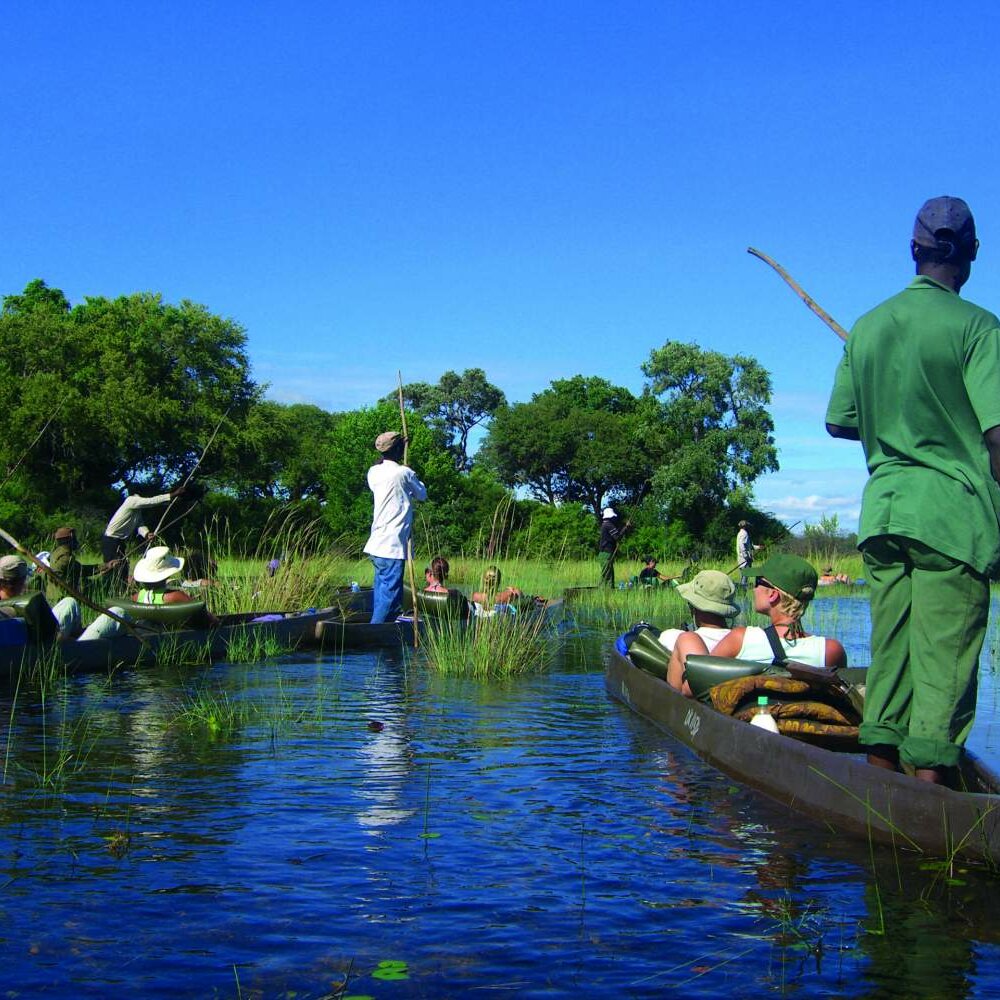
The reward: right now the mokoro trip is at its most beautiful. In a dugout canoe you glide over water where three months earlier there was still grass, and the elephants wade through the channels as if they had the flood timetable in their heads.
Black clay in the rainy season
In January and February the problem isn't the water from above but the ground beneath. The black clay found in parts of Moremi and around Savuti turns after a heavy storm into a mass on which even four-wheel drive can only dance. Some sections aren't driven at all in these weeks. That's not the caution of desk jockeys, that's physics.
Kalahari sand in October
Sand behaves in exactly the opposite way. Wet, it's firm; dry and hot, it's soft. In October, when the Kalahari hasn't seen rain for months and the midday heat climbs above forty, the tyres grind in the deep sand, and every kilometre takes longer than the map claims. That's why in this season you drive early, rest at midday and go out looking for game again in the late afternoon. The animals do exactly the same, by the way.
Salt pans: never when wet
In the dry season the Makgadikgadi pans are a hard, white crust all the way to the horizon. Driving on it is one of the strangest feelings Africa has to offer: no track, no direction, just white. In the rainy season there's mud beneath that crust, and anyone who rolls onto it anyway learns patience there. A great deal of patience ;-)
In return, the flamingos come to the pans in the rainy season, and the zebras pass through in big herds. From the edge you can see it wonderfully. From the middle, mostly just your own recovery strap.
The underrated months: May and November
Anyone who only chooses between dry season and rainy season overlooks the two months when the clocks cross. For many travellers those are exactly the best ones.
May: the Delta fills up, the bush is still green
In May the rain is over, but the land hasn't forgotten it yet. The trees still carry leaves, the air is clear, the nights turn cool, and from the north the flood pushes into the Delta. The animals begin to gather at the water, without every spot at the water hole already being taken by a vehicle. The high season with its full camps only comes a few weeks later.
The catch: the grass is still tall. A leopard that lies on a bare branch in October as if on a serving tray likes to hide behind a curtain of grass stems in May. You have to earn it then.
November: the first rain after the heat
November is the month when Botswana breathes out. After weeks of dust and heat, the first thunderstorms arrive. In the afternoon the clouds pile up, it crashes for half an hour, and afterwards the whole bush smells of wet earth. Anyone who has experienced that once will still be telling the story years later at the pub.
At this time the animals are still at the familiar spots, because the first rain hasn't been filling the pans for long. At the same time the young are born, and with them the hunters appear. The tracks are mostly still good, only right after a storm does it get slippery for a few hours. And the other vehicles? Many have already left by then.
If you take just one piece of advice from this article, make it this one: look at the months at the edge of the season before you decide on the middle.
Dry season or green season: what suits you
The honest answer doesn't depend on the country but on you. Here's the comparison without soft focus.
| Dry season, May to October | Green season, November to April | |
|---|---|---|
| Seeing animals | easy, they stand at the water holes, the grass is short | harder, they're spread out everywhere, but full of young |
| Okavango Delta | full, mokoro at its best, some tracks under water | low, mokoro only in the channels that carry water all year |
| Tracks | almost everything open, soft deep sand in October | mud after storms, some areas hard to reach |
| Heat | June and July pleasant, cold nights, October hot | muggy, but thunderstorms cool things down |
| Crowds | high season, lodges and camps booked out early | quiet, often no other vehicles at a sighting |
| Photos | dust, golden light, lots of animals in the frame | green bush, dramatic sky, babies in the frame |
My advice in three sentences:
If you're going to Botswana for the first time and want to see the big animals, take June to September. If you've already seen elephants on the Chobe and the thought of mud appeals to you more than it scares you, take the green season. And if you MUST tick the leopard off your list, don't come in February and complain afterwards about the tall grass.
One more thing for everyone who arrives with a clean jacket and ironed trousers: in the dry season the jacket turns brown from dust, in the green season from mud. In Botswana it only stays white in the suitcase.
Which tour in which month
Not all of our Botswana tours run at the same time, and that's no coincidence. Here are the three that fit the two clocks.
Overland Safari Botswana: Okavango & Chobe
The Overland Safari lasts 8 days and costs from 2099 EUR. It starts at Victoria Falls, drives through the Kalahari past the Makgadikgadi pans, spends a whole day in an open 4x4 in Moremi and sends you into the Delta by mokoro. The next departures are in November and December, so at the start of the green season: the first thunderstorms, the first young animals, a low Delta and little traffic at the sightings. If you want the bush green and quiet, this is the one for you.
Botswana Zimbabwe Round Trip: Safari & Victoria Falls
The round trip is the short version: 7 days, from 2489 EUR, with a mokoro trip in the Okavango, game drives in Moremi, a boat safari on the Chobe, the pans near Nata and finally Victoria Falls. It also runs in November and December, one departure even over the turn of the year. Honestly: the Falls carry little water at the end of the year, but on the Zimbabwe side a curtain always remains. In return, the elephants are still on the Chobe then, and in the pans the flamingos are announcing themselves.
Lodge Safari in Botswana
The Lodge Safari is the trip for the peak flood. 12 days, from 2110 EUR, with Chobe National Park, the Kalahari with the San and a side trip to the Namib Desert. You stay in a mix of lodges and tented camps. The next departure is in July 2027, exactly when the Delta is fullest and the Chobe is busiest.
If you want to set off this autumn and take Namibia along: the Namibia Botswana Safari takes 10 days to Victoria Falls and still runs several times this autumn.
And so that nobody thinks everything in Botswana is luxury: Florian S. wrote after the round trip that the camping accommodation demanded a certain adaptability. True. That's exactly what you go there for.
What else you should sort out before departure
Entry, health, money, left-hand traffic and the question of where to find fuel in the Kalahari: all of that is in the Botswana dossier, and it's kept up to date there. A copy in this article would be outdated in half a year, and you'd have believed it anyway.
Two things that aren't in any dossier:
- For July and August, pack a warm jacket. Anyone who confuses Africa with heat sits in an open vehicle at six in the morning and freezes through the first game drive.
- For October, pack patience. The heat slows everything down: the animals, the vehicles, the conversations around the campfire.
If you want to compare Botswana with another country in southern Africa: in Kruger National Park in South Africa the rule of dry season and rainy season works the way you'd expect. There is only one clock there. Botswana is the country that treated itself to a second one.
Answered briefly
Frequently asked questions
- When does the Okavango Delta have the most water?
- In June, July and August. The flood comes from the rain in the highlands of Angola and takes months to reach the Delta. That's why the Delta is fullest in the middle of the dry season, while the rest of Botswana is dusty. For mokoro trips that is the best time.
- Can you travel to Botswana in the rainy season?
- Yes. From November to April the bush is green, there are lots of young animals and hardly any crowds. After storms some tracks turn to mud, and individual areas such as parts of Savuti or Moremi are then hard to reach. The animals are there, just more spread out and harder to spot in the tall grass.
- Which is the hottest month in Botswana?
- October. Shortly before the first rain, the midday heat in the Kalahari often climbs above forty degrees, and the deep sand is soft. In return, the animals are now at their densest at the last water holes.
- When is the zebra migration in Botswana?
- In the rainy season, roughly from December to March. Then large herds of zebra move into the Makgadikgadi and Nxai pans, where the fresh grass grows after the rain. The flamingos come to the pans at the same time.
- How cold does it get in Botswana in July?
- It's pleasantly warm during the day, but at night and in the early morning the temperature in the Kalahari drops to around freezing. A warm jacket for the first game drive in an open vehicle therefore belongs in your luggage.