At a glance Contents
- The flood arrives months after the rain
- The delta year, month by month
- Dry season from May to September: water and wildlife
- The green season from December to April
- What this means for tracks and camps
- Mokoro, motorboat or game drive: what is worth it when
- What to pack and how to get in the right mindset
- Which trip suits which season
- Frequently asked questions
The flood arrives months after the rain
If you are planning your first trip to the Okavango Delta, you quickly stumble over an oddity: in the middle of the dry season, the delta is at its highest. That sounds wrong, but it is the whole logic of the place. In Botswana itself, hardly any rain falls in the dry season. The water you see then began its journey long before, in the highlands of Angola.
There it rains heavily in the southern summer, roughly from November to March. The water collects in rivers, trickles south across very flat terrain and takes weeks to reach the panhandle of the delta in northern Botswana. From there it spreads out in the shape of a fan. The ground is so level that the flood advances only slowly. By the time it reaches the area around Maun and the southern edges, the rain in Angola is long over and the sun has been shining in Botswana for months.
For you as a traveller, this means the calendar of the country and the calendar of the delta run out of step with each other. If you only ask about the weather, you get half the answer. We described how the country as a whole works through the year in Best time to visit Botswana. Here we look at what happens in the delta itself.
One honest note up front: how high the flood is in a given year and how early it comes varies. Some years bring plenty of water, others clearly less. Everything you read below describes typical patterns, not a guarantee for a particular date. If you book a particular week, you are booking a pattern, not a water level.
The delta year, month by month
The following overview describes the usual course of the year. Shifts of one to two weeks are normal, and in some years there can be more.
| Period | What happens in the delta | What you experience |
|---|---|---|
| December to February | Hot summer with thunderstorms, the delta is at its low point | Green landscape, many young animals, migratory birds, soft tracks |
| March to April | The flood reaches the north of the delta | The water rises, the air gets drier, the light gets clearer |
| May to June | The flood spreads south | Channels fill up, mokoro trips get better, nights turn cool |
| July to August | Peak around Maun and in the south | Full water, wildlife concentrated on the islands, cold mornings |
| September to October | The water recedes, it gets hot and dusty | Best wildlife viewing at the last waterholes, but heat |
| November | Low point, first rainfall | Little water, first thunderstorms, the landscape turns green again |
Note the offset: in the north the water arrives earlier and often stays longer, in the south it comes later and leaves earlier. Camps and lodges in the delta are therefore not all at their best at the same time. A camp in the north can already be standing in water in May, while the channels in the south are still waiting for the flood.
Dry season from May to September: water and wildlife
This is the classic answer to the question about the best time to visit, and it holds for good reason. Our country dossier also names May to September as the window in which the delta is in flood. You can find more about the country in the Travel information Botswana.
What awaits you at this time:
- Mokoro trips on real water. The dugout canoe glides through reed-lined channels, the poler stands at the back, and you sit just above the waterline. At a low water level it becomes a trip on stretches of the route, at a high level a silent glide through. This is exactly what most people are looking for when they dream of the delta.
- Animals at the islands. When the land around dries out, the delta remains the magnet. Elephants, buffalo and antelope come to drink, and the predators come with them. The game drives in the Moremi reserve and in Khwai are especially rich in these months.
- Little rain, few mosquitoes. The days are dry and clear. The nights, especially in July and August, are properly cold though. Open safari vehicles early in the morning then call for a hat, gloves and a warm jacket. This surprises many who associate Africa only with heat.
- Good visibility. The grass is low and the bush is thinner. You spot animals earlier and from further away.
The price for these advantages: it is high season. Camps are booked out early, and places on the tours fill up first. If you want to travel in July or August, do not wait until spring.
If you have a choice, May to June is a good compromise: the flood arrives, the nights are still bearable, and the peak rush has not really started yet. September offers the counterpart: wildlife is strongly tied to the remaining waterholes, but the heat is already building.
The green season from December to April
Many guidebooks write off the rainy season. That is too sweeping. For a certain kind of traveller it is the better choice.
What speaks for it: the landscape is lush, the sky dramatic, and birdlife is at its peak. Migratory birds are here, and the salt pans further east fill up, so flamingos appear in large flocks. Many animals have young, and the hunters follow. Prices in the camps are lower, and you share the delta with far fewer people.
What speaks against it: it is hot, the air is humid and thunderstorms are frequent. Wildlife spreads out because there is water everywhere, and you see fewer large concentrations. And mokoro trips depend on the water level. In these months the delta itself is often at its low point, because the flood is still on its way. If you travel then, put the focus on game drives and birds and treat dugout trips as a bonus, not the main reason.
Then there is the track, and that is the point where travellers most often underestimate what the rain does.
What this means for tracks and camps
In the delta you do not drive on asphalt. The main axis from Maun via Nata to Kasane is mostly paved, but everything that leads into the delta is sand track, deep ruts and fords. Here the season decides the day.
In the dry season the tracks are firm, but often deep sand. The drive through Moremi and Khwai is bumpy and slow, yet reliable. There are water crossings where the delta floods tracks, and they are usually passable even in the flood, but not everywhere. Some camps are placed so that they can only be reached by boat or plane when the water level is high.
In the rainy season the same tracks turn into mud channels. Black cotton soil becomes sticky and slippery, fords swell, and some stretches are closed for days. A daily destination that is a morning drive in July can take half a day longer in February or fall through entirely. Plan spare days for this time and travel only with guides who know the current situation.
Between the seasons, in November and in March, it is hardest to say what awaits you. Here an honest look at the route is worthwhile, along with a willingness to change the plan.
A practical rule of thumb: the more independently you travel, the more important the dry season is. If you travel in a guided group with an experienced driver, you cope better with the green season, because someone on site decides which ford works and which does not.
Mokoro, motorboat or game drive: what is worth it when
There are several ways of getting around in the delta, and not every one suits every month. The mokoro, the traditional dugout canoe, is the heart of it. It is quiet, it sits low, and you are at eye level with water lilies, frogs and dragonflies. For that it needs water under the keel, so the flood months. If you ask late in the year whether a mokoro trip is possible, you often hear: on the deeper channels yes, on the side arms rather not.
Motorboats come into play where the distances are longer and the channels wider. They get you faster to remote islands and can be used even at a medium water level. On the Chobe, which follows its own river logic, the boat safari is an experience almost all year round, because elephants come there in the afternoon to drink as soon as the land dries out.
The game drive in an open 4x4 finally works in every season, just differently. In the dry season you look for the animals along the watercourses. In the green season you look for them in the thicket and in the clearings, and your guide needs more patience. If you want both, water and wildlife, it is best to plan May to September and leave room for both forms. If you mainly want birds and atmosphere, you can also be happy in summer.
What to pack and how to get in the right mindset
The season determines not only what you see but also what goes into your duffel bag. That sounds trivial, but it decides whether you enjoy the days or merely get through them.
For the dry season the rule is: layers. In the morning on the open vehicle you need a fleece, windbreaker, hat and gloves, at midday a thin shirt is enough, and in the evening at the campfire the warm jacket again. A sleeping bag with a good comfort rating is worth it if you sleep in a tent. Dust is a constant companion, so a scarf, lens cloths and a cover for the camera belong in your luggage.
For the green season the rule is: rain protection and airiness. A light, waterproof jacket, quick-drying clothing, insect protection and sturdy shoes that are allowed to get wet. Mosquitoes are a bigger issue in the humid season, and what belongs to vaccinations and precautions you clarify through our travel information and with your doctor, not through a blog article.
And then there is the inner attitude. In the delta, patience is the real currency. The poler knows the channels, the guide reads tracks you do not see. If you set off with a list in your head of ticking off every animal, you will often be disappointed. If you embrace the pace and the silence, you usually take away more.
The group also plays a role. Feedback from guests on our Botswana trips stresses again and again that flexibility counts: daily stages shift, camps are simple, the group adapts to weather and water. If you bring that along, you experience the trip more relaxed, whatever the month.
Which trip suits which season
The delta is rarely the only destination. Most trips combine it with Chobe, Victoria Falls or the Makgadikgadi pans. Then a second question arises: what is the season like for the rest of the route? Victoria Falls, for example, carry the most water at the end of the rainy season, while late in the year the river stands much lower. If you want to see the delta in flood and the falls at high water, you have to find a compromise, because the peaks do not fall in the same month.
Three trips from our programme that include the delta at different lengths:
Botswana Zimbabwe round trip: Safari & Victoria Falls is the most compact option at seven days. It combines the mokoro trip in the Okavango with Moremi, a boat safari on the Chobe, the pans near Nata and the falls. For getting started and for people with little holiday time, this is the quickest way to get to know the delta. Price from 2489 euros.
Overland Safari Botswana: Okavango & Chobe lasts eight days and is geared more towards game drives: a whole day in Moremi in open 4x4 vehicles, plus Chobe, Kalahari and the salt pans. Price from 2099 euros. It is a good candidate if you want to see wildlife and value driving time through the terrain.
Namibia Botswana Safari: 10 days to Victoria Falls puts Namibia first, with Etosha, and then leads via Khwai and Moremi into Botswana. Price from 2399 euros. Here you get two countries of very different character, and the delta is the wet counterpart to the dry expanse before it. If you are interested in the whole picture, this is the right one.
All three are group trips with a minimum of four participants. Departures vary, and you can see the current dates on the tour pages.
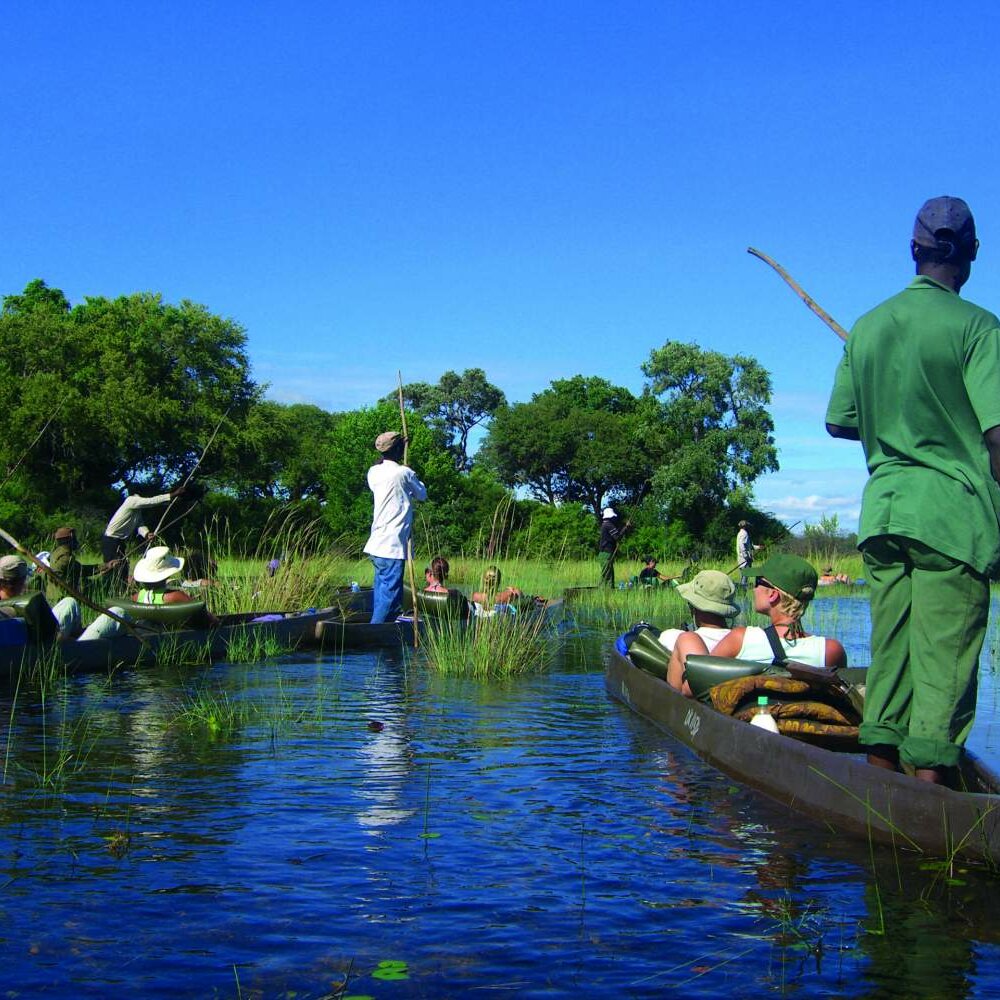
Finally, a thought we often share with our guests: there is no bad time in the delta, only a fitting one. If you want water and dugout canoe, travel in the southern hemisphere's winter. If you want green, birds and quiet and can put up with moody tracks, travel in summer. In between it is a question of expectation, not of the calendar.
Answered briefly
Frequently asked questions
- When is the Okavango Delta at its fullest?
- The peak is usually in July and August, around Maun and in the south. In the north the water arrives earlier. The exact level varies from year to year because it depends on the rainfall in Angola.
- Can I also take a mokoro trip in the delta during the rainy season?
- Yes, but it depends on the water level. In the green season the delta is often still low, because the flood from Angola arrives later. Some channels are then too shallow, others are easily navigable. Ask in advance about the current water level in the region concerned.
- Why is the delta at its wettest in the dry season?
- The rain falls in the southern summer in the highlands of Angola. The water needs several months to flow across the flat terrain into the delta. It therefore reaches the area around Maun only when the dry season has long been under way in Botswana.
- How cold does it get in the delta in July and August?
- During the day it is pleasantly warm, but at night and in the early morning it is properly cold, especially on open safari vehicles. Pack a hat, gloves, a fleece jacket and a good sleeping bag. Many guests underestimate this because they associate Africa only with heat.
- Which month is the best compromise?
- May and June are seen as a good middle way: the flood arrives, the channels fill up, the nights are not yet icy and the high season has not yet reached its peak. September is also strong, but soon gets hot.
- Where do I find entry and health information for Botswana?
- Everything on entry, documents, health and money is in our travel information on Botswana, which we keep up to date. There you will find binding details that we deliberately do not repeat in best-time-to-visit articles.