Travel Information

Botswana: best time to visit, entry, travel facts

When Chobe and the Okavango show the most animals, which months are too hot or too wet, and what visa, your own motorcycle and the veterinary checkpoints require at entry.

View tours
Visa
Visa-free for up to 90 days per calendar year (DE, AT, CH, EU)
Free entry stamp at the border post, no embassy visit needed
Passport validity
Valid for at least 6 months beyond your departure date, with at least 2 blank pages
Best time to travel
May to September (dry season, Okavango in flood)
Currency
Botswana Pula (BWP)
Time zone
UTC+2 (Central Africa Time), no daylight saving
Side of the road
Drive on the left
Helmet & gear
Helmet mandatory for rider and passenger
Main road
A3/A33 Maun-Nata-Kasane, mostly paved
Fuel
ULP95 in all larger towns, wide gaps in the Kalahari
Int'l driving permit
International driving permit only mandatory from day 91, recommended from the border onward

Game viewing: dry season or green season?

From June to October the animals stand at the water along the Chobe and in the Delta; from December to March the zebra herds move to the salt pans in the south.

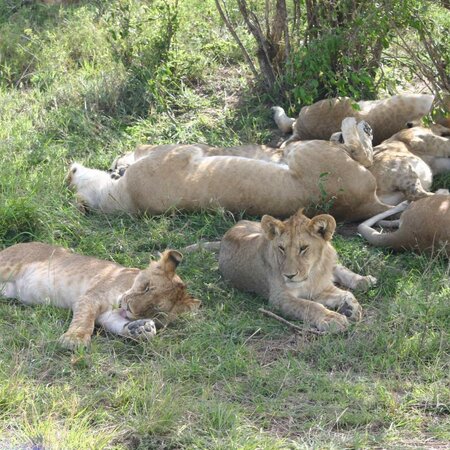
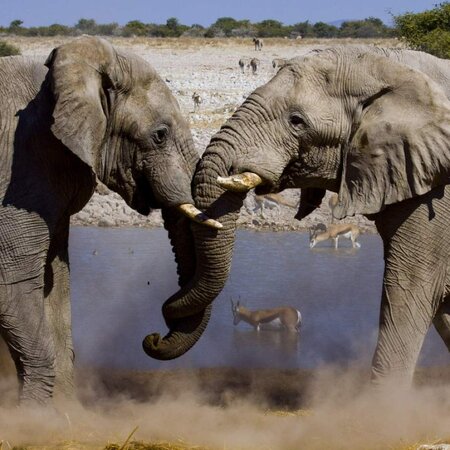
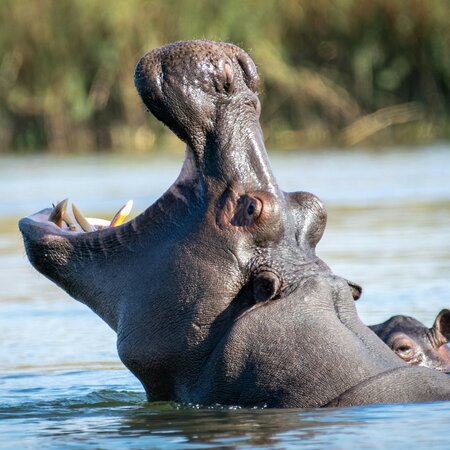
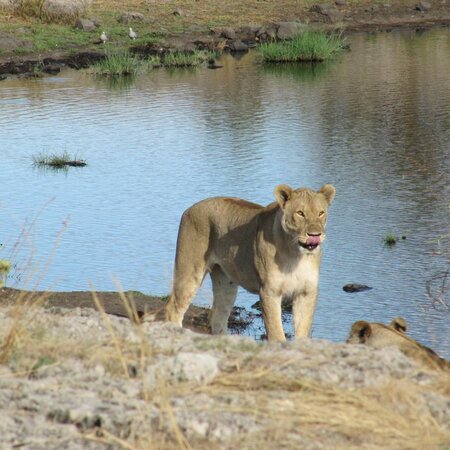
For wildlife sightings in Botswana one factor decides everything: water. From May to October practically no rain falls, the pans and pools in the bush dry out, and the animals move to the few rivers that remain: the Chobe, the Khwai, the Boteti and the channels of the Okavango Delta. On the Chobe riverfront near Kasane, elephant herds of several hundred animals stand at the water in August and September, alongside buffalo, hippos and the lions waiting for them. Botswana holds around 130,000 elephants, the largest population in Africa, and in the dry season a large share of them concentrates on a strip a few kilometres wide along the river.

In the Okavango Delta and in Moremi, June to October is the clear peak: the grass is grazed down, visibility reaches far, and the waterholes are predictable. Wild dogs raise their pups in dens from June to August, which noticeably raises the chance of finding a pack in Khwai. From October the weather tips: 35 degrees and more by day, the animals practically cling to the water, sightings are at their densest, but the stay is at its most exhausting.

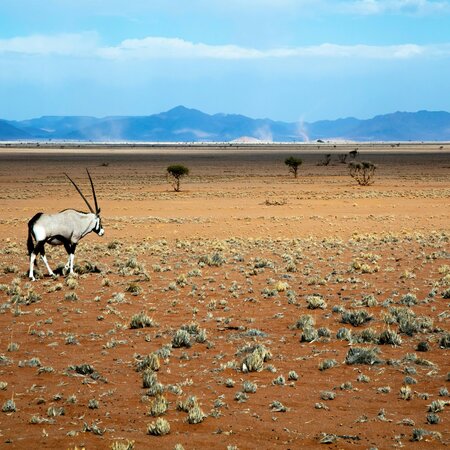
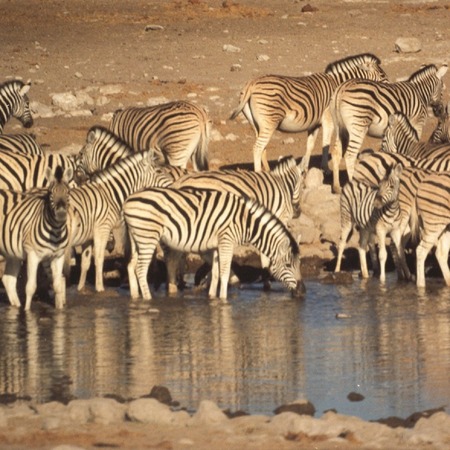
The rainy season from November to March turns the picture around. Impala and wildebeest drop their young in November and December within a few weeks, which draws in the predators. Up to 20,000 zebra move from the Chobe and the Boteti River onto the green grasslands of Makgadikgadi and Nxai Pan, and the herds stay there from December to March. The Central Kalahari is green then, and oryx, springbok and the cheetahs and lions of Deception Valley are easier to see than at any other time. More than 500 bird species are recorded in the country; the migrants arrive in November and stay until March.

In short: Chobe, Moremi and Khwai from June to October, Makgadikgadi, Nxai Pan and the Kalahari from December to March. If you want both in one trip, travel in April or May, when the north is drying out and the south is still green.

Region Jan Feb Mar Apr May Jun Jul Aug Sep Oct Nov Dec
Chobe riverfront (Kasane to Ngoma)
Okavango Delta, Moremi and Khwai
Savuti and Linyanti
Makgadikgadi and Nxai Pan (salt pans)
Central Kalahari (Deception Valley)
Best sightings Good chances Few sightings

What guests say about their trip to Botswana

★★★★★

Jürgen B.

Die Routenführung durch Namibia und Botswana ist durchdacht und abwechslungsreich. Die Etappen, wie die 290 km bis zum Waterberg, ermöglichen intensive Moto Enduro-Erfahrungen und bieten beeindruckende Landschaften. Die Kombination aus Camping und unterschiedlichen Unterkünften für die 20 Teilnehmer sorgt für eine klare Struktur.
★★★★★

Christian K.

Die Tour führte durch Namibia und Botswana, eine anspruchsvolle Motorradtour, die ich mit der Hoffnung auf spannende moto enduro-Strecken und kulturelle Erfahrungen gestartet habe. Besonders auffällig war die Gruppendynamik während der täglichen Etappen, die mit maximal 20 Teilnehmern klar strukturiert und durch tägliche Briefings begleitet...

★★★★★

Klaus S.

Die Tour führte durch Namibia und Botswana und bot eine durchdachte Routenplanung. Insbesondere die Strecke zum Waterberg lieferte herausfordernde moto enduro-Passagen, die den Schwierigkeitsgrad „Experte“ gerecht wurden. Den Höhepunkt bildeten die eindrucksvollen Landschaften rund um das Okavango-Delta, wo eine klare Streckenführung entscheidend war.

Climate in Botswana: weather month by month in Maun

Northern Botswana lies at around 940 m and is semi-desert with summer rain. Maun receives about 450 mm of rain a year, Kasane on the Chobe around 600 mm, and almost all of it falls between November and March as afternoon thunderstorms: 1 to 2 hours of heavy rain, then the sky opens up again. A whole rained-out day is rare; a soaked track the next morning is the norm.

From May to August it is winter: 25 to 28 degrees by day under a cloudless sky, cooling to 5 to 9 degrees at night, and down to freezing in the Kalahari. On the open deck of a safari vehicle on the 6 a.m. morning drive you need a beanie and gloves. September brings the turn: 33 degrees in the shade, 35 to 38 degrees in October, humidity drops below 30 percent and the wind carries dust. From November the night temperatures rise to 20 degrees, humidity climbs above 60 percent, and the days turn muggy.

Month Max °C Min °C Rain days Humidity % Sun hours
Jan Wet season 32 20 10 65 8
Feb 31 19 8 66 8
Mar 31 18 6 61 9
Apr Dry season 30 14 2 52 9
May 28 9 1 43 10
Jun 25 6 0 41 10
Jul 25 6 0 38 10
Aug 28 9 0 31 10
Sep 33 14 1 27 10
Oct 35 19 3 31 10
Nov Wet season 34 20 5 45 9
Dec 33 20 8 58 8

Best Time for a Motorcycle Trip

The dry season keeps the tracks rideable - and it coincides with the flood in the Okavango Delta.

5 Ideal
Best time to travel
May to September

Dry season: tracks firm, Okavango Delta in flood, best wildlife sightings at the last remaining waterholes.

Region Jan Feb Mar Apr May Jun Jul Aug Sep Oct Nov Dec
Okavango Delta, Moremi & Chobe (Maun-Khwai-Nata-Kasane)
Ideal Doable Not passable

Botswana's rainy season (November to March) makes the sand tracks in the Okavango Delta and around Moremi impassable in places - black cotton soil turns into deep, sticky mud after rain, in which even experienced riders get stuck. The tarred roads (A3 Maun-Nata-Kasane) stay rideable year-round, but the actual destinations - Khwai, Moremi, the tracks towards the Chobe riverfront - lie off that road.

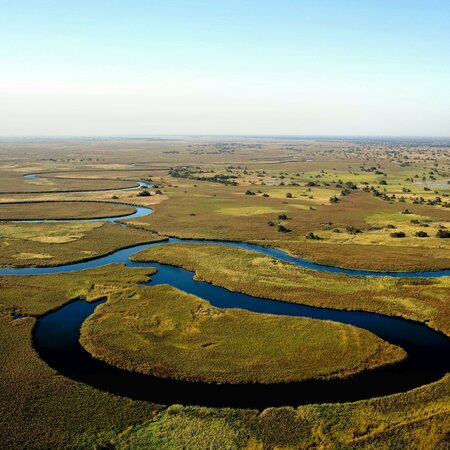
The flood in the Okavango Delta is the opposite of the rain: it originates in the Angolan highlands, takes months to travel the roughly 1,000 km to Botswana, and reaches the Delta in the middle of the dry season, usually peaking in June and July. That is why the best time to travel here coincides with the dry season rather than contradicting it: firm tracks and full water at the same time.

Only one region is listed, because our tours focus on the northeast (Maun, Khwai, Moremi, Nata, Kasane) - the drier south of the country (Kalahari, Gaborone) follows a different pattern, less tied to the flood, and is not relevant for a motorcycle trip here.

Best time to go, depending on what you are after

Seeing animals: July to October

The north has its densest sightings between July and October. The water in the bush is gone; elephants, buffalo and antelope stand at the Chobe, at the lagoons of Moremi and along the Khwai, with the predators beside them. The grass is short and visibility reaches 200 m and beyond. September and October deliver the most animals per drive, but also 35 degrees in the afternoon.

If you cope badly with heat: May to August

From May to August the thermometer stays at 25 to 28 degrees by day and drops to 5 to 9 degrees at night. No rain, hardly any mosquitoes, and the malaria risk is at its lowest. Sightings are already good from June, just not yet as dense as in September. If you want to avoid the 35 degrees of October and the muggy 60 percent humidity of summer, travel in these 4 months.

The most popular time: July to September

July, August and September are the most-booked months: dry season, the flood in the Delta at its peak, summer holidays in Europe. The campsites in Moremi and Chobe are then booked out 6 to 12 months ahead, and the lodges charge high-season rates. If you are flexible, take June: the same wildlife density as July, but more space.

Birds and green landscape: November to March

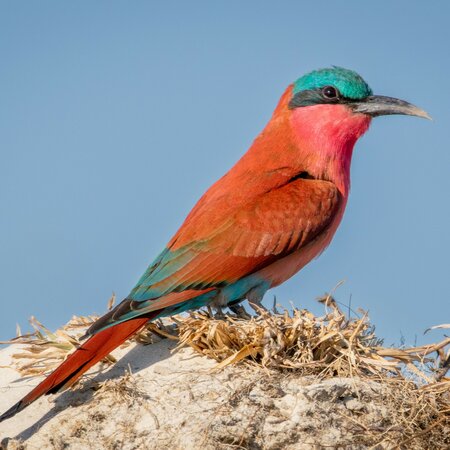
The migrants come with the rain: carmine bee-eaters, storks and eagles, plus flamingos on Sua Pan when it holds water. Most of the country's more than 500 bird species are present then. The Kalahari and the salt pans of Makgadikgadi are green and full of zebra and oryx; impala and wildebeest have young. In return, parts of Moremi are flooded, the grass stands tall and prices sit 20 to 40 percent below high season.

Photographers: September, October and January

September and October deliver the densest scenes: hundreds of elephants on the Chobe against the light, dust in the evening sun, predators at the water. The light is hard, so the best hours are before 8 a.m. and after 4 p.m. January and February offer the counter-programme: dramatic storm skies, deep green, zebra herds on the pans of Nxai Pan and the calving season with young animals in the frame.

Visa and Entry Requirements

German, Austrian and Swiss citizens enter visa-free - the paperwork lies elsewhere.

With a German, Austrian or Swiss passport you enter Botswana visa-free. At the border post, immigration stamps a free visitor status valid for up to 90 days per calendar year into your passport - no embassy, no form in advance. Your passport must still be valid for at least 6 months at entry and have at least 2 blank pages, or entry can be refused at some posts.

Anyone wanting to stay longer than 90 days must apply for an extension at the immigration office in Gaborone, Maun or Kasane before the period expires - this is not possible at the border itself.

For your own motorcycle, a Carnet de Passages is not enough, because Botswana does not require one: a Temporary Import Permit (TIP) is issued directly at the border post by the Botswana Unified Revenue Services (BURS), free of charge, valid for the length of your stay. In addition, every foreign-registered vehicle pays a National Road Safety Fund Levy of 40 Pula, in cash, valid until 31 December of the current year regardless of your entry date.

Visa typeStayCostWhere to applyValidity
Tourist entry90 days per calendar yearfreeBorder post (stamp on entry)Calendar year, not extendable at the border post
Temporary Import Permit (own motorcycle)Length of stayfree, plus 40 BWP Road Safety Fund LevyBURS counter at the border postUntil 31 December of the current year

Entering with Your Own Motorcycle

No Carnet needed, but insurance at the counter and veterinary checkpoints inland.

Botswana is one of the least complicated countries in southern Africa for your own motorcycle: a Carnet de Passages is not required. At the border post, BURS issues a free Temporary Import Permit, plus the 40 BWP Road Safety Levy (see the visa table). You must carry the vehicle registration document in your own name - if you are riding a motorcycle not registered to you (a rental, or a friend's machine), some border officials ask for a written, ideally notarised power of attorney from the owner. Without it, entry at the counter can take longer or be refused.

Third-party insurance for the vehicle is mandatory. Botswana is not a member of the COMESA Yellow Card system common in East Africa - the green card from Europe does not apply here. Private insurance counters sit right at the border post and sell short-term third-party cover for the length of your stay; without this proof, the vehicle is not processed at the counter.

Inland, you will repeatedly encounter veterinary checkpoints (vet gates): Botswana is divided into foot-and-mouth-disease control zones, separated by double fences. At every checkpoint you ride your front wheel through a disinfection trough and disinfect your boot soles in a provided tray; any raw meat, dairy products or fresh fruit carried from another zone is confiscated. Keep your boots within reach - the process only takes a few minutes, but you do dismount.

The relevant border crossings for a motorcycle trip are Mamuno/Trans-Kalahari (from Namibia), Ngoma (from the Caprivi/Zambezi region) and Kazungula (from Zambia/Zimbabwe, no ferry since the new bridge). All three are open daily and routinely handle motorcycles. Taking a rental motorcycle directly in Maun or Kasane is the simpler alternative if you only want to ride the Delta region - for a route linking countries (Namibia-Botswana-Zimbabwe), bringing your own motorcycle is still worthwhile, because the formalities here are this easy.

0 / 6
No Carnet needed - but without third-party insurance from the counter at the border post, the motorcycle is not processed. The COMESA green card does not apply here.

Driving Licence and Documents

Your EU licence covers the first 90 days, after that the international one becomes mandatory.

Holders of a valid foreign driving licence may ride in Botswana for up to 90 days without an international driving permit (IDP). For a shorter motorcycle trip, your German, Austrian or Swiss card licence alone is enough. After that, the IDP becomes mandatory - since most trips are considerably shorter, this rule rarely applies, but anyone staying longer or combining several countries on one big loop should carry the IDP from the start anyway: some border posts and police expect it as a matter of course even within the 90 days. It is only valid together with your national licence, never alone.

At traffic checks - not uncommon on the highways between Maun, Nata and Kasane - you will routinely be asked for your driving licence, vehicle registration and proof of third-party insurance. Carry all three within reach, ideally in a waterproof document wallet.

0 / 4

Roads and Sand Tracks in Botswana

Tar between the towns, deep Kalahari sand the moment you turn off the A3 towards the Delta.

Botswana's main artery for a motorcycle trip through the northeast is the A3 between Maun, Nata and Kasane - paved throughout, but with two very different sections. The moment you turn off the A3 towards Khwai or Moremi, the tar ends: deep Kalahari sand follows, with stretches of flooded wetland, and a proper 4x4/off-road motorcycle with deep-sand experience is a requirement, not an upgrade for straight-road travel enduros.

Wildlife crossing the road is real along the entire Nata-Kasane stretch, not just a figure of speech: elephants regularly cross the road, even during the day. Do not ride any stretch in Botswana after dark - this applies to car drivers just as much as riders, only the consequences of hitting an elephant are disproportionately greater on two wheels.

In built-up areas, such as through Gweta or Nata, cattle, goats and donkeys walk freely on the road - they have the right of way, because they will not move aside. Slow down well below the speed limit there. Since the new bridge, the Kazungula crossing (to Zambia or Zimbabwe) runs without a ferry across the Zambezi, which considerably simplifies the onward route to Livingstone or the southern Zambian leg of the trip.

1
A3 Maun - Nata (via Gweta, past the Makgadikgadi salt pans)
300 km
100% paved

Paved throughout, with sunken sections and potholes in places that are hard to spot against the light

After rain
Standing water can hide sunken tar sections - slow down, never ride blind through standing water
Realistic daily distance
Doable as one travel day, but the potholes force a noticeably reduced pace
Fuel stops
Fuel stations in Maun, Gweta and Nata, none in between
Passes
none
Permits
none
2
A3 Nata - Kasane
305 km
100% paved

Good tar condition, noticeably fewer potholes than the Maun-Nata section

After rain
Unproblematic, tar dries quickly
Realistic daily distance
Doable as one travel day, but keep speed reduced throughout for wildlife crossings (elephants)
Fuel stops
Fuel station in Nata, then not again until Kasane, no stops in between
Passes
none
Permits
none
3
Khwai Reserve & Moremi Game Reserve (tracks from Maun/Khwai)
80 km

Deep Kalahari sand, partly underwater in the wetlands, rideable only with off-road experience and deep-sand technique

After rain
Impassable in places after rain, black cotton soil turns into deep mud
Realistic daily distance
40 to 80 km, with many stops for wildlife viewing - kilometres say little about riding time here
Fuel stops
No fuel station in the reserve, enter with a full tank and a reserve
Passes
none
Permits
DWNP park fee plus a confirmed campsite reservation is mandatory, self-drivers without a booking are turned away at the gate

Fuel and Refuelling Stops

ULP95 in every larger town, but sometimes over 250 km with nothing in between.

Botswana has taken unleaded 93 (ULP93) off the market nationwide - at the pumps you consistently get ULP95, which suits any modern motorcycle without issue. There is no special high-octane fuel for high-compression engines; ULP95 is the only grade available.

The real issue is supply density: on the Maun-Nata-Kasane stretch, fuel stations exist only in the three towns themselves, nothing in between. Anyone planning the track via Chobe National Park between Kasane and Maun without the detour through Nata - roughly 611 km unpaved - rides the entire way with no fuel station at all; for a motorcycle with a standard tank, that is only manageable with a reserve canister. There is not a single fuel station inside the Khwai Reserve or Moremi itself.

Payment at the larger stations (Maun, Nata, Kasane) works by card; at smaller village stations, cash in Pula is the safer bet - card terminals fail there more often than expected. For any track off the A3: leave with a full tank and carry a reserve canister.

Emergency Numbers and Safety

112 is not a reliable option in Botswana - here are the real numbers.

The European 112 is not a reliable option in Botswana. Police, ambulance and fire brigade have their own, nationally valid three-digit numbers, which also work in the mobile-signal-weak regions of the northeast, provided there is any signal at all - in Khwai, Moremi and the Chobe wilderness that is not guaranteed. Also keep the number of the lodge or camp where you are staying within reach - radio or satellite contact is usually available there, and staff often reach help faster than a call to a national number would. Police and army checkpoints on the main roads are routine and rarely take more than a couple of minutes if your papers are in order.

Health and Insurance

Most travel health insurance policies do not cover riding a motorcycle over 125cc.

Botswana lies in a malaria area, mainly in the north (Okavango Delta, Chobe, Moremi) and more strongly during and shortly after the rainy season. Malaria prophylaxis, or at least a stand-by emergency medication, belongs in your travel medical kit, along with evening mosquito protection. A yellow fever vaccination certificate is only required if you are arriving from a yellow fever endemic area.

For medical emergencies away from the towns, air rescue (for example through providers such as Medical Rescue International) is the realistic option - the nearest clinic from Khwai or Moremi is several hours away. Travel insurance with an explicit rescue flight and motorcycle inclusion is not an extra here, but a requirement.

0 / 4
Most standard travel insurance policies exclude riding a motorcycle over 125cc - check the policy before you pay, not only after a claim.

Money and Payment Options

Pula is practically only available in the country itself - at the ATM in Maun or Kasane, not before you leave home.

The national currency, Botswana Pula (BWP), is hard to obtain outside the country, so it is best to withdraw cash straight after arrival at an ATM in Maun or Kasane - Visa is accepted at most machines, Mastercard less often. Card payments work reliably in lodges, larger restaurants and fuel stations in the three main towns. In villages, at smaller fuel stations and for the short-term insurance at the border counter, you need cash.

US dollars or euros are often accepted as a supplement in lodges. ATM density is limited once you leave Maun, Nata or Kasane - top up your cash reserve there before moving on.

Mobile Network and Internet

Good 4G along the A3, but you are mostly offline in the Delta and Moremi.

Mascom Wireless has the best nationwide coverage, followed by Orange Botswana and BTC. In Maun, Kasane and Francistown, 4G works reliably; along the A3 between towns, coverage is patchy. Once you turn into the Khwai Reserve, Moremi or the Chobe wilderness, mobile signal is mostly gone entirely - plan communication home accordingly, though many lodges offer satellite Wi-Fi at reception.

A local SIM card (Mascom or Orange) from a kiosk in Maun or Kasane is cheaper than international roaming; eSIM options from international providers also work on both networks if your device supports eSIM.

On the Road in the Country

Left-hand traffic, wildlife crossings and respect for the veterinary checkpoints - the three things that shape everyday riding.

Botswana drives on the left, for most travellers from continental Europe the biggest mental adjustment - especially when overtaking and at roundabouts in Maun or Kasane. At the veterinary checkpoints, travellers are expected to dismount patiently and without argument - the staff follow a national disease-control regulation, not harassment.

Photograph people, especially in villages off the tourist routes, only after asking. Botswana is politically stable and its people notably welcoming towards travellers; polite treatment of older people (asking permission, not addressing them directly by first name) is appreciated. In the national parks, strict rules apply against riding off designated tracks - going cross-country is forbidden and penalised, however tempting a shortcut looks.

What Botswana Adds to Your Kit

The addition to your normal travel gear - not the whole list.

0 / 6

Photos from Botswana

Joe Küster
Author
Joe Küster
Founder & Creative Engine of Overcross

"Jack of all trades, almost all!" The driving force and idea machine behind Overcross.

Languages: de, en
×

Send request

Adventure

How did you
hear about us?

Adventure truck Road path Palm tree
Ask a Route Expert

How do you want to travel?