Travel Information

India by Motorcycle: Visa, Entry, Passes and Best Season

What to sort out before leaving for India: visa, driving licence, bringing your own motorcycle, and when the Himalayan passes are open.

View tours
Visa
E-visa (tourist), applied for online in advance
30-day visa from around USD 25 (often USD 10 Apr-Jun), 1-year visa around USD 40, plus approx. 2.5% bank fee; processing usually 3-5 working days
Passport validity
At least 6 months from entry, 2 completely blank pages
Best time to travel
Himalayas (Ladakh/Spiti): June to September. South/Kerala and Rajasthan: October to March
Currency
Indian Rupee (INR), cash only outside the cities
Time zone
IST, UTC+5:30, no daylight saving time
Side of the road
Left-hand traffic
Helmet & gear
Helmets compulsory for rider and pillion, enforcement varies by state
Main road
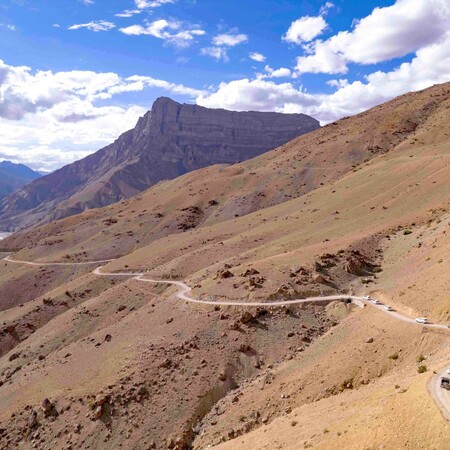
National highways mostly paved, BRO mountain tracks partly gravel, landslide risk after rain
Fuel
Unleaded, 89-91 octane typical (from 2026 minimum 95 RON with E20 nationwide); in Ladakh, fuel stations up to 320 km apart
Int'l driving permit
International Driving Permit under the 1949 Geneva Convention (not Vienna 1968), valid only together with your national licence

What guests say about their trip to India

★★★★★

Tim H.

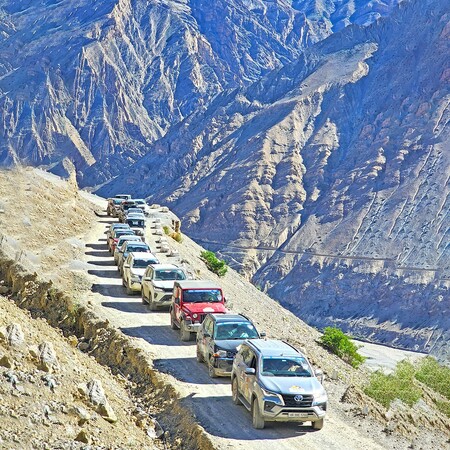
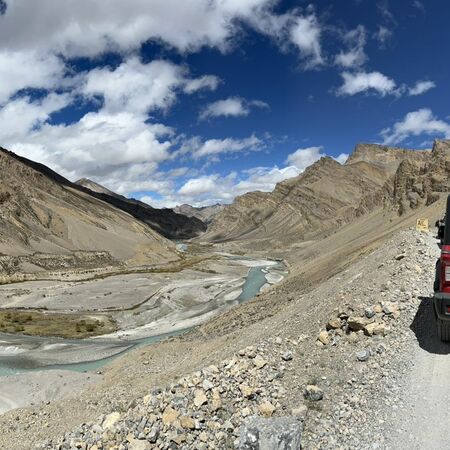
Die Routenplanung der Himalaya Motorradreise durch Ladakh ist strukturiert und durchdacht. Die Streckenführung zum Umling La Pass und den Khardung La bietet abwechslungsreiche Landschaften und klare GPS-Tracks. Die Gruppengröße von maximal 10 Personen ermöglicht individuelle Betreuung.
★★★★★

Klaus M.

Die Royal Enfield Motorradtour durch Rajasthan ist für fortgeschrittene Fahrer konzipiert, mit maximal 12 Teilnehmern für eine intensive Erfahrung. Die täglichen Fahrten, beispielsweise die Erkundung von Jaipur und die Bootsfahrt auf dem Pichola-See, erfordern sowohl physische als auch fahrerische Fähigkeiten, um die anspruchsvollen Strecken sicher...

★★★★★

Bernd S.

Die Royal Enfield Gujarat Motorradreise führte mich durch die vielfältigen Landschaften Indiens, wo ich mit hohen Erwartungen in Bezug auf technische Vorbereitung und Support startete. Die Betreuung während der Tour war klar strukturiert, insbesondere die täglichen Briefings und die Bereitstellung von GPS-Tracking für die rund...

Best time for a motorcycle trip

When the Himalayan passes are open and when the monsoon governs the south, because the two follow opposite calendars.

10 Ideal
Best time to travel
Himalayas Jun-Sep, South/Raj. Oct-Mar

The Manali-Leh Highway and Khardung La are usually snow-free only from late May to mid-November; Kerala and Rajasthan, by contrast, are driest from October to March.

Region Jan Feb Mar Apr May Jun Jul Aug Sep Oct Nov Dec
Himalayas (Ladakh, Zanskar, Spiti)
Rajasthan / North India (plains)
South (Kerala, Tamil Nadu, Goa)
Ideal Doable Not passable

The Himalayas and the rest of India follow opposite calendars, so 'the best time for India' can't be answered in one sentence. The Manali-Leh Highway is usually opened to civilian traffic by the Border Roads Organisation (BRO) from late May to early June, and closed again from mid- to late November because of snow and icing at Baralacha La; the real riding season therefore lasts a good five months. Khardung La falls within the same window (May to October); fresh snow in early autumn can close it for days at short notice.

The south-west monsoon usually reaches Kerala, the first region in India to feel it, in early June and shapes the backwaters until August: roads stay passable but are wet, slippery, and visibility is poor. From October to February the monsoon is over, water levels in the backwaters are high, and temperatures of 24 to 32 degrees are pleasant. Rajasthan has no pass closures, but temperatures there climb above 45 degrees between April and June, which turns riding into a health question rather than a question of passability; here too, October to March is clearly the preferred time. Anyone combining several regions on one trip should therefore plan separate time windows rather than look for one shared best season.

Visa and entry to India

What you actually need to enter India, and what the e-visa really costs.

Travellers from Germany, Austria and Switzerland need a visa for India, and the e-visa is the standard route. It is applied for online through the official portal indianvisaonline.gov.in, at the earliest 120 days and at the latest 4 days before entry. Processing usually takes 3 to 5 working days; the e-visa confirmation and the passport need to be printed out.

The 30-day e-Tourist visa costs between 10 and 25 US dollars depending on the season, plus a bank fee of around 2.5 percent. For longer or repeated trips there is a 1-year e-visa for around 40 US dollars and a 5-year version; both allow multiple entries, while the 30-day visa is valid for a single entry only. For a two- to three-week Himalaya or South India tour, the 30-day e-visa is enough.

The passport must still be valid for at least six months on entry and have two completely blank pages. Airlines already check this at check-in; a passport that is too full or about to expire leads to being turned away.

A separate permit is needed by anyone riding into restricted zones on the Ladakh route such as the Nubra Valley, Pangong Tso or Tso Moriri: foreigners need a Protected Area Permit (PAP) there in addition to the visa, which a travel agency in Leh can usually arrange overnight (see table below).

Visa typeStayCostWhere to applyValidity
e-Tourist visa, 30 days30 days from entry, single entryUSD 10 (Apr-Jun) / USD 25 (Jul-Mar) + approx. 2.5% bank feeOnline: indianvisaonline.gov.inUsable for 120 days from issue
e-Tourist visa, 1 yearMax. 90 days per stay, multiple entryapprox. USD 40 + bank feeOnline: indianvisaonline.gov.in365 days from issue
Protected Area Permit (Ladakh)7 to 15 days, for the Nubra Valley, Pangong Tso, Tso Moriri, restricted zone around Khardung Laapprox. USD 10-15 (environmental fee, Red Cross fee, daily fee)Through a registered travel agency in Leh; not available online for foreignersMust be obtained before each leg into the restricted zone

Bringing your own motorcycle or renting locally

Why a carnet exists for India, but almost nobody actually imports their own motorcycle, and what happens instead.

Formally, importing a motorcycle is possible: India recognises the Carnet de Passages en Douane and lets a private motorcycle into the country duty-free for six months on it, with an extension for a further six months through a local customs agent. The carnet costs around 300 to 500 US dollars through your home automobile club, plus a deposit or bank guarantee equal to the vehicle's value; issuing it takes two to six weeks.

Where the idea actually fails is the border itself: there is no overland route by which a foreign-registered motorcycle can enter India. Wagah on the Pakistani border is closed to vehicles, and the crossings into Nepal and Myanmar are open only to bilateral traffic between those neighbouring countries, not to motorcycles from third countries. Anyone who really wants to import their motorcycle ships it by container or RoRo to Mumbai or Chennai; Chennai is closer to South India routes, while Mumbai is used more for the north and Rajasthan. Shipping line booking, carnet processing at the destination port and the crossing itself add up to six to eight weeks of lead time.

A Green Card insurance is not valid at the destination port; Indian third-party motor insurance is mandatory, arranged by a local customs agent or insurance broker before collection. The vehicle registration document, carnet and an international driving permit must be carried at every police checkpoint. Anyone who is not the registered owner of the vehicle, for example with a borrowed motorcycle, needs a notarised power of attorney from the owner; without this document, the motorcycle will be impounded in the event of an accident or a check.

In practice, hardly any customers ship their own motorcycle for a two- to three-week tour: spare parts for a European touring motorcycle are still available in Leh, but practically not in Kaza or Padum in the Spiti and Zanskar valleys. Every workshop along the Himalayan routes is set up for Royal Enfield, which is why our tours here run on rented Royal Enfields rather than on riders' own machines: reliable support on the ground beats the appeal of riding your own bike.

0 / 6
A carnet allows the import, but no border actually leads in: there is no overland route for a foreign-registered motorcycle into India. Anyone who really wants to import one ships it by RoRo or container to Mumbai or Chennai, with six to eight weeks of lead time.

Driving licence and permit

Which convention India's international driving permit falls under, and what the traffic police actually want to see at a checkpoint.

India has ratified the 1949 Geneva Convention on Road Traffic, not the 1968 Vienna Convention. The International Driving Permit (IDP) must therefore be issued to the 1949 format; most German, Austrian and Swiss IDPs meet this automatically, because those countries are also party to the 1949 convention. The IDP is valid only together with a valid national driving licence, never on its own, and is valid for one year from issue.

Legally, the IDP is mandatory for riding a motorcycle. In practice, many rental operators in Leh or Manali only ask for the national driving licence with a motorcycle category, because tourists are rarely checked. That doesn't hold in the event of an accident or a police check: without an IDP, the motor insurer can refuse to pay out, and riding without a valid licence brings a fine. The national licence must show the category for motorcycles with clutch and gears (listed as MCWG in India); a licence for automatics or scooters only is not enough for the Royal Enfields used on the tours.

0 / 4

Roads and passes in the Indian Himalayas

What the Manali-Leh Highway and Khardung La really mean in daily distance, fuel-stop spacing and condition after rain, not the kilometres on the map.

The Manali-Leh Highway (NH3) is the main axis of every Ladakh tour: around 428 km from Manali via the Atal Tunnel, Baralacha La, the More Plains and Tanglang La to Leh, mostly paved but with long gravel and loose-rock stretches, especially between Pang and Debring. The BRO re-clears the road every spring, so its condition varies depending on when a given stretch was last worked on. The 9 km Atal Tunnel under the Rohtang Pass is passable year-round and has replaced the older, often-closed pass crossing since 2020; it shortens the route and pushes the start of the season a few weeks earlier.

Khardung La can be ridden as a day trip from Leh, around 39 km one way, now largely paved but narrow with tight hairpins above 5000 m. Both routes share the same rule: realistic daily distances are 150 to 200 km, not the motorway speeds the map suggests, because altitude, pass sections and road condition dictate the pace. Anyone continuing from Leh into the Nubra Valley rides over the same Khardung La and additionally needs the Protected Area Permit for it.

1
Manali-Leh Highway (NH3)
428 km

Mostly paved, but long gravel and loose-rock stretches especially between Pang and Tanglang La; regular BRO roadworks

After rain
Mudslides and landslides possible on the steep slopes near Gramphu and Darcha; the road can be closed for days
Realistic daily distance
150 to 200 km — altitude and pass sections rule out motorway pace
Fuel stops
Only in Tandi/Keylong, then not again until about 320 km later in Karu near Leh; in between, only unofficial canister fuel at tent dhabas
Passes
Baralacha La 4890 m, Nakee La 4740 m, Lachulung La 5065 m, Tanglang La 5328 m
Permits
None for through traffic alone; an Inner Line/Protected Area Permit is only needed for side trips to Pangong Tso or Tso Moriri
2
Khardung La (from Leh)
39 km

Road surface largely paved in recent years, but narrow with tight bends above 5000 m

After rain
Fog and snow showers possible even in summer; visibility can drop to a few metres within minutes
Realistic daily distance
As a day trip from Leh; no overnight accommodation at the pass
Fuel stops
Last fuel station is in Leh; no supply at the pass
Passes
Khardung La 5359 m (official BRO measurement; signs on site often incorrectly show 5602 m)
Permits
Inner Line/Protected Area Permit required for foreigners as soon as the route continues into the restricted Nubra Valley zone

Fuel and range in India

What fuel is actually sold at the pumps, how far the tanks stretch in Ladakh, and when the canister dhaba is all that's left.

Regular unleaded fuel at most Indian filling stations is 89 to 91 octane (RON); since 1 April 2026 the government has required a minimum of 95 RON with up to 20 percent ethanol blend (E20) nationwide, with transitional periods in individual regions facing supply shortages. This is not an issue for the Royal Enfields used on the tours, as they are built for ordinary pump fuel. Premium grades of 93 to 98 octane are only available at a few stations in big cities, and practically nowhere in the Himalayas.

On the Manali-Leh Highway there is a roughly 320 km gap between Tandi/Keylong and Karu near Leh with no official fuel station. In between, tent dhabas at Sarchu, Pang or Zingzingbar sell canister fuel at noticeably higher prices and with no guarantee of quality; for this stretch it's worth setting off from Keylong with a full tank plus a reserve canister. In towns and larger settlements payment is usually in cash; card payment is rarely possible at fuel stations outside the big cities.

RegionOctaneAvailability
Cities and national highways (Rajasthan, Kerala)89-91 RON, from 2026 min. 95 RON (E20)Dense network; card payment rare outside big cities
Manali-Leh Highway (Tandi to Karu)89-91 RON at official pumps320 km with no fuel station; only canister dhabas in between
Leh and the Nubra Valley89-91 RONLast guaranteed fuel station before Khardung La/Nubra is in Leh

Safety and emergency numbers

Which number in India actually helps if something happens on the highway or at a pass.

India has had a unified nationwide emergency number, 112, for a few years now, combining police, fire and ambulance services and reachable by call, SMS or the '112 India' app; in states with a fully built-out emergency response system (ERSS), your location is transmitted automatically. The older individual numbers 100 (police) and 108 (ambulance) still work in parallel and are still more familiar to many Indians than 112.

For a rider broken down or in an accident on a national highway, 1033 is often the faster option: the NHAI's free highway helpline puts you straight through to tow trucks, ambulances and highway police along the national roads, in multiple languages. In the high mountains between Manali and Leh, mobile coverage is missing entirely on some stretches (see connectivity below): on the loneliest sections the nearest contact is often a passing BRO vehicle or another vehicle in the convoy, not a phone call.

Health and altitude risk

What actually matters at Khardung La, and what a standard travel insurance policy quietly excludes for motorcycles over 125cc.

The Royal Enfields used on the Himalaya tours have engines of 350 to 450cc, which automatically triggers the motorcycle exclusion clause for engines over 125cc in many European travel insurance policies, regardless of riding ability. Riding above 3000 m altitude is just as commonly excluded, and that applies throughout the entire Manali-Leh route and at Khardung La (5359 m). A suitable policy therefore needs an explicit add-on for motorcycling and high altitude, ideally noted in writing on the policy itself.

For Ladakh, a mandatory 48-hour acclimatisation period in Leh (3500 m) applies before setting off for passes above 5000 m such as Khardung La or Chang La; local doctors even recommend 2 to 3 days if you arrive by flight. Early signs of altitude sickness are headaches, nausea and insomnia in the first 24 to 48 hours.

0 / 5
Most travel insurance policies exclude motorcycling over 125cc and riding above 3000 m altitude by default, and both apply to every Ladakh route. Without a written add-on covering both, nobody is insured at Khardung La.

Money and payment in India

Where cards work and where, past the last ATM, only cash counts.

The national currency is the Indian Rupee (INR); import and export of cash is limited and rarely checked at the border. ATMs are available in every larger city and in Leh, but there are none after that on the Manali-Leh Highway or in the Nubra Valley; withdraw cash for the entire mountain stretch beforehand in Leh or Manali. Card payment works in hotels and larger restaurants in the cities, while cash only is the norm at fuel stations and dhabas along the pass roads.

PlaceOption
Delhi/Mumbai airportsCurrency exchange counters and ATMs, usually a worse rate
Banks in citiesBest exchange rate; passport required to exchange money
Leh, the last major stop before the highwaySeveral ATMs, then none until Keylong/Manali
Dhabas and fuel stations in the mountainsCash only, no card payment

Mobile network and internet

Why a foreign eSIM doesn't work in Ladakh, and which network actually has coverage there.

For security reasons, foreign prepaid SIM cards and international travel eSIMs are blocked in the union territory of Ladakh, which includes the Nubra Valley, Pangong Tso and the entire route from the Himachal Pradesh border onward. Anyone who needs a signal there can only get around the block with an Indian postpaid SIM or a local prepaid SIM bought on site; a prepaid SIM from another state bought in Delhi or Manali also doesn't automatically work in Ladakh.

Of the three big providers, BSNL is considered the most reliable in the mountain regions; Airtel has recently extended its network to Pangong Tso and Khardung La; Jio covers most cities nationwide but has gaps in the high mountains. On long stretches of the Manali-Leh Highway, for example between Sarchu and Pang, there is no signal at all for hours, regardless of provider.

People and etiquette

What actually helps or hinders you on the road, not general background on the country.

Motorcycle convoys are met with curiosity almost everywhere in the countryside, and a short stop for a photo or a chai by the roadside often opens more doors than planned. What's less tolerated is passing pedestrians, cows and carts too closely: locals and sacred cows effectively have right of way on the road, and honking instead of braking causes trouble. Asking before taking photos of people, especially women, and at religious sites, is expected and rarely refused.

At Buddhist monasteries in Ladakh (such as Thiksey and Hemis), clothing covering shoulders and knees is the minimum expectation; motorcycle gear is usually already enough for that. Alcohol is available with restrictions in parts of Ladakh and on religious holidays, while it's freely sold in Rajasthan and Kerala. Traffic runs on its own, informal rules: honking works as a warning signal rather than aggression, and reading it that way rather than getting annoyed makes for a more relaxed ride through traffic.

Packing list additions for India

Only what this trip adds to your usual touring kit, not the basics.

0 / 7

Photos from India

×

Send request

Adventure

How did you
hear about us?

Adventure truck Road path Palm tree
Ask a Route Expert

How do you want to travel?