Tunisia from 2.050 €

Germany from 299 €

Peru from 2.379 €

South Africa from 869 €

Namibia from 1.129 €

Greece from 1.579 €

Switzerland from 1.289 €

Senegal from 4.729 €

Mauritania from 4.729 €

Nigeria from 10.089 €

India from 2.469 €

France from 270 €

Spain from 1.239 €

Italy from 1.079 €

Chile from 2.819 €

Morocco from 2.059 €

Kenya from 1.899 €

Austria from 2.679 €

Tanzania from 2.369 €

Ukraine from 2.060 €

Cameroon from 10.199 €

Congo (DR) from 10.089 €

Western Sahara from 4.729 €

Balkan from 669 €

China from 8.899 €

Travel Information Nepal

Adventures between the Himalayas and ancient cultures

Everything you need to know about Nepal

Travel map of Nepal by the tour operator OVERCROSS

Travel map of Nepal by the tour operator OVERCROSS


  1. General Information
  2. Geography & Climate
  3. Flora & Fauna
  4. Cities & Regions
  5. Transport Network
  6. Population
  7. Politics & Economy
  8. Culture & Sights
  9. National Parks & Nature Conservation
  10. Holidays
  11. Travel Information
  12. Medical Information
  13. Foreign Representations
  14. Sources and Links


1. General Information

Continent: Asia
Geographical Location: Between Tibet/China (to the north) and India (to the east, south, and west)
Highest Peak: Mount Everest, 8848 m 
Longest River: Ghaghara, 1080 m
Form of Government: Parliamentary Federal Republic
System of Government: Transitional government
Languages: Nepali
Neighboring Countries: India and Tibet/China
Capital: Kathmandu
Area:  147,181 km²
Inhabitants: 30,213,200
Population Density: 205 inhabitants per km²
Religions: approx. 80% Hindus, approx. 9% Buddhists, approx. 4% Muslims, approx. 3% Kirant Mundhum, approx. 1% Christians, less than 1% others
Currency: Nepalese Rupee
Climate: Very diverse climate zones, due to the extreme differences in altitude
Timezone: UTC +5:45
Country Code: + 977
ISO Code: NPL
Electricity: 230 V, plug types C / D / M are used
Opening Hours: generally weekdays 10:00-17:00, Saturdays until 13:00, sometimes until 15:00, closed Sundays


back to top of page


2. Geography & Climate

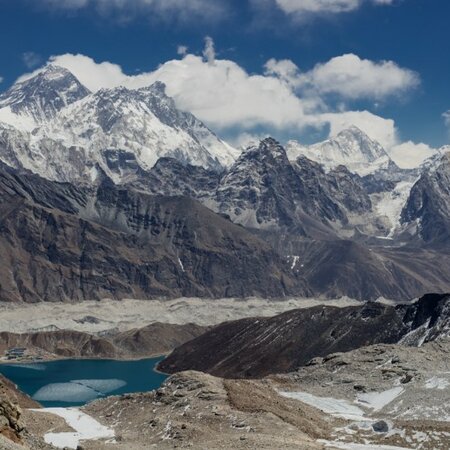
Nepal is located in South Asia between Tibet to the north and India to the south. It is home to a large part of the Himalayas and along with Mount Everest (8848 m), seven other of the ten highest mountains in the world.

In terms of natural geography, Nepal can be divided into three main regions: the Terai (Nepalese Terai Gangetic Plain), the Midland (up to 3000 m, with highly structured relief), and the High Mountain region. This division is also tied to socio-economic, cultural and ethnic divisions in the country. Several rivers, all of which ultimately flow into the Ganges, have carved deep gorges through the mountains. The deepest of them is, at  6000 m, the deepest gorge in the world.

The differences in altitude lead to very different climate zones: it is subtropical in the lowlands in the south, temperate in the Pre-Himalayas above 1500 m, and alpine in the high mountains from 4000 m. The Southwest Monsoon dominates nearly the entire country from June to September and brings 80 - 90% of the annual rainfall. In the remaining months, it stays mostly dry.

Climate charts:

Kathmandu Temp. °C min/max Sun hours / day Rainy days
Jan 3 18 6 1
Feb 4 20 6 5
Mar 7 25 7 3
Apr 12 29 10 3
May 16 30 6 13
Jun 19 28 5 17
Jul 20 28 3 24
Aug 20 28 2 23
Sep 18 27 3 15
Oct 14 26 5 4
Nov 7 23 5 0
Dec 3 19 5 1


Dhankuta Temp. °C min/max Hours of sunshine / day Rainy days
Jan 9 15 8 2
Feb 10 12 7 2
Mar 13 20 8 3
Apr 16 23 8 7
May 17 23 7 13
Jun 19 24 5 18
Jul 18 23 3 20
Aug 19 24 4 16
Sep 17 23 4 14
Oct 15 21 6 6
Nov 12 18 7 1
Dec 9 16 7 1


back to top of page


3. Flora and Fauna

Nepal's fauna includes 30 different species of larger mammals, over 80 species of smaller mammals, and hardly countable butterflies and insects. Tigers are strictly protected, whose population has unfortunately been greatly reduced in recent years. There are also several species of deer in Nepal. In the very remote regions of the Annapurna massif, bears and snow leopards are said to still occur. More common, however, are the yak and the dzhok-pa, a cross between yak and cow.
 
Above all, the plants and trees from the Terai are used industrially. The foremost example here is the sala tree, whose wood is used to make the windows and doors that can be admired throughout the Kathmandu Valley. One often also finds tall poinsettias, various types of bananas, apple, lemon, and grapefruit trees.
 

back to top of page


4. Cities and Regions

The largest city is Kathmandu. With numerous cultural and historical sights, the former royal city truly has a lot to offer.
In the Kathmandu Valley, there is another important city: Bhaktapur. It, too, was once the capital of a kingdom at one time.
Mount Everest is known worldwide as the tallest mountain on earth. It is located in the Khumbu region on the Tibetan border.


back to top of page


5. Transport network

There is left-hand traffic. The traffic is, as in all developing countries, very chaotic, hectic and noisy. Most of the time, it seems as if there are no rules. The most commonly used means of public transport is the bus. But if you want it even cheaper, you can ride in a typical local Tuk Tuk. Rickshaws are also quite common.


back to top of page


6. Population

At the 1991 census, about 18.5 million people lived in Nepal. Today, the population is assumed to be around 30 million people. The annual population growth rate is about 2.1 percent. Nepal is ethnically and culturally a mosaic of minorities. In a census in 2001, over 100 different ethnic groups and castes as well as 124 different languages and dialects were counted (most of which are endangered).

The Nepalese caste system still exists as a social phenomenon, although the rules are less strictly interpreted these days and the discrimination of individual castes was declared unlawful by the 1962 constitution, which referred to a Hindu monarchy. Caste boundaries are partly permeable, and the categories of ethnic affiliation and caste overlap or depend on the perspective of the observer. The Nepalese caste system developed in parallel with the Indian one.


back to top of page


7. Politics and Economy

With an average income of 1,200 euros per capita, Nepal is, after Afghanistan, the second poorest country in Asia and one of the ten poorest countries worldwide. Access to international shipping is far away and air traffic is severely hampered by the mountains. The years of war have further severely damaged the already weak economy.


back to top of page


8. Culture & Sights

Chandra Bahadur Dangi: was born on November 30 and is the smallest man in the world.

Tenzing Norgay: was born on May 29, 1914. On May 29, 1953, he became the first person to climb the highest mountain in the world, Mount Everest.


back to top of page


9. National parks and nature conservation

In Chitwan National Park, in addition to tigers, you can also watch the strictly protected one-horned rhinoceros and elephants.

Nepal has nine national parks, three nature reserves and one hunting area. Over 15,000 square kilometers, amounting to more than 18 percent of the total area, are protected.


back to top of page


10. Public holidays

Holiday Date
Maghi Parba 15 January
Sahid Diwash: Martyrs' Day 30 January
Basant Panchami 1 February
Rastraya Pajatantra Dibas: Democracy Day 18 February
Maha Shivaratri 24 February
Nari Dibas: International Women's Day 8 March
Holi 13 March
Ram Navami 5 April
Navavarsha (New Year) 13 April
Labour Day 1 May
Buddha Jayanti 10 May
Republic Day 29 May
Krishna Janmashtami 14 August
Ghatasthapana 21 September
Fulpati Saptami 28 September
Maha Ashtami 29 September
Maha Navami 30 September
Vijaya-Dashami (Ten Days of Victory) 11 October
Constitution Day 9 November
Christmas 25 December


back to top of page


11. Travel Information

→ Safety information from the Federal Foreign Office


back to top of page


12. Medical Notes

Medical care in Nepal is very poor. Accidents and illnesses often plunge the people living there into severe poverty from which they cannot escape. No insurance system covers the costs of illnesses and their consequences. Doctors and hospitals are also usually several days' marches away and thus very difficult or even impossible to reach.

→ Here for the medical notes of the Federal Foreign Office


back to top of page


13. Foreign Representations

Embassy of the Federal Republic of Germany
Kathmandu Gyaneshwar
Kathmandu

Telephone: +977 1 441 27 86
E-Mail: [email protected]

Postal address:
Embassy of the Federal Republic of Germany
P.O. Box 226
Kathmandu
Nepal
 

Embassy of the Democratic Federal Republic of Nepal
Guerickstraße 27, 2nd Floor
10587 Berlin

Telephone: +49 30 343 599 20 22
E-Mail: [email protected]


back to top of page


14. Sources and Links

www.wetterkontor.de
www.auswaertiges-amt.de
Wikipedia


back to top of page

Karte von Nepal

×

Send request

Adventure

How did you
hear about us?

Ask a Route Expert