Travel Information

Romania Travel Information for Motorcycle and Off-Road Tours

Everything you need to know before your Romania tour: when the Carpathian passes are open, entry rules, roads, safety and packing list, from a rider's perspective.

View tours
Visa
Visa-free for EU/EEA/CH (an ID card is enough); other nationalities often up to 90 days
Romania has been a full Schengen member since 1 January 2025, with no more passport checks at the land border with Hungary and Bulgaria
Passport validity
For EU/EEA/CH, a valid ID card or passport is enough; non-EU citizens should allow at least 3 months' remaining validity beyond the return date
Best time to travel
June to September for the Carpathian passes; the lowlands and Transylvania from April to October
Currency
Romanian Leu (RON)
Not a euro country; card payment is common in cities, plan for cash in rural areas
Time zone
UTC+2 in winter, UTC+3 in summer
One hour ahead of Germany, year-round
Side of the road
Drives on the right
Helmet & gear
Helmet required (ECE 22) for rider and passenger; protective clothing is not a legal requirement
Main road
DN7C Transfăgărășan (Sibiu-Curtea de Argeș) and DN67C Transalpina (Novaci-Sebeș)
Fuel
Filling-station network dense along main roads (Petrom, OMV, Rompetrol, MOL, Lukoil); no filling stations on the pass roads themselves
Int'l driving permit
Not needed for an EU driving licence; recommended for non-EU licences

What guests say about their trip to Romania

★★★★★

Stefan K.

Die technische Vorbereitung der 4x4 Camping Reise in den rumänischen Karpaten wurde durch tägliche Briefings und klare GPS-Tracks gewährleistet. Besonders erwähnenswert war das kompetente Team, das die anspruchsvollen Offroad-Strecken im Cindrel-Gebirge sicher leitete, was für die kleine Gruppengröße von maximal 6 Personen vorteilhaft war.
★★★★★

Tobias Z.

Die 4x4 Camping Reise in den rumänischen Karpaten bietet eine klare Struktur mit täglichen Briefings und nachvollziehbarer Routenplanung. Besonders positiv war der reibungslose Ablauf beim Wechsel von Asphalt auf Offroad-Strecken am zweiten Tag, der den Einstieg in die anspruchsvollen Touren erleichterte. Das Format fördert gezielte...

★★★★★

Tobias K.

Die Routenplanung dieser 4x4-Entdeckungsreise durch die Karpaten in Rumänien war präzise und gut strukturiert. Die offroad Pisten führten durch abwechselnde Landschaften, von alpinen Bergpfaden bis zu versteckten Singletrails. Besonders herausragend waren die Etappen zu den Schlammvulkanen und die abschließende Weinverkostung, die den Abenteueraspekt mit lokalen...

Tobias K. 4x4 Offroad Adventure through the Carpathians

Best Time to Travel & Pass Opening in Romania

What matters isn't the weather in the valley, it's whether the Transfăgărășan and Transalpina are open. That's usually only a good four months of the year.

8 Ideal
Best time to travel
June to September

The two high Carpathian passes usually only open from mid to late June and already close by the end of October. Transylvania and the lowlands ride well from April to October.

Region Jan Feb Mar Apr May Jun Jul Aug Sep Oct Nov Dec
High Carpathian passes (Transfăgărășan, Transalpina)
Transylvania and the Carpathian foothills
Lowlands and the south (Wallachia, Bucharest, Danube)
Ideal Doable Not passable

The country's two best-known roads, the Transfăgărășan (DN7C) and the Transalpina (DN67C), are high-mountain passes over 2000 m that are completely closed every winter. Most recently, the Transfăgărășan opened in mid-June and closed at the end of October; the Transalpina opens similarly, from mid-May to mid-October, and is additionally open there only during the day, between 8am and 8pm. Before setting off, it's worth a quick online check of the current status: depending on the weather, both roads can also be closed at short notice in the middle of the season.

Transylvania and the Carpathian foothills ride well from April to October; winter brings snow and ice right down into the valleys. In the lowlands towards Bucharest and the Danube, the riding season is longer, though it gets very hot and humid there in high summer.

Expect short, heavy afternoon thunderstorms in the Carpathians in early summer, a typical pattern in the mountains from June to August.

Entry & Visa for Romania

For EU, EEA and Swiss nationals, entry is a pure formality. For everyone else, the 90-day rule across the whole Schengen area applies.

Romania has been a full member of the Schengen area since 1 January 2025. Travellers from Germany, Austria, Switzerland and the rest of the EU/EEA can enter with a valid ID card or passport, with no passport check at the land border with Hungary or Bulgaria. Until the end of 2024, there were still regular border checks with stamping there; that's now history.

Nationals of many non-EU countries (including the USA, Canada and the United Kingdom) enter visa-free for tourist purposes for up to 90 days within 180 days. Those 90 days are counted across the whole Schengen area together, not just for Romania: anyone who has already spent time in other Schengen countries needs to keep an eye on the running total. Your passport should be valid for the whole length of your stay.

Nationals of countries requiring a visa need a Schengen visa, applied for at the relevant Romanian consulate before travelling. Check shortly before departure whether an ETIAS travel authorisation is now also required for your nationality.

Visa typeStayCostWhere to applyValidity
EU/EEA/Switzerland (ID card)Unlimited, freedom of movementnoneNo check at the land border (Schengen)No end date
Visa-free third countries (e.g. USA, UK, Canada)Up to 90 days per 180-day periodnoneBorder check on entry, applies across the whole Schengen area90 of 180 days
Countries requiring a visaAs stated on the issued visaVisa feeRomanian consulate before travellingAs stated on the visa

Bringing Your Own Motorcycle to Romania

No carnet, no customs paperwork, no toll sticker for motorcycles. Entry is as simple as into any other EU country.

For a motorcycle registered in the EU, entry into Romania is a pure formality: no Carnet de Passages, no customs declaration, no separate import document. Third-party insurance from the country of registration automatically applies EU-wide, and a Green Card isn't required within the EU. If your insurer issues one anyway, carry it, it saves discussion at a check.

If you're arriving on a motorcycle registered outside the EU/EEA (for example with UK plates), clarify your cover directly with your insurer before departure: depending on the provider, a Green Card for travel outside the country of registration may still be a good idea, or required.

You don't need to buy a Romanian toll sticker (rovinetă) for a motorcycle. The toll applies to cars, motorhomes and heavier vehicles; motorcycles are explicitly exempt and pay at no toll point in the country.

If you're riding a motorcycle that isn't registered to you, carry an informal authorisation from the owner alongside the registration document, ideally bilingual or in English. It's not a legal requirement, but it makes every check easier.

The common road border crossings are at Nădlac and Borș (from Hungary), Moravița (from Serbia), and Calafat and Giurgiu (from Bulgaria, across the Danube). Since 2025, none of them carry out a regular passport check any more.

0 / 6
Romania has been a full Schengen member since 1 January 2025, and there's no more passport check at the land border with Hungary and Bulgaria. The toll sticker (rovinetă) doesn't apply to motorcycles, it's reserved for cars and heavier vehicles.

Driving Licence and Documents

An EU driving licence is enough. You'll still be checked regularly, though.

An EU card licence is recognised in Romania without restriction; an International Driving Permit isn't needed for EU/EEA citizens. Non-EU nationals should, depending on their country of origin, additionally carry an International Driving Permit under the Vienna Convention; it speeds up checks and is required in some cases.

Police checks on country roads are common in Romania, mostly speed checks. You'll be asked for your licence, vehicle registration document and proof of insurance. Romania is among the European countries with the highest number of road deaths per capita, a large share of them from risky overtaking manoeuvres on two-lane country roads. Ride accordingly, with plenty of anticipation.

0 / 5

Roads and Passes in Romania at a Glance

From a freshly resurfaced pass road to a village lane with a horse-drawn cart. Romania has both.

The national roads (DN) between the larger towns are mostly paved, many of them only two lanes wide and heavily used by heavy goods traffic. Romania is among the EU countries with the most road deaths per capita, and a large share of the accidents happen during risky overtaking manoeuvres on exactly these roads. Ride defensively and only overtake with a clear view ahead.

In the countryside, especially in Transylvania and Maramureș, horse-drawn carts are a normal part of traffic, often with no lights. Avoid riding in rural areas at dusk or at night. Free-roaming dogs that bark and chase after vehicles are common in villages; slow down rather than panic-accelerating away.

Roadworks on the two high passes are no exception: part of the surface is repaired after every winter, and short-notice full closures of individual sections are possible during the season.

Away from tarmac, a dense network of forest tracks (drumuri forestiere) runs through the Carpathians, popular for 4x4 and off-road tours away from the pass roads. Their condition varies widely, from well-graded to washed out, and changes after every heavy rain; local guidance is worth more here than a map app.

1
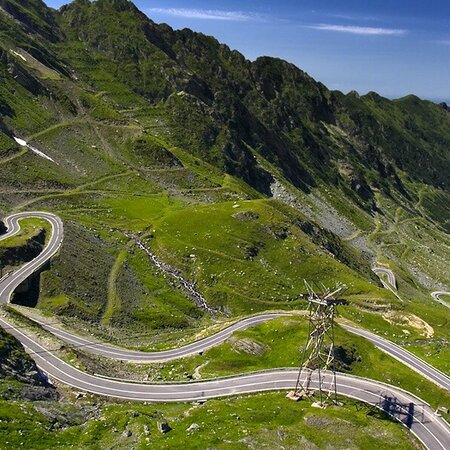
DN7C Transfăgărășan: Bascov (near Pitești) to Arpașu de Jos (near Sibiu)
151 km
100% paved

Twisty pass road with five tunnels, crash barriers present for most of the way

After rain
Fog and rockfall on the pass summit around Lake Bâlea
Realistic daily distance
Allow around 3 to 4 hours for the pass stretch; average speed is around 40 km/h because of the bends
Fuel stops
No filling station on the pass stretch itself, fill up beforehand
Passes
Bâlea Lac 2042 m, Bâlea Tunnel 884 m, Romania's longest road tunnel
Permits
none
2
DN67C Transalpina: Novaci to Sebeș
148 km
100% paved

Fully paved, open in season only during the day between 8am and 8pm, 30 km/h speed limit at the pass summit

After rain
Fog and wet surfaces on the hairpins above the tree line
Realistic daily distance
Allow at least 3 hours for the pass stretch
Fuel stops
No filling station on the pass stretch itself, fill up beforehand
Passes
Pasul Urdele 2145 m, Romania's highest road
Permits
none

Fuel and Range in Romania

Filling up isn't an issue on the main routes, but it is on the two high passes.

The filling-station network along the main roads is dense; major chains such as Petrom (OMV group), Rompetrol, MOL and Lukoil are rarely far apart. Super 95 (Benzină) and diesel (Motorină) are available nationwide, while Super 98 is mainly found in larger towns.

Along the actual pass stretch of the Transfăgărășan and the Transalpina, there isn't a single filling station. Filling up before the climb is essential, not just a recommendation, as both routes are long enough that a low tank becomes a real problem.

Payment by card works at the major chains almost everywhere; in rural areas and at smaller stations, cash is the safer option.

FuelAvailabilityNote
Super 95 (Benzină)Available nationwide on main roadsStandard for touring and enduro motorcycles
Super 98Mainly larger townsDon't factor it into stage planning away from towns
Diesel (Motorină)Available nationwideRelevant for support vehicles
Transfăgărășan / TransalpinaNo filling station on the pass stretchFill up before the climb

Safety on the Road in Romania

The biggest risk sits in road traffic, not crime; in the Carpathians, the wilderness adds another layer.

Romania is considered safe for travellers, and the usual caution in towns and cities is enough. The real risk is road traffic: Romania has one of the highest road death rates in the EU, mostly from risky overtaking manoeuvres on two-lane country roads. Ride with anticipation and only overtake with a clear view ahead.

The Carpathians are home to an estimated 10,000 to 13,000 brown bears, the largest population in the EU. In July 2025, a motorcyclist died in a bear attack on the Transfăgărășan. Keep your distance from the treeline at photo stops, never feed them, and if you're camping in the mountains, store food in a smell-proof container, kept away from where you sleep.

Check the current safety advice from the Federal Foreign Office before and during your trip.

Health and Vaccinations in Romania

No mandatory vaccinations, but the same insurance gap as almost everywhere: motorcycles over 125cc.

No mandatory vaccinations are required for Romania, but your standard vaccination cover should be up to date. In rural regions and the Carpathians, medical care is thinner on the ground than in the cities, so a first-aid kit belongs in your luggage.

Tap water is generally safe in the cities; in the countryside, bottled water is the safer choice.

0 / 5
Most travel and health insurance policies exclude riding motorcycles over 125cc. Check your policy before booking and, if in doubt, take out additional cover that explicitly includes motorcycling and repatriation.

Money and Payments in Romania

Romania is an EU country, but not a euro country. The leu is what settles the bill.

Payment is in Romanian Leu (RON); euros are rarely accepted outside tourist hotels. Card payment and cash machines are standard in cities; in the countryside and at smaller filling stations, cash is more reliable.

As an EU citizen, you may carry an unlimited amount of cash; it only becomes declarable at an equivalent value of EUR 10,000 at the EU's external border, not within the EU.

Internet, SIM and Navigation

As an EU citizen, you can use your home contract with no extra charge, though that won't help you at all on the pass summit.

As an EU/EEA citizen, Roam like at Home applies: your phone contract from Germany, Austria or another EU country works in Romania with no extra cost and your usual data allowance. For non-EU citizens, a local SIM card or eSIM from Orange, Vodafone or Digi Mobil is cheap and easy to get hold of.

Coverage is good in cities and along the main roads; in the Carpathians, especially on the pass summits of the Transfăgărășan and Transalpina, there are long stretches with no signal. Download offline maps of your route in advance.

Language, Culture and Riding Style

Romanian is a Romance language, closer to Italian than to the Slavic languages of its neighbours.

The official language is Romanian, a Romance language. In tourist regions and with younger people, you'll get by well with English; in the countryside, a few words of Romanian or French help. Transylvania is also home to Hungarian- and German-speaking minorities.

Hospitality is taken seriously; an invitation for a coffee or a palincă (fruit brandy) is meant sincerely. Romanian Orthodox holidays, above all Easter, which often doesn't fall on the same date as the Western calendar, shape the year, and on those days many shops and filling stations in the countryside are closed.

On riding style: overtaking on blind sections is one of the main causes of accidents in the country. Even if traffic behind you is pushing, stay restrained.

Packing List for Romania

Only what Romania adds on top; a general motorcycle packing list is assumed.

0 / 5

Photos from Romania

×

Send request

Adventure

How did you
hear about us?

Adventure truck Road path Palm tree
Ask a Route Expert

How do you want to travel?