Travel Information

Germany Travel Information for Motorcyclists

Everything you need for your Germany tour: entry rules, tolls, Alpine passes in the south, fuel and safety, from a rider's perspective.

View tours
Visa
EU/EEA/Switzerland: only an ID card or passport required, no visa needed
Other nationalities are often visa-free for up to 90 days in the Schengen area, depending on nationality
Passport validity
EU/EEA/CH: valid on the day of travel is enough. Other nationalities: valid for at least 3 months beyond the planned departure from the Schengen area, issued within the last 10 years
Best time to travel
May to September in the Alps, March to October in the rest of the country
Currency
Euro (EUR)
Time zone
UTC+1 (CET)
UTC+2 (CEST) from late March to late October
Side of the road
Drives on the right
Helmet & gear
Helmet required for rider and passenger; protective clothing is not a legal requirement
Main road
No central corridor needed, dense toll-free motorway network; the best-known route in the south is the German Alpine Road (Lindau to Berchtesgaden)
Fuel
Super E10/E5 (95 octane) and SuperPlus (98 octane) available nationwide, diesel everywhere
Int'l driving permit
Not needed for EU/EEA/Swiss licences; other nationalities should carry an International Driving Permit

What guests say about their trip to Germany

★★★★★

Matthias B.

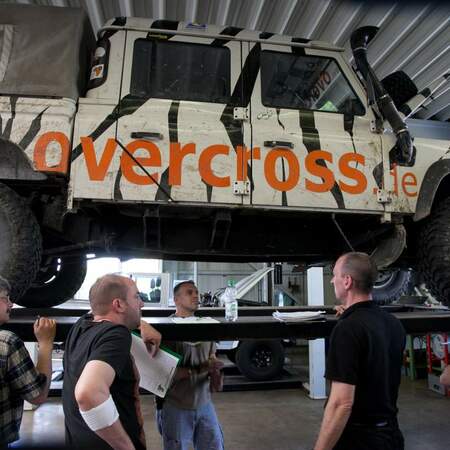
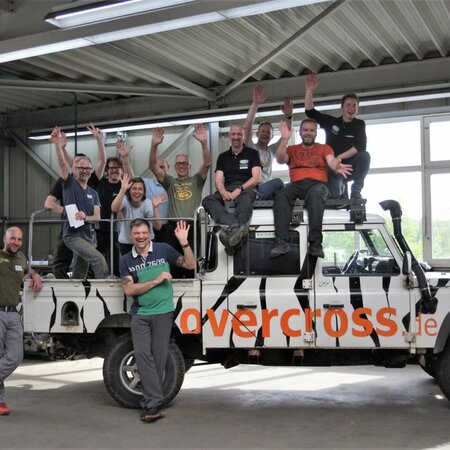
Die Gruppendynamik während des 4x4-Schrauberkurses in Deutschland war klar strukturiert, was den Lernprozess erleichterte. In der Maximalgröße von sechs Teilnehmern konnte jeder individuell betreut werden, während praktische Themen wie Sicherheitsaspekte eingeübt wurden.
★★★★★

Florian S.

Der OVERCROSS Busch-Schrauberkurs in Deutschland bietet eine klar strukturierte Organisation, die den 48-tägigen Workshop effektiv gestaltet. Die Teilnehmer erfahren praktische Schrauberei an Geländewagen, vor allem Land Rover Defender, und profitieren von einem umfangreichen Rahmenprogramm. Die Gruppengröße von maximal sechs Personen ermöglicht individuelle Betreuung durch den...

★★★★★

Markus R.

Der 4x4 Reparatur-Workshop in Deutschland bietet durch die maximale Gruppengröße von sechs Teilnehmern eine ausgewogene Gruppendynamik. Während der praktischen Lerneinheiten, wie dem umfassenden Reparaturkurs in der Landrover Werkstatt, konnte das Tempo gut angepasst werden, sodass alle Teilnehmer aktiv eingebunden waren und individuelle Fragen optimal angesprochen...

Best Time to Travel & Climate in Germany

Germany rides well from spring through autumn. In the south, altitude decides the season; in the rest of the country, it's mainly the rain.

6 Ideal
Best time to travel
May to October, Alps from May/June

The lowlands and coast ride well from March to October, with June to August the warmest and driest months. In the Alps and foothills, snow can linger on pass summits into May, so the season starts later there.

Region Jan Feb Mar Apr May Jun Jul Aug Sep Oct Nov Dec
Alpine region and foothills
Lowlands, low mountain ranges and coast
Ideal Doable Not passable

The season in Germany is shaped less by the map than by altitude. The lowlands and coast ride well from March to October, though the shoulder months bring more rain and cooler nights than high summer.

In the Bavarian Alps and the foothills, higher pass roads can still carry snow or leftover winter grit into April, and in some years into May. The classic season for Alpine passes there only starts in May and runs into October, with July and August the safest but also busiest months.

The third factor is rain. Germany has no pronounced dry-season pattern like Morocco, but autumn and winter are noticeably wetter than summer, and at higher altitude, rain in spring and autumn can quickly turn to sleet. Anyone riding into the Alps in spring or late autumn should plan daily stages flexibly and check the weather forecast for the pass summit, not just the valley.

Entry & Visa for Germany

EU citizens enter with their ID card. For other nationalities, passport validity is what matters most.

Citizens of the EU, the EEA and Switzerland enter with a valid ID card or passport; no separate visa is required. The document must be valid on the day of travel, and Germany does not require any minimum remaining validity from this group.

For nationals of many other countries, including the USA, the United Kingdom, Canada, Australia and New Zealand, entry for tourist stays of up to 90 days within any 180-day period is visa-free across the whole Schengen area. The passport must still be valid for at least three months beyond the planned departure from the Schengen area and must not be more than ten years old. Anyone planning a multi-week European tour with stops in several Schengen countries should count the 90-day limit across the whole trip, not just the German leg.

Travellers whose nationality requires a visa apply for a Schengen visa before departure at the relevant German mission. Check the rules that apply to your nationality well ahead of departure, most reliably directly with the German Federal Foreign Office or the German embassy in your home country.

Visa typeStayCostWhere to applyValidity
Visa-free (EU/EEA/Switzerland)Unlimited (freedom of movement)noneNo application needed, an ID card or passport is enoughOngoing validity of the ID document
Visa-free (Schengen agreement, e.g. USA, UK, Canada, Australia)Up to 90 days per 180-day periodnoneNo application needed, passport check on entry90 of 180 days across the whole Schengen area
Schengen visa (countries requiring a visa)Depends on visa type, usually up to 90 daysFee at the diplomatic missionGerman embassy or consulate in your home country, before departureAs stated on the visa
Own motorcycle (EU registration)UnlimitednoneNo registration needed, free movement of goodsOngoing registration and insurance
Own motorcycle (non-EU registration)Matches the rider's own staynoneCarry a Green Card or border insuranceTied to the length of stay

Bringing Your Own Motorcycle to Germany

For EU number plates, entry is a pure formality. It only gets relevant for vehicles registered outside the EU.

For motorcycles with EU or EEA registration, there are no formalities at the German border. Movement of goods within the EU is free, and a customs or import document such as a Carnet de Passages is not needed. You should still carry the original vehicle registration certificate part I (the Fahrzeugschein) and proof of third-party motor insurance.

With a motorcycle registered outside the EU/EEA (for example Switzerland, the United Kingdom or the USA), check with your insurer before departure whether your third-party cover is recognised in Germany, or whether you need a Green Card as international proof of insurance. Without valid proof of insurance, a check can mean a fine, and a claim can turn into a serious problem.

If you're riding a borrowed motorcycle that isn't registered to you, carry an informal authorisation from the owner, ideally bilingual or in English. It saves discussion at a traffic stop and also helps at the spot checks that have again been carried out at internal Schengen borders for the past few years.

Germany sits in the middle of the Schengen area, and the borders with Austria, Switzerland, France, the Netherlands, Belgium, Luxembourg, Denmark, Poland and the Czech Republic are normally not checked. A few countries have reintroduced stationary checks from time to time, so keeping your passport or ID card within reach always puts you on the safe side.

0 / 6
Germany asks for no customs or import document for EU number plates. That doesn't automatically apply to insurance: without recognised proof of third-party cover, you're not protected in the event of a claim, so clarify this before you leave, not at the border.

Driving Licence and Documents

An EU card licence is enough. For other nationalities, it depends on the agreement with the home country.

An EU category A card licence is recognised in Germany without any issue; an International Driving Permit is not required for EU, EEA or Swiss licences.

For licences from non-EU countries, recognition depends on the relevant agreement with Germany. An International Driving Permit (issued under the 1968 Vienna Convention) is usually the safer choice, and it is only valid together with the national licence.

Roadside police checks are rare in Germany and usually brief. You'll be asked for your licence, vehicle registration document and proof of insurance. Keep all three within easy reach, ideally in a waterproof folder.

0 / 6

Road Conditions & Riding in Germany

A dense, well-developed network with no tolls. The challenge isn't the road surface, it's the traffic and the speed.

The federal motorways (Autobahnen) are toll-free for motorcycles and cars, including foreign number plates. Only trucks over 3.5 tonnes pay a distance-based toll. Many motorway sections have no fixed speed limit; instead, an advisory speed of 130 km/h applies as a non-binding recommendation. Where a sign sets a speed limit, it is binding, and speed camera checks are common.

On rural roads outside built-up areas, the limit is 100 km/h unless signed otherwise, and 50 km/h within towns. At unsigned junctions, the right-of-way rule is priority to the right. The blood alcohol limit is 0.5‰, and for new riders on a probationary licence and under-21s, an absolute ban on alcohol at the wheel applies.

Motorcycles are exempt from the low-emission-zone sticker requirement and may enter every German low-emission zone without an emissions badge; that rule is for cars and motorhomes, not you.

Well-known, twisty routes such as the German Alpine Road in the south or the Black Forest High Road (B500) are popular with riders and correspondingly busy. On individual stretches of the B500, noise complaints from residents have led to periods of tighter speed enforcement, so check current signage on the spot.

1
German Alpine Road (Lindau to Berchtesgaden)
100% paved

Fully paved, very twisty, heavy tourist traffic in high season

After rain
A few sections in the Allgäu and Berchtesgadener Land get slippery with wet leaves and grit after rain
Fuel stops
Frequent all along the route
Passes
Several passes around 1000 to 1200 m, plus the toll Rossfeld Panorama Road near Berchtesgaden at around 1600 m
Permits
none
2
Rossfeld Panorama Road (eastern loop of the German Alpine Road)
100% paved

Toll road, open year-round according to the operator, highest point around 1600 m

After rain
Fog and visibility on this high road depend more on the weather than the road surface does
Fuel stops
No filling station on the road itself, Berchtesgaden before and after
Passes
Around 1600 m
Permits
Toll for motorcycles around EUR 6 (as of 2024, check on the spot)
3
Black Forest High Road (B500), Baden-Baden to Freudenstadt
100% paved

Popular, very twisty route through the northern Black Forest

After rain
Fog at higher elevations, otherwise not a concern
Fuel stops
Available along the route
Passes
none
Permits
Periods of tighter speed enforcement on individual stretches due to noise complaints from residents

Fuel, Filling Up and Range

Filling up is never an issue anywhere in Germany. The only decision is which fuel grade.

Germany's filling-station network is one of the densest in Europe; even off the motorway, the next station is rarely far away. Super E10 (95 octane, up to 10% bioethanol) is the standard grade, with Super E5 (also 95 octane, maximum 5% bioethanol) sold alongside it. If you're riding an older or sensitive motorcycle that the manufacturer says can't take E10, fill up with Super E5 or SuperPlus at 98 octane.

Diesel is available everywhere, relevant for support vehicles.

Payment by card works at almost every filling station, and contactless is standard. You practically never need cash to fill up in Germany, unlike many other countries in this series.

FuelAvailabilityNote
Super E10 (95 octane)Available nationwide, standard gradeUp to 10% bioethanol, not suitable for every older motorcycle
Super E5 (95 octane)Available nationwide alongside E10Maximum 5% bioethanol, usually the safer choice for older engines
SuperPlus (98 octane)Available nationwide, often a bit more expensiveRecommended for high-compression engines
DieselAvailable nationwideRelevant for support vehicles

Safety on German Roads

Germany is one of the safest countries to travel in Europe. On the road, the biggest risk is more likely to be you than anyone else.

Germany is considered a very safe country for travellers, and crime aimed at tourists is rare. The usual care with valuables in busy places is enough.

The real risk lies in road traffic, especially on the twisty roads of the low mountain ranges and the Alps, where a lot of motorcycles are out on weekends. Ride defensively, expect oncoming traffic on narrow sections, and watch for cyclists and walkers at popular viewpoints.

The emergency numbers 110 (police) and 112 (fire brigade and ambulance) are the same right across the country, free of charge, and reachable around the clock, even without credit on your phone.

Health and Insurance

No mandatory vaccinations, and medical care is of a high standard. The catch is the motorcycle clause in some policies.

No mandatory vaccinations are required to enter Germany. Medical care is available nationwide and of a high standard, including in rural regions.

EU citizens use the European Health Insurance Card (EHIC) on the back of their insurance card for statutory treatment. Travellers from non-EU countries need private travel health insurance, as their home country's statutory scheme generally doesn't pay out in Germany.

0 / 4
Many travel and health insurance policies exclude riding motorcycles over 125cc or require an add-on. Check your policy before the trip, not only once you need to make a claim.

Money, Payments & Costs

The euro is standard everywhere, cards are accepted almost everywhere, but a little cash never hurts.

Payment is in Euros (EUR). Card payment, including contactless, is standard in hotels, restaurants and at filling stations. Small inns, mountain huts, or some parking machines in rural regions occasionally still take cash only, so you should always carry a few euro notes.

Internet, SIM & Navigation

Mobile coverage in Germany is good, but not complete. It can drop out in forests and narrow valleys.

With a SIM card or eSIM from an EU/EEA country, roaming works as it does at home, with no extra cost within the EU. Travellers from outside the EU are best off getting a local prepaid SIM or eSIM, available at airports, in supermarkets and from the major providers.

Coverage is good compared with many countries, but there are real dead zones in densely forested low mountain ranges such as the Bavarian Forest, the Black Forest, or in narrow Alpine valleys. For longer off-road or forest stages, an offline-saved map is worth having as a fallback.

Culture & Road Behaviour

Germany is straightforward, but it has clear rules, especially around noise.

The official language is German; in tourist regions and at filling stations, English usually gets you by. German road users generally stick strictly to rules and signage, and that applies among motorcyclists too.

Motorcycle noise is a genuine issue in popular twisty regions such as the Black Forest: resident initiatives and some federal states have for years pushed for restrictions on noise-heavy stretches, and some sections see targeted enforcement. Ride gently through towns and past housing, especially on Sundays and public holidays, when the so-called Sunday quiet rule is taken particularly seriously in many communities.

Packing List for Germany

Only what Germany adds on top. A general motorcycle packing list is assumed.

0 / 5

Photos from Germany

×

Send request

Adventure

How did you
hear about us?

Adventure truck Road path Palm tree
Ask a Route Expert

How do you want to travel?