At a glance Contents
What makes the Llogara Pass special
If you head south from Vlora towards Dhërmi and Himara, you can't avoid the Llogara Pass. The SH8 climbs from sea level into Llogara National Park, crosses the ridge at a good thousand metres and drops back down to the coast on the other side. In between you find pines, rock faces and bends that open up bit by bit, until the Ionian Sea appears below you.
What makes it special is the contrast. Heat and salt air at the bottom, cool forest higher up, then the moment when the trees end and the coast lies spread out before you. For many riders, this is the moment when Albania stops being a country you pass through and becomes a destination.
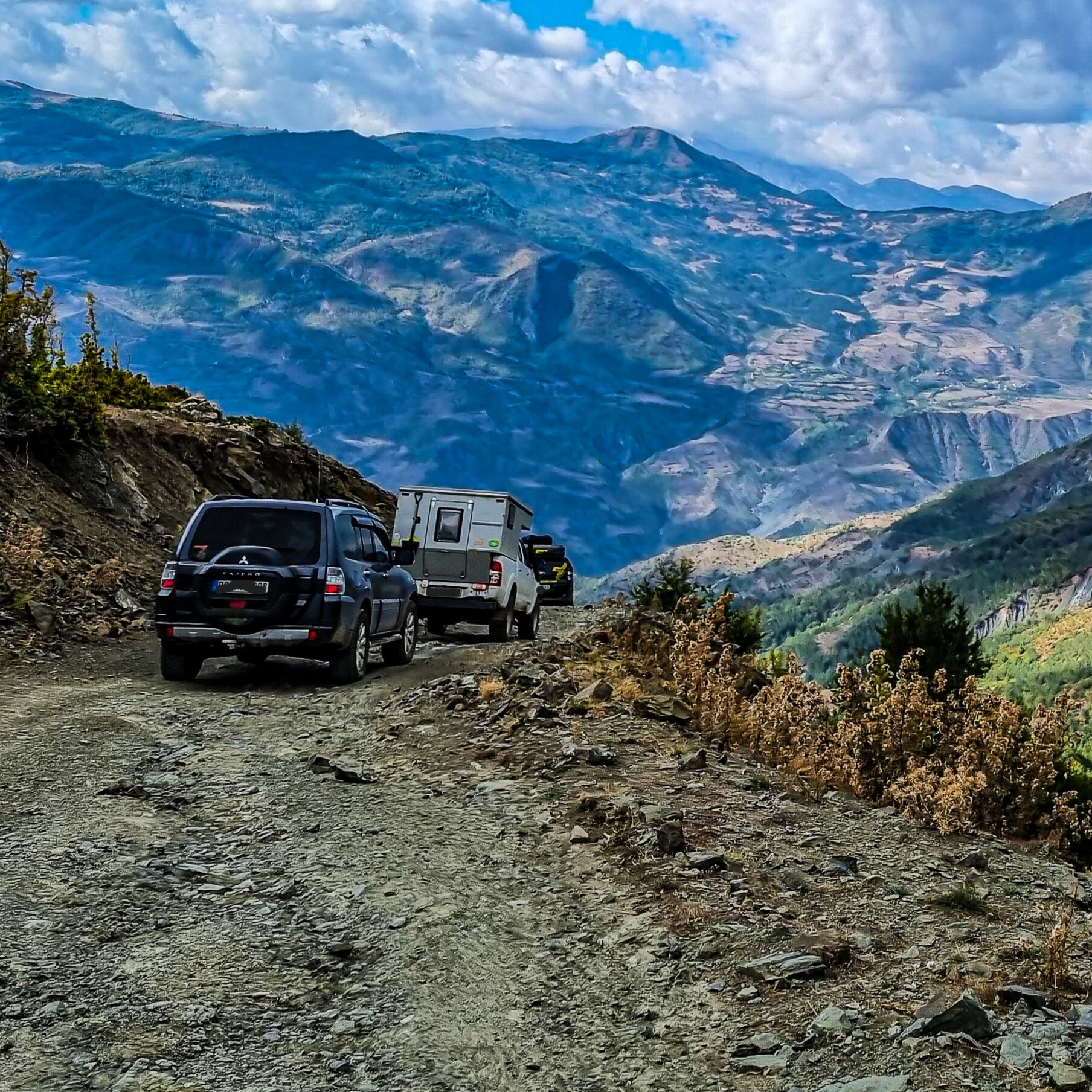
One note up front: the pass is paved and forms part of the coast's main route. This is not about dirt tracks, but about riding technique on tight hairpins and staying alert in traffic. That is exactly why many people see it as a good warm-up for what Albania demands away from the coast.
Don't plan the pass as an obligation between two hotels, but as a stage of its own in your day. If you rush it, you only see asphalt and brake lights. If you take your time, you get one of the most beautiful crossings on the Adriatic coast, with breaks in the forest, coffee at the roadside and a view you won't forget.
The road: hairpins, traffic, condition
The bends are tight, the road is narrow in many places, and there are no guardrails everywhere. Expect trucks, coaches, rental cars with unsure drivers and animals on the road. Goats and cows are part of the traffic in Albania, the way cyclists are elsewhere.
The surface changes. There are good sections, then patches, cracks and loose gravel in the bends, especially after rain. That is exactly where we see the most common mistake: if you enter a hairpin too fast, you only notice on the gravel that your line no longer works.
- Downhill: Use engine braking, don't keep pulling the brake. In vehicles with an automatic, select a low gear.
- Middle of the bend: Oncoming traffic likes to cut the corner. Keep to the right and look far out of the bend.
- Viewpoints: Stop only at marked pull-offs, never directly behind a hairpin.
- Fuel: Petrol stations are plentiful on the coast and in the towns, but patchy in the mountains. Set off with a full tank.
Helmets are compulsory for motorcyclists, protective clothing is not required. Wear it anyway: the asphalt is hard and help is far away. You can find the current information on entry, driving licence and insurance in the travel information for Albania.
How to ride the hairpins cleanly
A hairpin is a small riding-technique topic that keeps repeating. If you ride the first bends right, you ride the rest relaxed. If you ride them wrong, you are tired by halfway.
Brake before the bend, not in it. You enter at a calm speed, look early towards the exit and only get back on the throttle there. On a motorcycle that means: head up, upper body loose, knees against the tank. In an off-road vehicle it means: smooth steering, no hectic corrections, and distance to the vehicle ahead so that you don't suddenly come to a stop.
In every bend, expect what you can't see. Behind the crest there may be a truck, a tractor, a cow. The question is never whether something is coming, but whether you will still have room when it does. And let others pass. Nobody wins anything on the Llogara Pass by racing rental cars.
After the first bends you usually find a rhythm, and that is the right moment for a short break at the ridge. Drink something, look at the sea, let go of the bars. The descent to the coast demands much more of your brakes and concentration than the climb.
Check your vehicle before you start: brake pads, brake fluid, tyres, coolant. On the way up the engine works, on the way down the brakes do. If you skimp here, you notice in the third bend, and then it is too late.
Best season and best time of day
The good season for Albania is May to June and September to October. That applies to the Llogara Pass too. In early summer the forest is green, the air is clear and the coast is not yet crowded. In autumn the sea is warm, the heat eases off and the light is softer.
In high summer the pass is busy and hot. Columns of traffic crawl up the hairpins, cooling and brakes are put to the test, and you ride in a traffic jam instead of in a rhythm. In winter and in rain the ridge can be wet, slippery and foggy.
The time of day often matters more than the season. Set off early. Then you have little traffic, good light for the view and no sun blinding you in the bends. In the late afternoon the coast lies in backlight, which is lovely to look at but tiring to ride.
The Llogara Pass as part of an Albania trip
The pass is not a destination in itself, but the gateway to the Riviera. Most people who ride it want to continue south, to Dhërmi, Himara and the beaches. One of our Albania tours ends there too, and that is no coincidence: after the tracks in the north and in the highlands, the coast is the calm finale.
We don't list the Llogara Pass as a fixed stage of a tour, so that no false impression arises. But the routes we ride lie in the same landscape and demand the same attention:
- Albania Off-Road Round Trip, Land of the Eagles: seven days, from 1299 euros, small group of up to six people, Theth, Lura National Park and Tomorri. A tour for beginners on the track.
- Albania 4x4 Off-Road Adventure Trip: ten days, from 1999 euros, up to eight people, with Lake Koman, the Osum Canyons and the Riviera at the end.
- Balkans 4x4 Off-Road Tour Albania and Greece: ten days, from 1999 euros, with the Dajti mountain pass, the Osum Canyon and nights in a guesthouse or camp.
The advantage of a guided trip: you don't have to decide alone when a route is firm, dry and empty. The guide on site takes care of that, and you concentrate on your line.
Answered briefly
Frequently asked questions
- Is the Llogara Pass paved?
- Yes, the Llogara Pass is part of the paved SH8 coastal road. The surface is not equally good everywhere, though. Expect patches, cracks and loose gravel in the hairpins, especially after rain.
- When is the best time for the Llogara Pass?
- May to June and September to October are the most pleasant. It is then less hot and less crowded than in high summer. Also set off early in the day, when you have little traffic and good light.
- How difficult is the Llogara Pass by motorcycle?
- Not technically difficult, but demanding because of tight hairpins, a changing surface and oncoming traffic in the bends. If you ride calmly, keep to the right and leave reserves in your brakes, you will get through well.
- Are there petrol stations along the way?
- On the coast and in the towns petrol stations are plentiful, but in the mountains they are patchy. So start up the pass with a full tank and plan your next stop in Vlora or on the coast.
- Where do I find information on entry and driving licence?
- Everything on entry, driving licence and insurance is currently in our travel information for Albania at overcross.com/reiseinformation/albanien. We keep it up to date, so we don't repeat these points here.