Travel Information

Tanzania: best time to visit, entry, travel facts

Which animals you see in which month, what the Serengeti climate does across the year, and what to settle before entering with your own motorcycle: visa, import, tracks.

View tours
Visa
Visa required, e-visa online or visa on arrival, 50 USD single entry, 90 days
Passport photo and proof of onward travel required for the online application
Passport validity
Valid for at least 6 months from entry, with at least one blank page
Best time to travel
June to October, plus January/February
Currency
Tanzanian Shilling (TZS), approx. 1 USD = 2,500 TZS
USD notes only in pristine condition, none printed before 2009
Time zone
UTC+3, no daylight saving year-round
Side of the road
Drive on the left
Helmet & gear
Helmet mandatory by law only for the rider, not regulated for the passenger
Main road
T2/T5 paved between Namanga, Arusha and Dodoma; tracks to the Serengeti/Ngorongoro only with a guide in a safari vehicle
Fuel
Unleaded 95 widely available on the main route, reserve canister recommended for park access roads
Int'l driving permit
International driving permit under the 1949 Geneva Convention, recognised for up to 90 days

Which Animals You See in Tanzania, Month by Month

The dry season from June to October gathers the animals at the water, the rains bring calves and the migration to the southern Serengeti: which park pays off in which month.

Tanzania has two rainy seasons and one long dry season, and for game viewing it is water that counts. From June to October the Serengeti gets rain on 2 to 6 days a month, the grass is short and yellow, and the animals gather at rivers, waterholes and swamps. You see more animals per game drive then than in any other month, because visibility is long and elephants, buffalo and antelope have to come to the water every day.

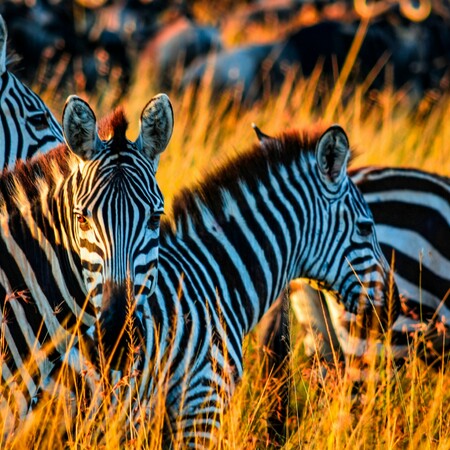
The Great Migration is the event the calendar is built around. Around 1.5 million wildebeest and about 250,000 zebra move clockwise through the Serengeti ecosystem over the year. From December to March the herds stand on the short-grass plains in the south around Ndutu and in the Ngorongoro Conservation Area; from late January into February around 400,000 calves are born there within about 3 weeks, and lions, hyenas and cheetahs follow them. In April and May the herds move north-west into the Western Corridor under heavy rain, in June and July they cross the Grumeti. From July to October they stand in the north at the Mara River, and the river crossings with crocodiles are most frequent in August and September. In November they return south with the short rains.

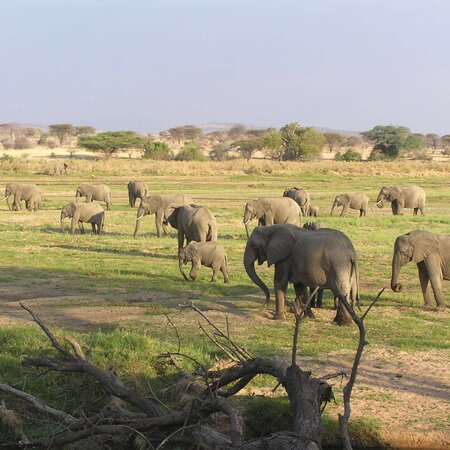
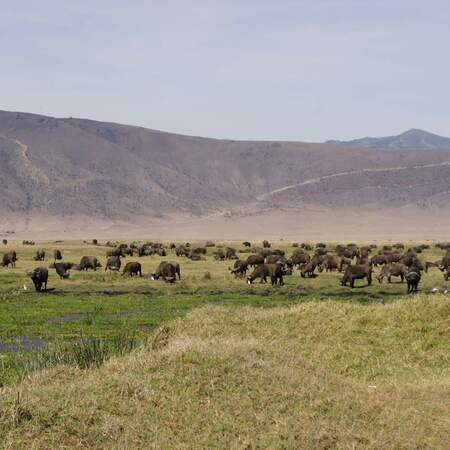
The Ngorongoro Crater works all year round, because the animals hardly ever leave the 260 km² crater floor: about 25,000 large mammals, among them around 30 black rhino, are there on every day of the year. In the rains from March to May the crater floor turns muddy and the drive is slower, but the view of the animals stays. Tarangire, by contrast, is a dry-season park: from July to October up to 3,000 elephants stand along the Tarangire River, while in the rains the herds spread out into the Maasai steppe outside the park and you see far fewer.

In the south, in Nyerere and Ruaha, the dry season from June to October is the only reliable time; in April and May many camps close because the tracks are under water. If you want birds, come between November and April: the European migrants are in, and more than 500 species are about in the Serengeti.

Region Jan Feb Mar Apr May Jun Jul Aug Sep Oct Nov Dec
Southern Serengeti (Ndutu, calving season)
Northern Serengeti (Mara River, crossings)
Ngorongoro Crater
Tarangire (elephants at the river)
The south: Nyerere and Ruaha
Best sightings Good chances Few sightings

Motorcycle Tours Through Tanzania

Guided tours through the Serengeti, Ngorongoro and on to Zanzibar - as a leg of an East Africa trip or the great Trans-Africa expedition.

Safari Tanzania: view all tours

What guests say about their trip to Tanzania

★★★★★

Martin M.

Die Organisation der Tansania Safari in Sansibar und Ngorongoro-Krater war nachvollziehbar und klar strukturiert. Die täglichen Aktivitäten, wie die Erkundung der historischen Steinstadt am ersten Tag und die geführte Safari in der Serengeti, waren gut durchdacht. Die maximale Gruppengröße von 20 Personen trug zur effizienten...
★★★★★

Robert F.

Die Organisation der Afrika Gruppenreise war durchweg klar strukturiert. Die täglichen Briefings vor den Touren in der Serengeti und die Reiseführer, die die Safarifahrzeuge begleiten, sorgten für einen reibungslosen Ablauf. Das Camping und die Unterbringung in Apartments waren gut koordiniert, was zur positiven Gruppendynamik beitrug.

★★★★★

Michael H.

In Tansania führt die Tour durch den Tarangire Nationalpark und den Ngorongoro Krater. Die Routenplanung ermöglicht eine ausgewogene Verteilung von Fahrten und Erkundungen. Die Tage im Serengeti mit Wildtierbeobachtungen wurden sinnvoll kombiniert mit Aufenthalten im Arusha Nationalpark, was die Reise abwechslungsreich gestaltete.

Serengeti Climate: Temperatures and Rain Through the Year

The figures are for the central Serengeti around Seronera at about 1,500 m, the core of the northern circuit. The altitude keeps temperatures in a narrow band all year: 26 to 29 °C by day, 12 to 15 °C at night, with no real summer or winter. What separates the months is the rain. The long rains from March to May bring 11 to 17 rain days a month, mostly as afternoon thunderstorms, rarely as all-day rain; the short rains in November and December about 12 days. January and February are a dry spell in between, but still with 9 rain days. From June to October it rains on 2 to 6 days, humidity drops below 60 %, and the sun shines 9 hours a day.

Two departures from the table you need to plan for: on the Ngorongoro crater rim at 2,300 m the thermometer drops to 5 to 8 °C in the early morning from June to August, and fog often sits until 9 am. On the coast and on Zanzibar the daytime high from December to March is 32 to 33 °C with 80 % humidity, and the coolness of the plateau is missing entirely.

Month Max °C Min °C Rain days Humidity % Sun hours
Jan Dry season 29 15 9 62 8
Feb 29 15 9 62 8
Mar Wet season 28 15 13 68 7
Apr 27 15 17 75 6
May 26 14 11 72 7
Jun Dry season 26 13 3 62 9
Jul 26 12 2 58 9
Aug 27 13 3 56 9
Sep 28 14 4 55 9
Oct 29 15 6 58 8
Nov Wet season 28 15 12 66 7
Dec 28 15 12 68 7

Best Time for Track Access in Tanzania

Two rainy seasons decide whether the tracks to the Serengeti and Ngorongoro are rideable.

7 Ideal
Best time to travel
Jun-Oct, plus Jan/Feb

Dry season from June to October, plus the short dry spell in January/February - Serengeti and Ngorongoro tracks are rideable throughout then.

Region Jan Feb Mar Apr May Jun Jul Aug Sep Oct Nov Dec
Northern Route: Arusha - Serengeti - Ngorongoro - Zanzibar
Ideal Doable Not passable

Tanzania has two rainy seasons in the north: the long rains from March to May and the short rains from November to December. For the track, the long rains matter most - the red laterite tracks in the Serengeti and Ngorongoro turn into mud within hours, at times impassable even for 4x4s, and the steep crater rim road to Ngorongoro becomes so slippery when wet that it is temporarily closed. Many camps in the parks close in April as a result. The short rains in November/December are milder: short, heavy afternoon showers, after which the tracks usually dry out again overnight - rideable, but with a buffer built into the day's plan. The best time for firm daily stages is the long dry season from June to October, when the tracks are hard and grippy, plus the short dry spell in January/February between the two rainy seasons. The paved part of the route - Namanga, Arusha, the road to Moshi and on to the coast - is rideable year-round regardless of rain.

Best time to go, depending on what you are after

Seeing animals: June to October

The dry season is the most reliable time for every park on the northern circuit: short grass, animals at the water, 2 to 6 rain days a month. For the migration crossings at the Mara River, August and September are the months with the most crossings, for elephants in Tarangire July to October. If you want the calving season, go to the southern Serengeti around Ndutu from late January into February.

If you cope badly with heat: June to August

On the plateau it rarely gets warmer than 26 °C by day in these months, humidity stays below 60 %, and nights cool to 12 to 13 °C. On the crater rim you need a jacket in the morning. Avoid the coast and Zanzibar between December and March, when 33 °C and 80 % humidity come together, and October, the hottest and dustiest month in the Serengeti.

The most popular time: July to October

Most visitors come between July and October, plus the two weeks around Christmas. The Ngorongoro Crater limits time on the crater floor to 6 hours per vehicle, and at the crossing points on the Mara River more than 20 vehicles often wait in August. Serengeti lodges are frequently fully booked for August 6 to 12 months ahead. If you want quiet and still the dry season, take June or the first half of October.

Birds and green landscape: November to April

With the short rains in November the migrants from Europe and Asia arrive, and until April more than 500 species are about in the Serengeti, many in breeding plumage. The plains are green, the air is free of dust, and the short-grass plains around Ndutu are full of wildebeest with calves. The price: 9 to 17 rain days a month, on the plateau mostly as afternoon storms, on the coast muggy.

Photographers: February for predators, September for rivers

In February the wildebeest herds stand with their calves on the short-grass plains around Ndutu, the predators are active and the air is clear after rain, with clouds instead of haze. In September river crossings, elephants and cats concentrate in the north and in Tarangire, the light is hard and the sky mostly cloudless. Plan for the early hours: from 6:30 to 9 am the light is low and the animals are moving, from 11 am the air shimmers over the plains.

Visa and Entry into Tanzania

Anyone travelling to Tanzania needs a visa - there is no exception for EU citizens.

German, Austrian and Swiss nationals need a visa for Tanzania, however short the stay. The simplest route is the e-visa through the official portal visa.immigration.go.tz: single-entry tourist visa, 50 USD, valid for up to 90 days, processing usually takes 2 to 10 working days. A multiple-entry visa costs 100 USD and is worthwhile for anyone leaving and re-entering via Kenya or Uganda during the trip. Alternatively, the visa is available on arrival at the major airports and the main land borders under the same conditions, but with a wait and cash payment only. Your passport must be valid for at least 6 months at entry and have a blank page for the stamp. The online application requires a passport photo with a white background, proof of onward travel (a return or connecting flight ticket) and often a hotel booking or invitation letter. A yellow fever vaccination is not mandatory for direct entry from Europe, but is required on entry from a yellow fever endemic country or after more than a 12-hour stopover there - check carefully which country currently counts as endemic if arriving via an East African hub.

Visa typeStayCostWhere to applyValidity
Tourist visa, single entry (e-visa)up to 90 days50 USDonline in advance, visa.immigration.go.tz90 days from entry
Tourist visa, multiple entryup to 90 days per entry100 USDonline in advance12 months
Visa on Arrivalup to 90 days50 USD (cash, USD)Dar es Salaam/Kilimanjaro/Zanzibar airports, major land borders (e.g. Namanga)90 days
Transit visaup to 7 daysapprox. 30 to 50 USDonline or on arrivalsingle transit
Own motorcycle - temporary import1 month per certificate, extendable17 USD/month plus vehicle third-party insurance 22 USD/3 monthsat the border, cash in USD1 month, then reissue

Entering with Your Own Motorcycle

Carnet or border paper, COMESA insurance, power of attorney - what Tanzanian borders really ask for.

A Carnet de Passages is not mandatory for Tanzania: at the main borders - above all Namanga from Kenya and Tunduma from Zambia - a temporary import permit bought on the spot for around 17 USD per month, extendable, is enough in practice. A Carnet is still worthwhile for anyone continuing through several countries with stricter procedures, because it guarantees the same process at every border. Third-party vehicle insurance is mandatory in any case: the COMESA Yellow Card is valid in Tanzania and most neighbouring countries and costs around 22 USD for three months at the border; without it, nobody gets through customs clearance. Carry the vehicle registration document (or a certified copy), passport and international driving permit. If someone rides a motorcycle not registered to them - borrowed, rented in a neighbouring country, or belonging to a travel companion - a written, ideally notarised power of attorney from the owner is needed; without it, some border posts refuse onward travel. The common crossings work reliably: Namanga (Kenya), Holili and Horohoro (Kenya, coast), Tunduma (Zambia), Kasumulu (Malawi) and the ferry to Zanzibar are regularly used by overlanders and have fixed, well-known fees. Smaller border posts in the west (Congo, Rwanda, Burundi) are less predictable in opening hours and formalities - plan a day of slack there. Anyone only riding the classic northern route Arusha-Serengeti-Ngorongoro-Zanzibar should note: the national parks on this route are visited exclusively by 4x4 with a ranger, and your own motorcycle stays parked in Arusha or Karatu.

0 / 7
Only clean, undamaged US cash counts at the border - creased or old notes (pre-2009) are regularly refused at Tanzanian border posts, even if the exchange rate is right.

Driving Licence and Papers on the Road

What traffic police at checkpoints on the road actually want to see.

The international driving permit under the 1949 Geneva Convention is recognised in Tanzania and covers the first 90 days in the country - after that, a Tanzanian licence would officially be needed, which in practice never comes up on a motorcycle trip. Without an IDP, a foreign driving licence does not automatically apply, even in EU card format. On the road, traffic police check driving licences and vehicle papers by spot check, and at larger checkpoints also electronically through the Tanzania Revenue Authority's system. The passport alone is not enough as proof - you will be asked for the licence and import papers. Helmets are a legal requirement only for the rider, not the passenger; on a guided tour, everyone wears a helmet regardless of the legal position.

0 / 3

Roads and Tracks on the Northern Route

From the paved highway to the red laterite track - what waits on each section of the route.

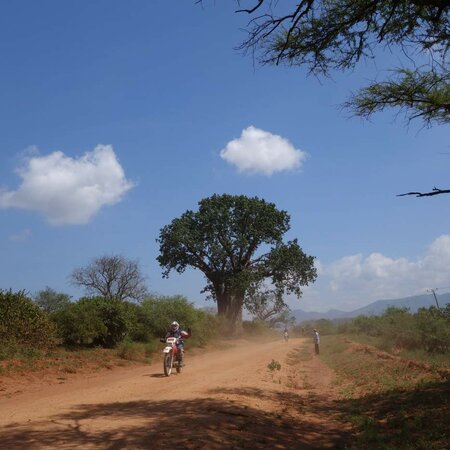
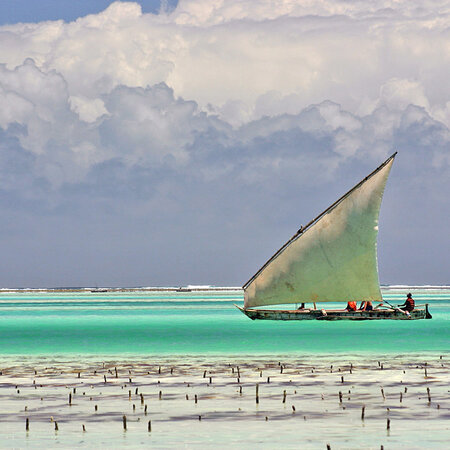
The tourist route essentially follows the north-east axis: a paved highway from the Kenyan border at Namanga via Arusha and on to the coast, with unpaved access roads to the Serengeti and Ngorongoro in between. On the highway (T2/T5, part of the Cairo-Cape Town route), long daily stages of 250 to 300 km are realistic, the surface is mostly good, with speed bumps before every village and dense truck traffic around the Chalinze junction. The laterite tracks from Makuyuni towards the Serengeti are rideable in the dry season but dusty and corrugated - time matters more than distance here. Inside the Serengeti and Ngorongoro, game drives are only permitted with licensed safari vehicles and a guide, and your own motorcycle stays safely parked at camp or in Arusha in the meantime. Anyone continuing from the northern route to the coast rides through to Dar es Salaam and takes the car ferry to Zanzibar from there; it occasionally cancels in rough seas during the long rains (March to May), so a buffer day before the flight home is worthwhile.

1
T2 Namanga - Arusha
105 km
100% paved

Paved, part of the Cairo-Cape Town highway, well maintained but with speed bumps before towns

After rain
No problem, rideable year-round
Realistic daily distance
100 to 150 km
Fuel stops
Every 20 to 30 km
Passes
none
Permits
none
2
Arusha - Serengeti National Park (Naabi Hill Gate)
145 km
20% paved 70% gravel 10% sand

Unpaved laterite track from Makuyuni, rideable in the dry season, dusty, corrugated

After rain
Muddy and at times hard to pass, arrival can be delayed by hours
Realistic daily distance
120 to 150 km, slower than the pure distance suggests due to corrugation and potholes
Fuel stops
Last reliable fuel station before the park gate in Mto wa Mbu, none after that
Passes
none
Permits
Serengeti entry approx. 70 USD/person/24h, cash in USD only
3
Serengeti - Ngorongoro crater rim
145 km
90% gravel 10% sand

Unpaved tracks inside the protected areas, only with 4x4 and guide (motorcycles not permitted in the park)

After rain
Temporarily closed in heavy rain, crater rim road becomes slippery
Realistic daily distance
80 to 120 km at the park speed limit (50 km/h, 25 km/h inside the crater)
Fuel stops
No fuel station inside the protected area
Passes
Crater rim approx. 2,200 m
Permits
Ngorongoro fee approx. 71 USD/person plus 295 USD crater descent per vehicle
4
Karatu - Moshi (via Mto wa Mbu)
155 km
90% paved 10% gravel

Mostly paved, winding at the foot of the Ngorongoro highlands

After rain
Occasional water damage to the tarmac, otherwise unproblematic
Realistic daily distance
150 to 180 km
Fuel stops
Every 30 to 40 km
Passes
no notable altitude
Permits
none
5
Moshi - Dar es Salaam (T2/T5 via Chalinze)
480 km
100% paved

Paved throughout, part of the Cairo-Cape Town route, heavy truck traffic around Chalinze

After rain
No problem
Realistic daily distance
250 to 300 km, a manageable long stage
Fuel stops
Every 20 km, closely spaced
Passes
none
Permits
none

Fuel Between the Highway and the Parks

Where the network ends and a reserve canister really becomes necessary.

On the paved main route - Namanga, Arusha, Moshi, the road to Dar es Salaam - fuel station density is good, usually every 20 to 30 km, with unleaded 95 and diesel available everywhere. On the way to the Serengeti and Ngorongoro, the dense network ends in Mto wa Mbu: this is the last reliable fuel station before the park gate, and there is none inside the protected areas after that. A reserve canister of 5 to 10 litres covers the distance to the next camp. Larger stations take card payment, rural areas are cash-only in Tanzanian shillings - bring small notes, since small stations rarely give change. Fuel quality on the main routes matches European standards; at very remote outlets, be prepared for contamination in the tank.

GradeOctaneAvailability
Unleaded petrol95Closely spaced on the main route, last station before the Serengeti in Mto wa Mbu
Diesel-Available throughout the main route
Reserve canister-Recommended for the Serengeti/Ngorongoro access road, 5-10 litres

Safety and Emergency Numbers

Emergency numbers work reliably - but not everywhere in the country.

The nationwide emergency numbers are police 112, ambulance 114 and fire brigade 118 - they work reliably in Dar es Salaam and larger towns, while in rural areas and especially around the Serengeti/Ngorongoro network coverage is patchy and the numbers do not connect everywhere. A state ambulance service exists in effect only in the big cities; away from them, the lodge or safari company usually organises transport in an emergency, often by private vehicle. That is why overseas health insurance with a repatriation clause (evacuation flight) belongs in the basic kit, not just standard travel insurance. Traffic police check driving licence, vehicle papers and speed at fixed and mobile posts; radar checks are common on the highways, with fines between 20,000 and 100,000 TZS demanded on the spot.

Health and Vaccinations

High-risk malaria area along the whole route, yellow fever only relevant for transit.

All of Tanzania below 1,800 m - including the entire route, Zanzibar included - counts as a high-risk malaria area, with transmission highest between November and May. Malaria prophylaxis after medical advice (atovaquone/proguanil, doxycycline or mefloquine) belongs on every Tanzania trip. A yellow fever vaccination is not mandatory for direct entry from Europe, but becomes mandatory on entry from a yellow fever endemic country or after more than a 12-hour stopover there. Tap water is not recommended anywhere in the country; bottled water is available everywhere.

0 / 5
Standard overseas travel insurance usually does not cover riding a motorcycle over 125cc, or only for an extra charge - check before the trip whether your own policy covers the engine size you are riding, not only after a claim.

Money and Payment on the Road

Cash rules outside the big cities, USD notes are needed only for fees.

The national currency is the Tanzanian Shilling (TZS), trading around 1 USD = 2,500 TZS. ATMs are reliably available in Arusha, Dar es Salaam, Moshi and Stone Town, but not in the national parks or at the lodges - withdraw cash for the safari days beforehand in town. Cards are accepted in lodges and larger hotels, often with a 3 to 5% surcharge; on the road in the countryside, only cash counts. Park and border fees are demanded exclusively in clean, newer US dollar notes - nothing printed before 2009, and no creased or torn notes.

What to pay withNote
Park and border feesCash in clean USD notes only
Lodges/hotelsCard usually possible, 3-5% surcharge
Fuel stations, main routeCard or TZS cash
Countryside/villagesTZS cash only, small notes

Mobile Network and Internet

Good coverage on the highway, clear gaps inside the protected areas.

Vodacom has the best network around Arusha and Kilimanjaro; inside the Serengeti itself, other providers reportedly perform somewhat better according to traveller reports. Coverage inside the protected areas and on the tracks between them is patchy to non-existent, while the coast and Zanzibar have good coverage. A local SIM card is cheap and available at airports and in any larger town; an eSIM can be activated online in advance. Card payment in lodges depends on the same network coverage - when there is no signal, the card terminal does not work either, another reason to carry enough cash.

Culture and Behaviour on the Road

Ramadan on the coast, photo permission with the Maasai, the horn as communication.

Tanzania is majority Muslim on the coast and Zanzibar, mixed Christian and traditional inland. During Ramadan, visitors on Zanzibar and the coastal towns are expected not to eat, drink or smoke in public during the day - many restaurants outside hotels close until sunset. Only photograph people, especially in Maasai villages, with explicit permission; a small fee is often expected on the spot for this, which is normal and part of the visit. Traffic drives on the left; hand signals and horn signals are used generously - a short horn before bends and villages is customary, not a sign of impatience. Helmets are a legal requirement only for the rider, but on guided tours everyone wears one for safety.

What Tanzania Additionally Requires

The gap between your normal travel gear and what this route specifically needs.

0 / 6

Photos from Tanzania

Joe Küster
Author
Joe Küster
Founder & Creative Engine of Overcross

"Jack of all trades, almost all!" The driving force and idea machine behind Overcross.

Languages: de, en
×

Send request

Adventure

How did you
hear about us?

Adventure truck Road path Palm tree
Ask a Route Expert

How do you want to travel?