Travel Information

Kenya: best time to visit, entry, travel facts

When Kenya has safari weather: dry seasons, the migration in the Masai Mara, climate month by month. Plus the eTA, entering on your own motorcycle and the tracks in the rains.

View tours
Visa
eTA required before departure, apply online at etakenya.go.ke, 30 USD, multiple entry available for up to 5 years / 90 days per stay
Officially 3-5 working days to process, usually 24-72 hours - apply at least a week ahead
Passport validity
Valid for at least 6 months beyond your planned departure date, with at least one blank page
Best time to travel
Dry seasons January/February and June to September
Currency
Kenyan Shilling (KES)
Time zone
UTC+3 (EAT), no daylight saving
Side of the road
Drive on the left
Helmet & gear
Helmet mandatory by law for rider and passenger
Main road
A104 Nairobi-Nakuru-Eldoret and A109 Nairobi-Mombasa are paved; off these roads expect red laterite tracks and black cotton soil
Fuel
Reliable along the main routes; plan for longer distances between stations off the A-roads
Int'l driving permit
Not mandatory, but recommended as an official translation of your driving licence
Kenya generally recognises foreign driving licences; an IDP under the 1968 Vienna Convention avoids discussions at checkpoints when your licence is not in English

Safari Season in Kenya: Dry Season or Green Season

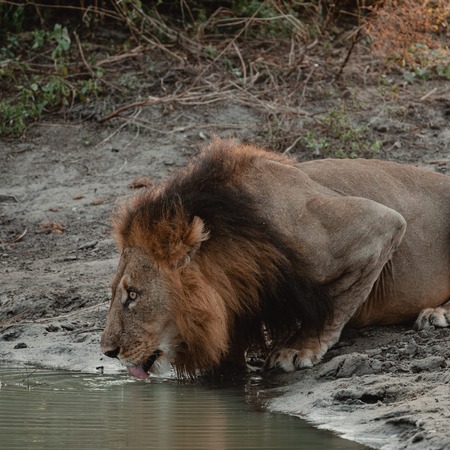
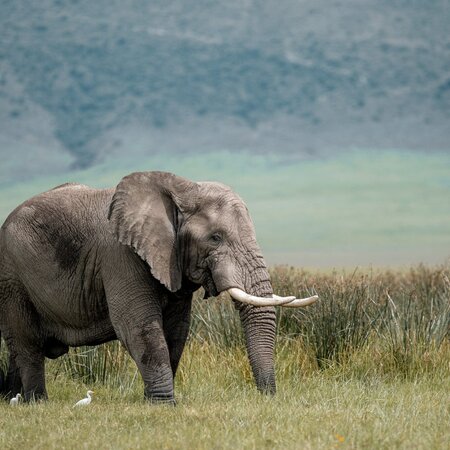
From July to October the Great Migration is in the Masai Mara; in January and February Amboseli shows its elephants in front of Kilimanjaro. What you see in which month.

Kenya has 2 dry seasons and 2 rainy seasons, and for game viewing the dry season from July to October counts most. The grass is short, the bushes carry little leaf, and the animals gather at the few remaining water sources: the Mara River, the Talek, the Amboseli swamps and the waterholes of Tsavo. In 1 hour of game drive you see more in these months than in 3 during the green season.

The Great Migration reaches the Masai Mara in July, depending on the rains; the first herds usually cross the Sand River in the 2nd half of July. The river crossings on the Mara River fall between late July and early October. There is no fixed date, and 3 to 4 nights in the Mara Triangle or on the Talek raise the odds considerably. From late October the wildebeest move back into the Serengeti. Lions, leopards, cheetahs, elephants and buffalo stay in the Mara all year; only the roughly 1.5 million wildebeest and zebras come and go.

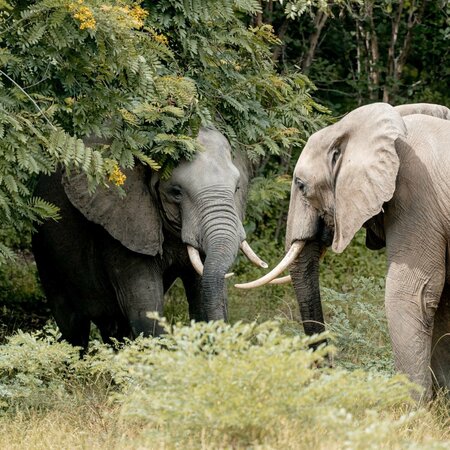
The 2nd dry season in January and February is shorter, but for Amboseli and Tsavo it is often the best time: Kilimanjaro stands clear of cloud until about 9 in the morning, the elephant families come to the swamps, and in Samburu and Laikipia reticulated giraffe, Grevy's zebra and beisa oryx show up along the rivers. Many antelopes and zebras give birth after the short rains in December and January, and the predators are correspondingly active.

The long rains from late March to May are the weakest time: tall grass, animals widely scattered, and many camps in the Mara close completely in April and May. The short rains in November and early December are milder, usually 1 to 2 hours of showers in the afternoon; the landscape turns green and the migratory birds from Europe arrive. For birders, and for anyone who wants to see animals without 20 other vehicles, November is a good compromise. Lake Nakuru and Lake Naivasha work all year; the flamingo count swings with the water level from a few thousand to over 1 million.

Region Jan Feb Mar Apr May Jun Jul Aug Sep Oct Nov Dec
Masai Mara
Amboseli
Tsavo East & Tsavo West
Samburu & Laikipia
Lake Nakuru & Lake Naivasha
Best sightings Good chances Few sightings

What guests say about their trip to Kenya

★★★★★

Markus W.

Die Tour in Kenia, speziell durch die Masai Mara und den Lake Nakuru, bot eine interessante Gruppendynamik. Die maximale Gruppengröße von 20 Personen ermöglichte, dass jeder ausreichend individuelle Aufmerksamkeit erhielt, während die gemeinsamen Mahlzeiten im Lastwagen den Austausch förderten. Das Tempo der Safari, das auf...
★★★★★

Martin F.

Die Camping Lodge Safari in Kenia führte mich durch das Masai Mara Nationalreservat und den Lake Nakuru Nationalpark. Die technische Vorbereitung war durch die täglichen Briefings und den Einsatz von qualifizierten Guides klar strukturiert. Die 4×4 Safari-Fahrzeuge waren gut gewartet, was die anspruchsvollen Strecken zum...

★★★★★

Robert F.

Die Organisation der Afrika Gruppenreise war durchweg klar strukturiert. Die täglichen Briefings vor den Touren in der Serengeti und die Reiseführer, die die Safarifahrzeuge begleiten, sorgten für einen reibungslosen Ablauf. Das Camping und die Unterbringung in Apartments waren gut koordiniert, was zur positiven Gruppendynamik beitrug.

Climate in the Masai Mara: Month by Month

The climate table is for the Masai Mara at around 1,600 m, the region where most Kenya safaris spend most of their time. Daytime highs stay between 24 and 29 degrees all year, and nights cool to 11 to 14 degrees; in July and August you need a fleece and a windproof jacket on the early-morning game drive. Rain falls in every month, and what matters is the amount: the long rainy season from late March to May brings 14 to 17 rain days per month, the short rainy season in November about 14, and the dry season from June to October 6 to 7, usually as a brief shower in the late afternoon. Humidity stays moderate at 58 to 74 percent, and the sun shines 6 to 8 hours a day.

Other regions differ: Amboseli and Tsavo lie at 1,000 to 1,200 m and are 3 to 5 degrees warmer, Samburu in the north reaches 34 to 36 degrees in February and March, and the coast around Mombasa has 28 to 32 degrees all year at over 80 percent humidity. Nairobi at 1,800 m is the coolest point on the route, around 10 degrees at night in July.

Month Max °C Min °C Rain days Humidity % Sun hours
Jan Dry season 28 13 7 60 8
Feb 29 13 7 58 8
Mar Wet season 28 14 11 62 7
Apr 26 14 17 72 6
May 25 13 14 74 6
Jun Dry season 25 12 7 66 7
Jul 24 11 6 64 7
Aug 25 11 7 62 7
Sep 26 12 7 60 8
Oct 27 13 10 62 7
Nov Wet season 26 13 14 70 6
Dec 27 13 10 66 7

Best Time for a Motorcycle Trip

Two rainy seasons put the tracks in the southwest out of action - the highlands around Nairobi stay far more forgiving.

7 Ideal
Best time to travel
Jan/Feb and Jun-Sep, consistently dry

In the dry windows the Masai Mara tracks are firm and grippy throughout - also the best time for wildlife viewing.

Region Jan Feb Mar Apr May Jun Jul Aug Sep Oct Nov Dec
Central Highlands & Rift Valley (Nairobi-Mount Kenya-Naivasha)
Masai Mara & Southwest Savanna
Ideal Doable Not passable

Kenya's rainy seasons decide whether a track is passable, not how pleasant the weather is. The long rains (March to May) hit the Masai Mara and the savanna in the southwest hardest: the black cotton soil (vertisol) there swells when wet into deep, sticky mud that even four-wheel-drive vehicles get stuck in - individual tracks and lodges become temporarily unreachable. The short rains (late October to December) are usually shorter and more localised, but can still make individual afternoons impassable. The central highlands around Nairobi, Mount Kenya and the Rift Valley are far more forgiving: the main routes are mostly paved, and rain makes the laterite sections slippery but rarely fully impassable. Between the rainy seasons lie the two dry windows, January/February and June to September, when the Mara tracks are also firm and grippy throughout - these are also the months with the best visibility for wildlife viewing. Ramadan has no effect on the routes themselves, but it does affect restaurant and shop hours on the coast (Mombasa route).

Best time to go, depending on what you are after

Seeing wildlife: July to October

The dry season from July to October brings the most sightings: short grass, animals at the water, the migration in the Masai Mara. If you want to see the river crossings, plan 3 to 4 nights in the Mara between early August and late September and expect crowded viewpoints. January and February are the second good choice, above all for Amboseli, Tsavo and Samburu.

If you cope badly with heat: June to August

June to August are the coolest months: 24 to 25 degrees by day in the Mara and the highlands, 11 to 12 degrees at night, around 10 degrees in Nairobi in the morning. Amboseli and Tsavo still sit at 27 to 30 degrees, Samburu and the coast above 30. Avoid February and March in the north, where it reaches 34 to 36 degrees. The airflow in an open vehicle makes the midday heat easier to bear than the number suggests.

The most popular time: August and September

August and September are the months with the most guests, because the migration, the dry season and the European school holidays coincide. Camps in the Mara are booked 6 to 9 months ahead, and 30 or more vehicles line up at the crossing points. To see the same animals with less traffic, take July or October, or move to the conservancies north of the Mara, where the number of vehicles is capped.

Birds and green landscapes: November to April

From November to April the European migratory birds are in Kenya; over 1,100 bird species have been recorded in the country. After the short rains in November the savanna is green, the air is clear, and young animals stand with the herds. Showers usually last 1 to 2 hours in the afternoon. For the Mara: April and May are rain months with closed camps, while November and December are perfectly driveable.

Photographers: January, February and September

For photos, light and background count: in January and February Kilimanjaro is clear from Amboseli until about 9 in the morning, the light is crisp, and the dust plumes of the elephants stand out against it. In September the crossing drama on the Mara River plays out against short yellow grass. In the green season from November the clouds and contrasts are more dramatic, but the animals disappear into tall grass. The golden hour is short on the equator: roughly 6:30 to 7:15 and 17:45 to 18:30.

Visa and Entry Requirements

Since 2024, Kenya has required an electronic travel authorisation before departure for practically every nationality - a visa on arrival at the counter no longer exists.

Since 2024, Kenya has required practically all nationalities to obtain an electronic travel authorisation (eTA) before entry, and the visa on arrival at the counter has been abolished. The eTA is applied for online at etakenya.go.ke, costs 30 USD and is usually issued within 24 to 72 hours, though 3 to 5 working days are officially allowed for processing. You will need: a passport valid for at least 6 months with one blank page, a recent passport photo, a confirmed flight or border crossing with entry and exit dates, proof of accommodation, and a yellow fever vaccination certificate if arriving from a yellow fever endemic area (relevant, among others, when entering via Tanzania, Uganda or Ethiopia). The eTA is available as a single-entry or multiple-entry permit with up to 90 days per stay, valid for up to 5 years. Anyone planning a route through Kenya, Uganda and Rwanda can apply for the East Africa Tourist Visa for 100 USD instead of three separate eTAs; it covers all three countries, but can only be applied for through the portal of whichever country is entered first, and it begins with the physical crossing into that country. At land borders, the eTA confirmation is checked together with your passport - carrying a printout as a backup is worthwhile in case there is no phone signal on the road.

Visa typeStayCostWhere to applyValidity
eTA Kenya (single entry)90 days30 USDOnline in advance at etakenya.go.keUsually issued in 24-72 hours
eTA Kenya (multiple entry)90 days per stay30 USDOnline in advance at etakenya.go.keValid for up to 5 years
East Africa Tourist Visa (Kenya+Uganda+Rwanda)90 days, multiple entry within the three countries100 USDOnline via the portal of the first country visitedOnly worthwhile for a combined route through all three countries

Entering with Your Own Motorcycle

What matters at the border for your own motorcycle: Carnet or form C32, COMESA insurance, and the right paperwork.

For your own, foreign-registered motorcycle, a two-tier system applies at Kenya's land borders. Travellers from countries outside the EAC and COMESA generally need a Carnet de Passages en Douane or a comparable document from their home country; without it, customs at the border issues form C32, a free provisional import document valid for 14 days. The motorcycle may only leave the customs post with one of these two documents, and an extension beyond the 14 days is possible through the Kenya Revenue Authority, though it is not guaranteed at the border crossing itself. Third-party liability insurance is mandatory: the COMESA Yellow Card is valid in Kenya and most neighbouring countries (Tanzania, Uganda, Rwanda, Zambia, Malawi and others), so it covers the whole East Africa route with a single policy, and it is issued at the border or by Kenyan insurers. Carry the vehicle registration document, proof of ownership and an international number plate sticker. If you are riding someone else's motorcycle - a borrowed one, or a fellow traveller's - border officials regularly ask for a written, ideally notarised power of attorney from the owner. Most crossings into Tanzania (Namanga, Isebania) and Uganda (Busia, Malaba) are well used to transit traffic; more remote posts cost more time and patience. For anyone not already travelling with their own motorcycle and a Carnet, renting a locally based motorcycle in Nairobi is in practice considerably less complicated than importing your own.

0 / 6
Without a Carnet, the only option at the border is the free 14-day import under form C32 - for a longer stretch in Kenya this must be extended with the Kenya Revenue Authority in good time, not on the day you plan to leave.

Driving Licence and Documents

An IDP is not a legal requirement, but it makes checkpoints on the road noticeably quicker.

Kenya is a signatory to the 1968 Vienna Convention and generally recognises foreign driving licences, so an IDP is not a legal requirement. In practice, an international driving permit is still worthwhile: it is an official translation, and many police officers at checkpoints outside the cities do not recognise a German, Austrian or Swiss card licence and check more slowly if no English translation is available. Helmets are a legal requirement for rider and passenger and are regularly checked at checkpoints and weighbridges on the main roads out of town. At checkpoints - police barriers, weighbridges for trucks - you will be asked for your driving licence, vehicle papers and eTA confirmation; a calm manner and patience speed up processing considerably.

0 / 4

Roads and Tracks While Riding Kenya

From the tarmac of the A104 to paths used only by the Maasai and wildlife - six typical stages.

The stages described here follow the classic Nairobi - Mount Kenya - Lake Baringo - Molo - Masai Mara - Lake Naivasha - Nairobi route, the core of almost every guided Kenya motorcycle tour. Tarmac and track alternate constantly once you leave the main roads A2 and A104; from Molo towards the Mara, longer stretches run only on paths used by the Maasai and wildlife, and a support vehicle usually travels separately from the convoy there. Daily stages of 150 to 225 km are the norm on these tracks, not the exception - much greater distances are possible on continuous tarmac, considerably less on gravel and hilly terrain. Altitude differences of roughly 1,500 to over 2,500 metres between individual stages mean cold nights despite the equatorial location, so pack warm clothing for the evening. Anyone riding the route in the opposite direction should build in a buffer of at least one day around Molo and the Masai Mara at the first rain reports of the season. Fuel and food are worth topping up whenever a town offers them, since several of these stages run for hours with nothing in between.

1
Nairobi - Mount Kenya (Nyeri/Nanyuki)
210 km

Paved main roads to the outskirts, then country roads with some gravel through villages and green hills, past Aberdare National Park

After rain
Laterite sections become slippery but mostly stay passable
Realistic daily distance
approx. 210 km
Fuel stops
Good supply in Nyeri and Nanyuki
2
Mount Kenya - Lake Baringo (Marigat)
220 km

Mostly gravel through open grassland, past game farms and reserves with free-roaming wildlife

After rain
Remote stretch, noticeably slower and muddy in the rain - carry supplies for the road
Realistic daily distance
approx. 220 km
Fuel stops
Plan for the last reliable fuel station before Marigat, in Nakuru
3
Lake Baringo - Molo
180 km

A mix of tarmac and gravel through western Kenya, some sections without a support vehicle

After rain
Gravel sections become wet and slippery
Realistic daily distance
approx. 180 km
Fuel stops
Fuel available in the towns along the route
Passes
Climb from roughly 1,500 m to about 2,500 m altitude - cold nights despite being near the equator
4
Molo - Masai Mara
200 km

Longer stretches on paths used only by the Maasai and wildlife, almost no human settlement

After rain
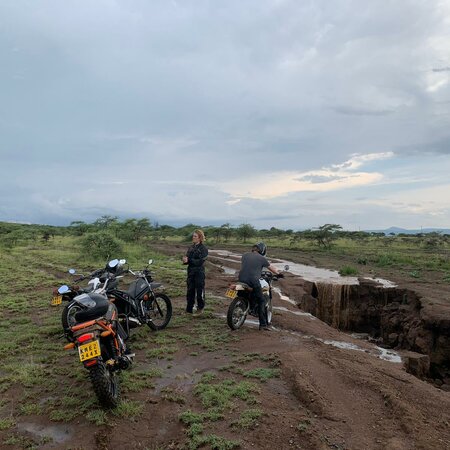
Black cotton soil makes this track temporarily impassable in the rainy seasons (March-May, November)
Realistic daily distance
approx. 200 km
Fuel stops
Plan for the last fuel stop before the Mara, in Narok
Permits
Maasai Mara National Reserve: 100 USD/day (Jan-Jun 2026) or 200 USD/day (Jul-Dec 2026) for non-residents, with different fee points depending on the county (Narok/Trans Mara)
5
Masai Mara - Lake Naivasha (via Narok)
225 km

Long gravel track to Narok, then tarmac through the green highlands

After rain
The track before Narok sits on black cotton soil and becomes hard going quickly after rain
Realistic daily distance
approx. 225 km
Fuel stops
Good supply from Narok onward
6
Lake Naivasha - Nairobi
150 km

Tarmac, with unpaved sections past the Mount Suswa Conservancy and the Ngong Hills Reserve

After rain
Traffic gets denser the closer you get to Nairobi - average speed in the city drops sharply in the rain
Realistic daily distance
approx. 150 km
Fuel stops
Good supply throughout

Fuel and Refuelling in Kenya

No problem on the main roads - a reserve canister pays off on the tracks to the Mara.

The A104 and A109, along with all larger towns, have reliable fuel stations from major brands (Shell, TotalEnergies, Rubis) selling Super and diesel and accepting cards as well as M-Pesa. Away from these routes - for instance between Mount Kenya and Lake Baringo, or on the way to the Masai Mara - stations are considerably further apart, sometimes 100 km or more; cash is the more reliable payment method there, since card terminals and mobile networks do not always work. A reserve canister of 5 to 10 litres is worthwhile on the remote stages; small rural stations occasionally sell lower-quality fuel from drums, which is best avoided if in doubt. The tank size of most travel enduros is easily enough for the 150 to 225 km daily stages typical here.

AspectNote
FuelSuper (petrol) and diesel at all larger stations
PaymentCard and M-Pesa on main roads, carry cash elsewhere
Reserve5-10 l canister for the Mount Kenya-Baringo-Mara tracks

Safety and Emergency Numbers

The local numbers apply nationwide - 112 also works without an active SIM card.

The nationwide emergency number is 999; alternatively, 112 also works from mobile networks without an active SIM card. For medical emergencies, the Kenya Red Cross Emergency Response is also reachable around the clock free of charge on 1199, and in practice is often faster on the scene than the state ambulance. In remote regions such as the Masai Mara or around Lake Baringo, it can take longer for an emergency call to get through or for a vehicle to arrive, depending on network coverage - safari lodges and camps usually have their own radio links and can help in an emergency. For serious accidents away from the cities, evacuation by Flying Doctors (AMREF) is realistic, which requires appropriate travel or evacuation insurance.

Health and Vaccinations

Most travel insurance policies do not cover riding a motorcycle over 125cc - check before you book.

Most European travel and overseas health insurance policies explicitly exclude riding motorcycles over 125cc or require an additional add-on - check the small print before booking, or nobody pays out in an emergency. A yellow fever vaccination certificate is mandatory on entry from a yellow fever endemic area, and otherwise recommended alongside protection against hepatitis A/B, typhoid and rabies. Malaria prophylaxis is relevant for lower-lying areas such as the Masai Mara and the coast, while the risk drops noticeably in the cooler highlands around Nairobi and Mount Kenya. A well-stocked travel medical kit, including remedies for travellers' diarrhoea, belongs in your luggage, since pharmacies are thin on the ground away from the larger towns.

0 / 4
Check before booking: many travel insurance policies exclude riding a motorcycle over 125cc - without the right add-on, the insurer will not pay out after an accident.

Money and Payment in Kenya

M-Pesa often replaces cash in Kenya - but it stays essential in the countryside.

The national currency is the Kenyan Shilling (KES); ATMs are reliably available in every larger town, in the highlands and on the coast, but rare in remote regions. M-Pesa, Kenya's mobile payment system, is more practical than cash for many payments - from the fuel station to the market stall - but requires a Kenyan phone number, which can be registered at any Safaricom counter at the airport. Cards are accepted in hotels and larger restaurants; in the countryside, cash is essential.

Payment methodCoverage
M-PesaWidely used nationwide, requires a Kenyan SIM card
Cash (KES)Essential away from towns and main roads
Credit cardHotels and larger restaurants in towns

Mobile Network and Internet

Safaricom covers the highlands and the Mara with 4G in most places - expect dead spots on remote tracks.

Safaricom has by far the best network, mostly with 4G even in the highlands and around the Masai Mara; Airtel is an alternative with somewhat thinner coverage. A local SIM card is cheap and available immediately at the airport or from any Safaricom dealer, and eSIM options also exist. In the national parks and on remote tracks such as between Mount Kenya and Lake Baringo, there are longer stretches with no signal at all.

Traffic and Etiquette

Left-hand traffic, wildlife on the road, and photo etiquette in Maasai areas - the key rules.

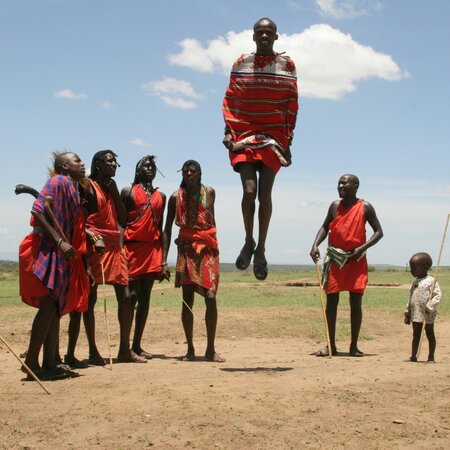
Kenya drives on the left; at roundabouts, traffic already in the circle has the right of way. Wildlife regularly crosses country roads outside the parks, especially at dusk - riding after dark should be kept to a minimum. Near Maasai communities, do not photograph people or their livestock without asking; a brief conversation or a small fee usually settles this without complications. On Fridays, expect more pedestrian traffic around mosques - otherwise everyday life has no religiously based restrictions for travellers.

What Kenya Adds to Your Kit

The addition to your normal gear - specifically for altitude changes, tracks and safari stops.

0 / 7

Photos from Kenya

Joe Küster
Author
Joe Küster
Founder & Creative Engine of Overcross

"Jack of all trades, almost all!" The driving force and idea machine behind Overcross.

Languages: de, en
×

Send request

Adventure

How did you
hear about us?

Adventure truck Road path Palm tree
Ask a Route Expert

How do you want to travel?