Everything you need to know about Tanzania
Travel map of Tanzania by the tour operator OVERCROSS
- General travel information about Tanzania
- Travel climate in Tanzania
- Geography of Tanzania
- Flora and fauna in Tanzania
- National parks and nature conservation in Tanzania
- Population in Tanzania
- Politics and economy in Tanzania
- Transport network in Tanzania
- Cities and regions in Tanzania
- Culture and sights in Tanzania
- Holidays in Tanzania
- Medical notes for Tanzania
- Travel advice for Tanzania
- Foreign representation in Tanzania
- Sources of information for Tanzania
1. General travel information about Tanzania
| Continent: | Africa |
| Geographical location: | East Africa, located south of the equator |
| Highest elevation: | Kibo (Kilimanjaro) 5895 m |
| Longest river: | Great Rovuma (approx. 780 km) |
| Form of government: | Federal Republic |
| Government system: | Presidential system |
| Languages: | Swahili (official language) and regionally about 128 different languages, mostly Bantu languages |
| Neighboring countries: | Kenya, Uganda, Rwanda, Burundi, D.R. Congo, Zambia, Malawi, Mozambique |
| Capital: | Dodoma |
| Area: | Approx. 945,100 km² |
| Population: | Approx. 61.5 million people (2023) |
| Population density: | 65 inhabitants per km² |
| Religions: | Islam 30-40% (mainly on the coast and Zanzibar), Christianity 30-40%, traditional African religions |
| Currency: | Tanzanian Shilling (TZS), 1 Euro is approximately 2,575 TZS (as of Jan 2024) the current exchange rate can be found at oanda.com |
| Climate: | Tropical, temperate to dry |
| Timezone: | UTC + 3 |
| Dialing code: | +255 |
| Country code: | TZ |
| Power: | In Tanzania, sockets of type D (BS 546, 5 A) and G (BS 1363) are used. Mains voltage is 3 x 230V with 50Hz alternating current. A travel plug adapter is advantageous. An overview of sockets and plugs used in our travel countries can be found at wikipedia.de |
2. Travel climate in Tanzania
Tanzania has a tropical climate, which is more temperate in higher altitudes. There are high temperatures throughout the year with only slight fluctuations. On the coast of Tanzania and the offshore islands of Zanzibar and Pemba, annual average temperatures of about 27 °C are reached, while on Tanzania's plateau the average is only 20 °C. In Tanzania, near the equator, there are two rainy seasons, one from March to May and one from October to November. With about 2000 mm per year, the eastern slopes of the mountains receive the most rainfall. On the coasts of Tanzania there is about 500 mm to 1000 mm of precipitation, and in the highlands it is between 1000 and 1500 mm. The Maasai Steppe in northeast Tanzania records 500 - 750 mm of rainfall annually. Basically, Tanzania is a country where it rains relatively little, so most of the country - the central region of Tanzania - gets less than 500 mm of rain per year.


3. Geography of Tanzania
Immediately south of the equator, between the Indian Ocean to the east and the lakes of the Central African Rift to the west, lies the United Republic of Tanzania, which with an area of 945,100 km² is about two and a half times the size of Germany. In addition to the mainland, the islands of Zanzibar, Pemba and some smaller islands in the Indian Ocean are also part of Tanzania's territory. Tanzania borders to the northwest on Kenya, to the north on Uganda and Lake Victoria, to the east on Rwanda, Burundi, and the Democratic Republic of Congo with Lake Tanganyika, as well as to the southwest on Zambia and far south on Malawi or Lake Malawi and Mozambique. In the east of Tanzania lies the Indian Ocean with the two shallow coral islands Zanzibar and Pemba, which are located off the northern coast.
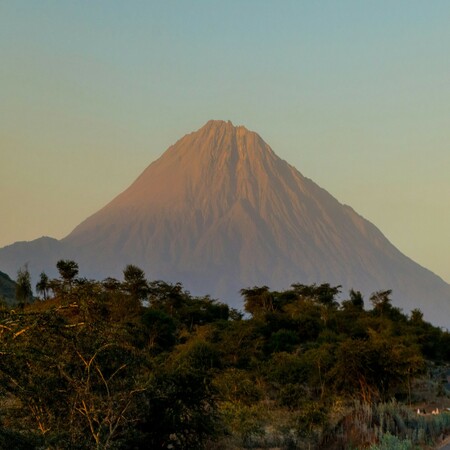
Inland, the coast is followed by various mountain ranges with the Usambara Mountains (2460 m) and the Uluguru Mountains (2650 m). The heartland is formed by the highlands with an altitude of an average 1000 to 1500 m above sea level. The Central African Rift bounds the highlands in the west and northwest, Lake Tanganyika forms the border here to the Democratic Republic of Congo. In the north, alongside Kenya and Uganda, Tanzania borders Lake Victoria. The border with neighboring Malawi is formed by Lake Malawi, which also belongs to the rift system. At 5895 m, the Kibo summit in the Kilimanjaro massif is the country's highest elevation.
4. Flora and Fauna in Tanzania
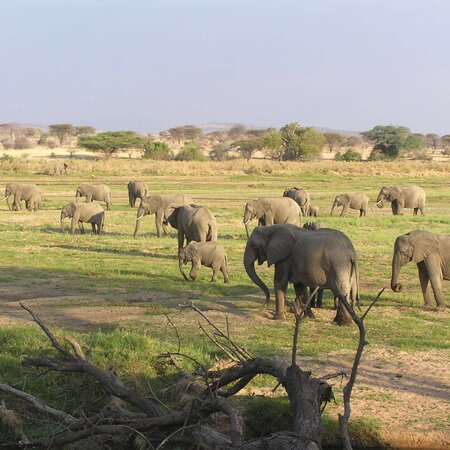
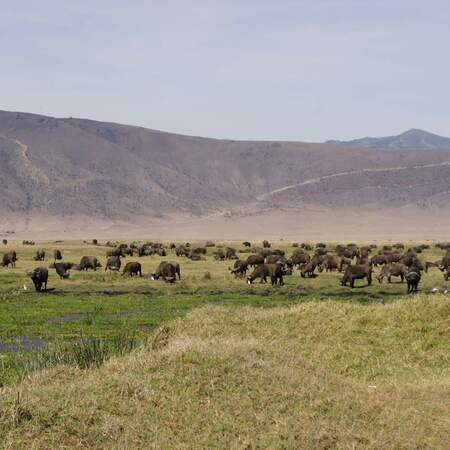
Tanzania is known for its great diversity of animal and plant species as well as its highly pronounced variety of different landscape structures. A large part of the country is forested area (35%), so-called Miombo forests. In the east, on the other hand, there are large areas of rainforest, which are home to most of Tanzania’s endemic plant and animal species. The largest parts of the country are covered with savannas and vast bushland. Especially the extensive plateaus of the country, which strongly characterize Tanzania's landscape, are covered with savanna. The most prominent plateau is the central plateau, which stretches at an altitude of 1200 m in the north and west of the country. In the north of Tanzania majestically rise two of the four highest mountains on the continent, the 4566 m high Mount Meru and the 5895 m high, year-round snow-covered Mount Kilimanjaro – also called the "Roof of Africa." Since Tanzania borders many African countries, some of the country's borders are formed by rivers and lakes. Another very interesting region of the country is the Serengeti, one of Africa’s most famous national parks, in the northwest of the country. This incredibly diverse landscape also hosts a uniquely large number of different animal species. Especially well-known wild animals such as lions, buffaloes, giraffes, zebras, elephants, antelopes and many more can be found all over the country in the wild. In particular, the Serengeti area is one of Africa's most complex and least disturbed ecosystems, with the largest contiguous population of wild animals living here far from human civilization. In total, around 4 million wild animals live in Tanzania, furthermore there are countless bird species and reptiles – among them ostriches, herons, flamingos, pelicans and cormorants, birds of prey, crocodiles, snakes and lizards. Tanzania is also home to a large number of endangered species such as the leatherback turtle, the blue whale, or the colobus monkey.
5. National Parks and Nature Conservation in Tanzania
The protection of the country's animal and plant life is given a very high priority in Tanzania, so there are 12 national parks and around 14 reserves in Tanzania. Furthermore, there are some protected marine reserves in the coastal regions of the country. The various protected areas are managed by the Tanzania National Parks Authority (TANAP).
Serengeti National Park:
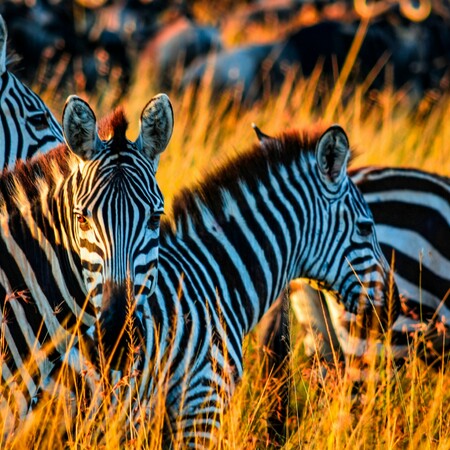
The most famous and oldest among the African national parks is the Serengeti National Park and it is located in the northwest of Tanzania. With an area of about 14,763 km2, it covers about a third of the actual Serengeti and is home to an incredibly high number of different animals. The park has been part of the World Natural Heritage since 1981, as well as part of the 23,051 km2 biosphere reserve. The Serengeti became famous for the "Great Migration," the seasonal migration of animal herds. During the short rainy season in October and November, over a million wildebeest and about 200,000 zebras travel from the hills in the north to the plains in the south, only to return north after the main rainy season in April, May, and June. The endless wide steppes offer the optimal place for a car safari through Africa’s wilderness. Observing the wildlife of this fascinating region is also possible from above, with a balloon safari.
Ruaha National Park:
Ruaha National Park lies right in the heart of Tanzania and is the second largest national park in the country. Due to its special location in the transitional zone between the East African acacia savanna and the miombo belt of southern Africa, it is home to many different animals. Above all, the antelope is strongly represented there, as the park has as many different antelope species as almost nowhere else in Tanzania. The park is especially known for having the largest elephant population in all of East Africa, with about 10,000 animals.
Arusha National Park:
The Arusha National Park is characterized by a very lively, hilly and green landscape and thus corresponds pretty much to the opposite of what visitors associate with Tanzania. Endless wide plains and dried-out savannahs are hardly to be found in the park. Arusha National Park is home to over 600 birds, from forest and mountain birds, to marsh and water birds, and even savannah birds. In addition, numerous mammals live here, such as zebras, buffaloes, elephants, waterbucks and bushbucks, hippos, large families of monkeys, as well as huge herds of giraffes. While lions are never sighted in the park, leopards and hyenas can be spotted at certain times of the day. A special feature of the Arusha National Park are walking safaris or even canoe safaris, which are only allowed in very few national parks. The fifth highest mountain in Africa, Mount Meru, is found in Arusha National Park, and gentle hikes on the mountain’s foothills are rewarded with unforgettable views. In optimal weather conditions and with clearing cloud cover, the snow-capped peaks of Kilimanjaro are visible in the distance.
Ngorongoro Conservation Area:
The Ngorongoro Crater is a caldera formed by the collapse of a volcano. It is the largest in the world: 20 km long, 600 m deep, and waterless. Between 25,000 and 30,000 animals live in the crater, including the Big Five: lion, elephant, buffalo, rhino, and leopard. The savanna landscape in the crater changes all the way to a green mountain landscape at the crater's rim. The Ngorongoro Crater offers an impressive landscape in every season. In 1979, the Ngorongoro Conservation Area was declared a UNESCO World Heritage Site. The view from the crater rim into the crater is breathtaking.
Lake Manyara National Park:
After a short drive downwards, you enter dense forest and a very winding road into the Lake Manyara National Park. Among the special features of Lake Manyara National Park are the breathtaking landscapes. Dense green groundwater forest, streams and waterfalls, grassy savannah, and swamp areas lead all the way to Lake Manyara. Due to its diverse vegetation and year-round water supply, the park provides the basis of life for a rich variety of wildlife. Over the lake, more than 400 different bird species can be spotted, and the surrounding grasslands provide an ideal home for elephants, zebras, rhinos, buffaloes, giraffes, wildebeests, and many other animals. Lions can repeatedly be spotted on the high treetops in the forest.
6. Population in Tanzania
The approximately 61 million inhabitants of Tanzania consist of around 120 ethnic groups. With around 95%, the Bantu group is the largest tribe. The general population growth is increasing, mainly because Tanzanian women give birth to an average of 5.4 children. As a result, the country is quite young, with the largest population group being people under 20 years of age. The two main religions in Tanzania are Islam and Christianity. Islam is mainly found in the north and coastal areas, while Christianity is more common in Tanzania's inland. Throughout the country, there are also many followers of traditional African natural religions. In total, around 130 languages are spoken in Tanzania, of which English and Swahili (KiSwahili) are the two official languages. Although most residents speak English fluently, communication in English is difficult in smaller and very remote areas.
7. Politics and Economy in Tanzania
Since 1977, Tanzania has been a federal presidential republic. The head of state with extensive powers is the president, who is directly elected for five years. One re-election is possible. He appoints the cabinet with the prime minister at the top. The legislative power lies with the National Assembly, which has 324 members, 232 of whom are directly elected. The dominant political party is the Revolutionary Party of Tanzania (Chama Cha Mapinduzi, CCM), the former single party. The largely autonomous Zanzibar has its own state institutions.
Despite strong development aid, Tanzania is one of the poorest countries in the world. The Tanzanian overall economy depends largely on the performance of the agricultural sector, which contributes about 46 percent to the gross domestic product (GDP). More than 75% of employees work in agriculture. A popular export product is, for example, cotton; furthermore, Tanzania has a strong presence of gold, diamonds, and iron ore. The service sector has also grown quickly in recent years and now accounts for about 39% of GDP. This is due to rapid growth in the areas of tourism, telecommunications, and finance.
8. Transport Network in Tanzania
The road network in Tanzania covers about 85,000 km, of which only about 4,000 km are paved. Some of the roads are not passable after heavy rainfall, as they are sometimes submerged or washed away. In Tanzania, people drive on the left!
The most popular way to travel in Tanzania is certainly by bus. If you are traveling within a city, you can also use so-called Dalla-Dallas, small minibuses. There are also tuk-tuks, motorized tricycles. Basically, traffic in Tanzania is much more chaotic than in Europe; there are usually no official stops for buses or taxis.
As far as the railway network is concerned, one line runs from Dar es Salaam westwards through the whole country via Dodoma to Kigoma. Another major travel route runs from Dar es Salaam southwest to Zambia. Also well-known is the TAZARA Railway, which can be used to travel through the whole country.
9. Cities and Regions in Tanzania
Tanzania is divided into 30 administrative districts, five of which belong to the semi-autonomous region of Zanzibar. The most popular tourist activities in Tanzania are definitely visits to national parks and natural monuments, of which there are very many in Tanzania. Cities are largely uninteresting for longer stays, and most tourists spend 1-2 days in each city before moving on.
Dar es Salaam:
Dar es Salaam is a city with over 4 million inhabitants and the largest city in Tanzania. Particularly beautiful are the many historical monuments and buildings as well as the cathedrals and museums. Furthermore, you can visit some of the many markets in the city center and indulge in typical Tanzanian cuisine.
Zanzibar:
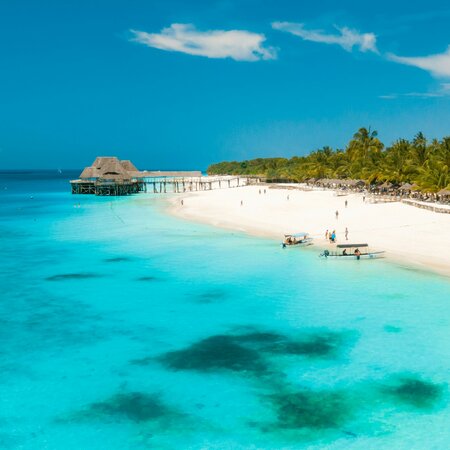
The archipelago off the mainland consists of two islands. One of the islands, Unguja, is particularly interesting. The capital of the island is Zanzibar City and its old town is called Stone Town and is a UNESCO World Heritage Site. There you can find numerous historic buildings and interesting sites.
Moshi:
Moshi is a well-known town in the Kilimanjaro region in northeastern Tanzania. Naturally, the most interesting attraction of the city is the Kilimanjaro mountain massif, which can be seen from parts of the city. There are also interesting markets in Moshi during the week that you can visit.
Arusha:
Arusha is a city in northeastern Tanzania. The region is considered the central hub and gateway for safari tourism in Tanzania. In the area surrounding the city, you will find several national parks worth seeing as well as interesting natural sites like the extinct volcano Meru, which is over 4,000 meters high.
Mbeya:
The city of Mbeya lies in the southern highlands of Tanzania at the foot of the Mbeya Range mountains.
10. Culture and Sights in Tanzania
Culturally, Tanzania is a very diverse and interesting country, which is also due to the many different ethnic groups and their influence on the population. As far as art is concerned, pottery and painting are especially popular in the country. Traditional woodcrafts are also particularly prevalent in the coastal regions and on Zanzibar. Traditional music, also called ngoma, can be heard throughout the country. The most important and original instrument is the drum. The music accompanies various religious rituals and ceremonies, and is played at traditional festivals and dance events. On Zanzibar, due to contact with Arabia, a completely unique music genre called taarab music has developed over the years.
The top attractions of Tanzania certainly include the many national parks and conservation areas spread throughout the country. When visiting these beautiful nature parks, you have the chance to observe many typical, as well as unique, African animals. Very special national parks include, for example, the Serengeti National Park or the Kilimanjaro National Park. These two regions, the vast Serengeti landscape and Mount Kilimanjaro, are also among the most popular natural attractions in Tanzania. In the wide open Serengeti landscape, you can enjoy excellent safaris and watch virtually all African animals in their natural habitat. Nowhere else can you experience such a diversity of animals on a safari as you can in Tanzania's Serengeti. Kilimanjaro is the highest mountain massif in Africa and was designated a UNESCO World Natural Heritage Site in 1987. A visit to this fascinating mountain would be worthwhile for the exceptionally beautiful view of Kilimanjaro alone. Not far from the Serengeti is the approximately 68,800 km² large Lake Victoria, which is definitely also worth a visit. The lake is known as the largest lake in Africa and the second largest freshwater lake in the world. Here too you will find a beautiful national park, Rubondo Island National Park, which is perfect for relaxing and bird watching.
11. Public holidays with a fixed date in Tanzania
| 1 Jan | New Year |
| 12 Jan | Anniversary of the Revolution in Zanzibar |
| 7 Apr | Sheikh Karume Day |
| 26 Apr | Union Day |
| 1 May | Labour Day |
| 5 Jun | Eid el Fitri (Festival of Breaking the Fast) |
| 7 Jul | Saba Saba |
| 8 Aug | Peasants' Day |
| 12 Aug | Eid el Hajj (Festival of Sacrifice) |
| 14 Oct | Mwalimu Nyerere Day |
| 10 Nov | Prophet's Birthday |
| 09 Dec | Republic Day |
| 24 Dec | Christmas Eve |
| 25 Dec | Christmas |
| 26 Dec | Second Day of Christmas |
12. Medical Information about Tanzania
Medical care in Tanzania cannot be compared to that in Europe. There is usually a lack of technical equipment and hygiene. In addition, there is often a lack of European-trained doctors with English language skills. You should not travel without your own individual travel pharmacy, as there are repeatedly shortages of medicines in the country. A travel medicine specialist or tropical doctor can advise you in advance. German Society for Tropical Medicine, Tropical Institute Tübingen
Special health regulations and vaccination requirements must be observed: Information from the Federal Foreign Office
In addition, the Federal Foreign Office recommends checking and updating standard vaccinations in accordance with the current vaccination calendar of the Robert Koch Institute for children and adults when travelling, including, among others, hepatitis A and B, polio, tetanus, malaria prophylaxis.
More information: www.auswaertiges-amt.de
13. Travel information for Tanzania
It is recommended to bring sufficient cash (euros/US dollars). Traveller's cheques are only accepted by a few banks and international hotel chains. When bringing US dollar notes, please note that banks and exchange offices usually only accept US dollar notes with an issue date from 2006 onwards. Exchanging euros into local currency is restricted to large cities and certain hotels. With German EC cards it is only rarely possible to withdraw cash from ATMs. Therefore, it is recommended to bring (several) credit cards (VISA / MasterCard), which allow cash withdrawals at most ATMs.
German nationals require a visa to enter Tanzania. It should be applied for before entry. The visa can also be issued on arrival at Tanzania's international airports, the port of Zanzibar or the large border crossings. The fee currently amounts to 50 US dollars or 50 euros and must be paid in one of these two currencies. In recent months, however, euro notes have occasionally no longer been accepted.
Current travel and security advice, entry and exit information as well as special criminal law notes and behavioral recommendations for your stay in Tanzania can be obtained from the Federal Foreign Office of the Federal Republic of Germany.
14. Foreign representation in Tanzania
| Embassy of the Federal Republic of Germany in Tanzania | |
| Jurisdiction/ Consular district: |
Tanzania and the Comoros |
| Location: | Dar-es-Salaam |
| Street address: | Umoja House, corner of Hamburg Avenue/ Mirambo Street., 2nd Floor, Dar-es-Salaam |
| Postal address: | Embassy of the Federal Republic of Germany, P.O. Box 95 41, Dar-es-Salaam, Tanzania |
| Phone: | +255 22 2212300, for emergencies: +255 786 971692 |
| Fax: | +255-22-2212 338 , Fax Visa Department +255-22-213 88 38 |
| E-Mail: | Contact form |
| Website: | http://www.daressalam.diplo.de |
| Official languages in the host country: | Tanzania: English; Comoros: French |
| Embassy of the United Republic of Tanzania in Berlin | |
| Location: | Berlin |
| Street address: | Eschenallee 11, 14050 Berlin |
| Postal address: | Kurfuerstenstrasse 84, 10787 Berlin |
| Phone: | +49 30 303 080 0 |
| Fax: | +49 30 303 080 20 |
| E-Mail: | [email protected] |
| Website: | https://www.tzembassy.go.tz |
15. Information sources for Tanzania
German Weather Service
Federal Foreign Office of the Federal Republic of Germany
Wikipedia