Travel Information Kazakhstan

Discover the expanses of the Kazakh steppe!

Everything you need to know about Kazakhstan

Travel map of Kazakhstan by the tour operator OVERCROSS

Travel map of Kazakhstan by the tour operator OVERCROSS


  1. General Information
  2. Geography and Climate
  3. Flora and Fauna
  4. National Parks and Nature Conservation
  5. Medical Information
  6. Population
  7. Politics and Economy
  8. Transport Network
  9. Cities and Regions
  10. Culture, Sights
  11. Public Holidays
  12. Travel Advice
  13. Foreign Representations
  14. Sources and Links


1. General Information

Continent: Asia
Geographical location: Central Asia, exactly in the middle of Eurasia
Highest elevation: Belucha (4,506 m)
Form of government: Republic
Government system: Presidential system
Languages: Kazakh, Russian
Neighboring countries: Russia, China, Kyrgyzstan, Uzbekistan, Turkmenistan
Capital: Astana
Area:  2,724,900 km²
Population: 19,042,000 (as of 1.1.2023)
Population density: 7 inhabitants per km²
Religions: Sunni Islam, Russian Orthodox, Catholic and Protestant Christianity, small Jewish communities 
Currency: Tenge (KZT)
Climate: continental (cold winters down to -40°C, hot summers over +40°C)
Timezone:  UTC +5 / +6
Country code: + 7
Country code: KZ
Electricity: 220 V at frequency 50 Hz, no travel adapter needed for Germans

back to top of page


2. Geography and Climate


The climate in Kazakhstan is distinctly continental due to the great distance from the world’s oceans, with cold, sunny and snow-poor winters followed directly by hot, dry and long summers. Spring and autumn are barely pronounced. Rainfall is low almost everywhere in Kazakhstan, and deserts and semi-deserts, especially in the west, occupy more than half the country. The humidity is very low. Strong winds are also typical, often taking the form of sandstorms in summer. An exception to these climate conditions is the mountains in the southeast, where summers are short and mild and winters less cold.


 Almaty (Southeast) Temp. °C min/max Sun hours / day Rainy days
Jan -8.9 -1 3.8 6
Feb -8.1 -0.2 4.2 6
Mar -1.7 6.2 4.7 10
Apr 6.3 16.5 6.5 10
May 11.1 21.3 7.8 10
Jun 15.7 26.3 9.3 7
Jul 18.5 29.4 9.9 5
Aug 16.8 28.2 9.5 4
Sep 11.7 23 8.2 4
Oct 4.4 14.5 5.9 7
Nov -1.7 6.3 4.2 7
Dec -6.4 1.2 3.3 6


Aktobe (Northwest) Temp. °C min/max Sun hours / day Rainy days
Jan -19.8 -10.9 2.8 6
Feb -19.7 -10.3 4.7 5
Mar -12.7 -2.9 5.7 5
Apr -0.4 10.9 7.9 5
May 7.4 21.9 10 5
Jun 12.8 26.7 10.6 5
Jul 15.2 29.3 10.7 5
Aug 13.2 27.6 9.7 4
Sep 6.8 20.8 7.6 5
Oct -0.6 10 4.4 6
Nov -7.8 -0.4 2.6 5
Dec -16.4 -7.6 2.2 6


Astana (North) Temp. °C min/max Hours of sunshine / day Rainy days
Jan -22 -12,1 2,7 7
Feb -21,7 -11,1 4,1 4
Mar -14,9 -4,2 4,9 4
Apr -1,9 9,2 7 4
May 5,9 20,1 8,9 6
Jun 11,3 25,6 10,2 8
Jul 13,8 27,4 9,8 6
Aug 10,7 24,5 8,6 7
Sep 4,9 18,7 6,9 5
Oct -2,9 8 4 7
Nov -11,8 -3,2 2,4 6
Dec -18,3 -9,3 2,1 6


back to top of page


3. Flora and Fauna

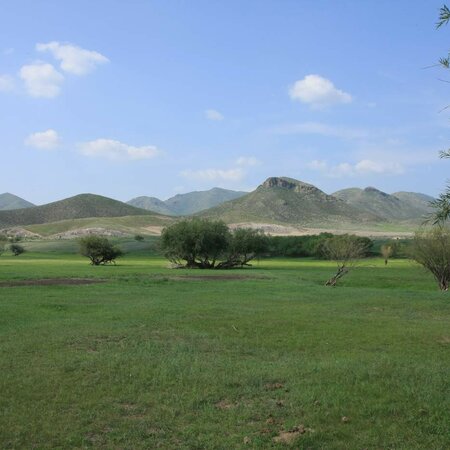
Due to its size and extension over many natural zones, Kazakhstan has an exceptionally rich animal and plant world. In the steppes and forest steppes of the north, many cereals and grasses grow, as well as medicinally useful plants such as valerian. Among typical tree species such as birch, aspen, willow, oak and linden you can find berry bushes, rodents, hares, badgers, wolves, foxes, occasionally also wild boars and deer, and in the steppe the rare and protected saiga antelope. Birds and waterfowl such as swans, eagles, bustards, vultures, cranes, herons, ducks, geese, woodpeckers, larks and others populate the sky. In the semi-deserts, the diversity of species is lower. Larger mammals here include wolves and corsac foxes, saiga and goitered gazelles, but the semi-deserts are mostly inhabited by smaller mammals like mice and hares. Sagebrush, chamomile and feather grass often grow. The most widespread natural area of the country is the desert, where mainly smaller mammals and reptiles live. In the high mountain regions of the Tien Shan, which are largely covered by spruce forests, you find one of Kazakhstan's strongly decimated and endangered national symbols, the snow leopard, which now survives almost only in nature reserves. Lynxes are also widespread and in the Altai mountains there are many bears. Ibex and wild sheep can also be found. Extraordinary are the seal colonies on the Caspian Sea, which are a result of the time before the last ice age, when there was a connection from the Arctic Ocean to the Caspian Sea.
 
back to top of page


4. National Parks and Nature Conservation

There are 12 national parks in Kazakhstan, mainly in the south of the country. 


5. Medical Information

Drink only water of safe origin, e.g. bottled water, freshly boiled tea or coffee, never tap water. Only use ice cubes if they are also made with clean water. Use only filtered, disinfected, or boiled water. When traveling, also use drinking water for washing dishes and brushing teeth. Drinking water in sealed bottles is considered safe. For food: cook, peel yourself or disinfect. Eat fish and meat only well cooked, fruit and vegetables only peeled and/or cooked. Be sure to keep flies away from your food. Wash your hands with soap as often as possible, always after using the toilet and always before preparing food and before eating. Use hand disinfection where appropriate, and use disposable towels.

The Foreign Office further recommends checking and updating standard vaccinations according to the current vaccination schedule of the Robert Koch Institute for children and adults when traveling to Kazakhstan, see http://www.rki.de


6. Population

After the population number in the 1990s initially dropped below 15 million due to emigration of Russians and Germans and declining birth rates, it has been rising again since 2003 and currently stands at around 19.04 million. However, due to its geographical size, Kazakhstan is one of the most sparsely populated countries in the world. The country is home to more than 50 ethnic groups, each with more than 1,000 members. The majority of the population, two-thirds, are Turkic-speaking Kazakhs, the largest minority, one fifth, are Russians. Other minorities include Uzbeks, Uighurs, Tatars, Ukrainians, Germans (1.1%) and a significant minority of about 100,000 Koreans. Most members of the minorities were deported to Kazakhstan during the Stalin era. Despite efforts to maintain good relations among the different population groups, tendencies to displace ethnic minorities are spreading in Central Asia. 

The predominant language is still Russian, although the role of Kazakh, which is also the official national language, is growing due to targeted promotion. The literacy rate is as high as in Germany at 97.5%. 

Despite decades of enforced atheism during the Soviet era, today only 2.8% of the population are atheists. Around 70% belong to Islam (the vast majority of them Sunnis), 26% to Christianity with its various denominations. Small groups of Jews and Buddhists exist alongside other religious forms.


7. Politics and Economy

The Sunni Islamic president Kassym-Jomart Tokayev has governed Kazakhstan since 2019 following the resignation of Nursultan Nazarbayev with an authoritarian style of leadership. The wealth of his clan is estimated at several billion US dollars. The opposition parties are severely restricted in their rights and, due to a 7-percent hurdle, have little chance of entering parliament; the media are strictly monitored. According to the OSCE, the last elections did not meet international standards. In foreign policy, there are strategic partnerships with Russia, China, and the USA. Especially close are the relations with Russia. Kazakhstan is seen as a stabilizing, protective "shield" between Russia and the other countries of Central Asia, as it lies like a buffer in between and shields these states from direct Russian pressure, so that after the collapse of the USSR in 1990, their own national identities have slowly begun to develop. The country is concerned about the Islamic Uighur minority oppressed in Xinjiang, on Chinese state territory. Kazakhstan and China have been linked by a partnership since 2005, which primarily aims to expand the transport infrastructure between the neighbors. Since 2015, there has also been a partnership agreement with the European Union, which aims to open Kazakhstan for tourism. In the struggle for regional supremacy, it is in direct competition with neighboring Uzbekistan, with which there are recurrent tensions over water and energy issues.

The basis of the Kazakh economy is oil and natural gas production as well as oil products. Kazakhstan wants to further expand its oil production, while at the same time there are strategies for an ecological transformation of the economy. With a nominal gross domestic product (GDP) of 223.6 billion US dollars and a GDP per capita of 11,748.3 US dollars in 2022 (Source: GTAI), Kazakhstan is still among the successful transformation states, even though the economic situation has recently deteriorated sharply. The goal is to join the group of the 20 most developed countries by 2050. In order to reduce Kazakhstan’s dependence on crude oil, there are efforts to promote the expansion of the manufacturing industry, agriculture, and transport sector as well as to restructure the energy sector. Small and medium-sized enterprises and structurally weak regions are to be particularly promoted.


8. Transport network

Kazakhstan is still little developed for individual tourism, especially for travelers who are traveling by car. Overland travel can be difficult due to the partially poor condition of the roads. The density of gas stations is generally good, but the sanitary infrastructure at rest stops or parking areas is basic. Diesel and gasoline with 80 to 92 octane are available at almost all gas stations, and in larger cities regularly also gasoline up to 98 octane. You can encounter problems with diesel vehicles in winter, as the fuel freezes at temperatures below minus 22 degrees Celsius, which often occur especially in northern and eastern Kazakhstan.


9. Cities and Regions

The capital and government seat is Astana, located in central Kazakhstan, with 1,300,000 inhabitants. It is a university city and one of the major industrial and service hubs in Kazakhstan. The largest city of the country and at the same time the economic and cultural center is the metropolis Almaty in southeastern Kazakhstan with 1,900,000 inhabitants. Other cities include Shymkent in the south (652,500 inhabitants), Karagandy in central Kazakhstan (485,300 inhabitants), Taraz (406,262 inhabitants), Pavlodar (495,554), Öskemen in the northeast, and the oil strongholds Aktau and Atyrau in western Kazakhstan. The settlement between the cities is extremely sparse. The national territory is divided into 14 vast regions and 3 cities with special status. These units are further subdivided into districts.


10. Culture, Sights

State cultural activities focus on conveying traditional, mostly ethnically Kazakh cultural content. In the fields of music and theater, the state promotes the preservation of both Kazakh and European music and theater traditions. International artists regularly perform in Astana and Almaty. The range of cultural offerings is broad. In addition to Kazakh and Russian cultural content, Western pop music and international film productions are also very popular.

Sights:

  • Unique architectural ensemble for Central Asia in a largely bombastic architectural style in the still developing capital Astana: e.g. Nur Mosque, Bayterek Tower, Presidential Palace, City Park, Palace of Peace and Reconciliation, ...
  • Almaty, metropolis and cultural center of Kazakhstan: First President's Park, Cathedral of St. Sophia (most important and beautiful Russian Orthodox Church in the country), Kok-Tobe Hill, Big Almaty Lake, Ascension Cathedral, Almaty Central Park, Central State Museum of Kazakhstan
  • Mausoleum and mosque complex of Khoja Ahmed Yasawi in the city of Turkestan
  • Tamgaly, a site featuring, in part, over 3,000 year old petroglyphs (rock carvings), ancient graves, and cult sites: part of the UNESCO World Heritage since 2004
  • Sary Arka / Kazakh Uplands: since 2008, an area of the Kazakh Uplands has been part of UNESCO World Natural Heritage
  • ...and of course the endless expanses of largely untouched landscapes in the steppes, desert, and mountains


11. Holidays

Holiday Date
New Year January 1
New Year, 2nd Day January 2
Orthodox Christmas January 7
International Women's Day March 8
Nouruz, Spring Festival March 22
People's Unity Day May 1
Defender of the Fatherland Day May 7
Victory Day May 9
Capital City Day July 6
Islamic Festival of Sacrifice June 28 (2023), June 16 (2024), June 6 (2025)
Day of the First President of the Republic December 1
Independence Day December 16
Independence Day, 2nd Day December 17


12. Travel Information

Travelers who do not have any knowledge of Kazakh or Russian are advised to have a language- and location-savvy companion when visiting remote areas. Foreigners staying temporarily in Kazakhstan are required to carry their original passport with a valid visa, if required according to visa regulations, and registration (white migration card). The Kazakh police have the right at any time to stop foreigners on the street and ask them to present their passport and residence permit. Travel documents must be valid for at least six months beyond the end of the trip. Entries for children in a parent's passport have not been valid since 26.06.2012. Each child needs a separate identification document. 

On June 5, 2016, there was an attack by armed individuals on gun shops and a National Guard base in the city of Aktobe, in northwestern Kazakhstan. On July 18, 2016, there was an armed attack on a police station in Almaty, in which several police officers were killed. The terror warning level that was then announced was lifted again in January 2017.

It is advised not to travel overland after dark, especially in the south of Kazakhstan.

The usual urban crime rate should be expected (theft, robbery, scams, bribes from alleged police stops). It is recommended not to move around at night without company and not to use "unofficial" taxis. When visiting places with large numbers of people, such as markets, usual precautions regarding the safe storage of identification documents and cash should be taken, as there is also a potential risk of pickpocketing.


13. Diplomatic Missions

Embassy of the Republic of Kazakhstan

Nordendstraße 14/17
13156 Berlin
Phone: +49 (0)30-47007111
Phone 2: +49 (0)30-47007110
Email: [email protected]


Embassy of the Federal Republic of Germany

Kosmonawtow 62, Microdistrict Chubary, 010000 Astana, Kazakhstan

​Phone: +7 71 72 79 12 00

Email: [email protected]


back to top of page


14. Sources and Links

Wikipedia

Federal Foreign Office

Kazakhstan Official Tourism

Lonely Planet

Borat ;)


back to top of page


Karte von Kazakhstan

×

Send request

Adventure

How did you
hear about us?

Ask a Route Expert

How do you want to travel?