Everything you need to know about Cambodia
Travel map of Cambodia by the tour operator Overcross
- General travel information for Cambodia
- Travel climate in Cambodia
- Geography in Cambodia
- Flora and fauna in Cambodia
- National parks and nature conservation in Cambodia
- Population in Cambodia
- Politics and economy in Cambodia
- Transport network in Cambodia
- Cities and regions in Cambodia
- Culture and sights in Cambodia
- Public holidays in Cambodia
- Medical advice for Cambodia
- Travel information for Cambodia
- Foreign representation in Cambodia
- Information sources for Cambodia
1. General travel information for Cambodia
| Continent: | Asia |
| Geographical location: | Southeast Asia, on the Gulf of Siam located on the northern hemisphere |
| Highest elevation: | Phnom Aural (1,813 m a.s.l.) |
| Longest river: | Mekong (500 km) |
| Form of government: | Parliamentary elective monarchy |
| System of government: | Parliamentary system of government |
| Languages: | Khmer |
| Neighboring countries: | Thailand, Laos and Vietnam |
| Capital: | Phnom Penh |
| Area: | Approx. 181,000 km² |
| Inhabitants: | Approx. 16.8 million people (2024) |
| Population density: | 93 inhabitants per km² |
| Religions: | Approx. 93% followers of Theravada Buddhism, approx. 2% Muslims, minorities of Christians, ethnic and Chinese religions |
| Currency: | Khmer Riel, 1 EUR is about 4,600 KHR; The current exchange rates for our travel countries can be found at oanda.com |
| Travel climate: | Monsoon climate |
| Time zone: | UTC +7 |
| Dialing code: | +855 |
| Country code: | K |
| Electricity: | In Cambodia, plug types A, C and G are used. The mains voltage is 230V with a change interval of 50Hz. A travel plug adapter is advantageous. An overview of the sockets and plugs used in our travel countries can be found at wikipedia.de |
2. Travel climate in Cambodia
The climate of Cambodia is shaped by the monsoon, with consistently high temperatures up to 30 °C in April and at least 26 °C in December. From May until October, the humid southwest monsoon blows, bringing heavy rainfall in Cambodia with annual precipitation amounts of up to 2,000 mm, and up to 5,000 mm on the western mountain slopes. The climate of the remaining season between November and April is determined by northeast winds, which bring dry-hot continental air from the interior of Asia to Cambodia.


3. Geography in Cambodia
Cambodia is located on the Indochinese Peninsula in Southeast Asia. To the north, its state territory of about 180,000 km² is bordered by Thailand and Laos, in the east and south, Vietnam surrounds the country, while the southwest of Cambodia has a coastline of 443 kilometers on the Gulf of Siam, which is also called the Gulf of Thailand and forms a part of the South China Sea. Cambodia's territory also includes 64 islands, the largest of which is the island of Kaôh Kŏng near the Thai border. Other large islands are Koh Rong off the coast of Sihanoukville, Koh Thmei on the border with Vietnam, as well as Koh Samit, Koh Tang, and Koh Tonsay.
The Cambodian Basin, with Tonle Sap Lake, which is up to 10,400 km² in size during the wet season, stretches over two thirds of the country in the north. In an easterly direction, the basin, located between 5 and 30 m above sea level, drains into the Mekong Delta, which already belongs to Vietnam.
The Cambodian Basin borders in the north on the Dongrek mountains, which are up to 756 m high, and which transition northeast into the much higher Annamite Cordillera. This, the Indochinese Peninsula framing mountain range, which extends in a southeasterly direction to heights of up to 2819 m, is only partly in Cambodia. In the south of the Cambodian Basin are the Cardamom and Elephant mountains, which are separated from the sea only by a narrow coastal plain.
The northwestern mountains drain via rivers such as Sreng and Sangke into the Tonle Sap Lake, which passes its excess water over the Tonle Sap River to the Mekong, while the precipitation of the eastern mountains, via the Kong and other rivers, flows directly into the Mekong, which runs from north to south through Cambodia and ultimately carries all the country’s precipitation to the South China Sea.
Due to the low gradient in the interior of the Cambodian Basin, the water masses of the Mekong back up to the Tonle Sap Lake during monsoon season, causing it, along with its tributaries and outflows, to swell to the largest lake in Southeast Asia with a water surface of up to 20,000 km².

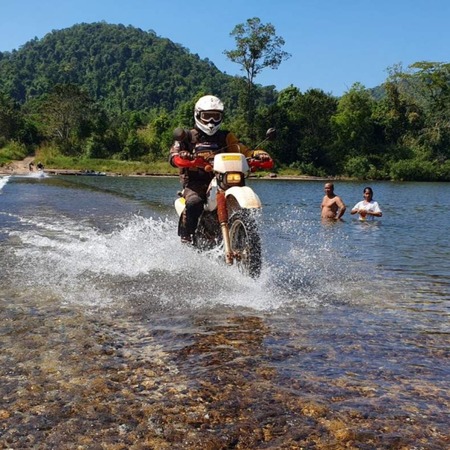
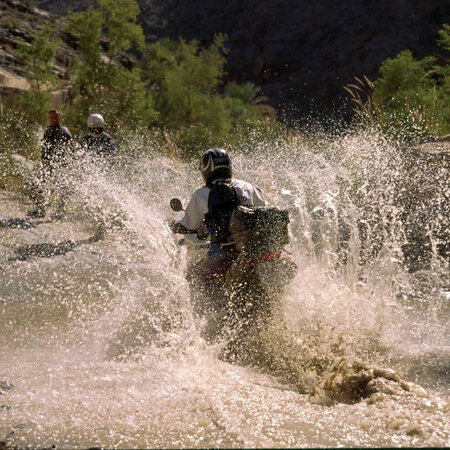
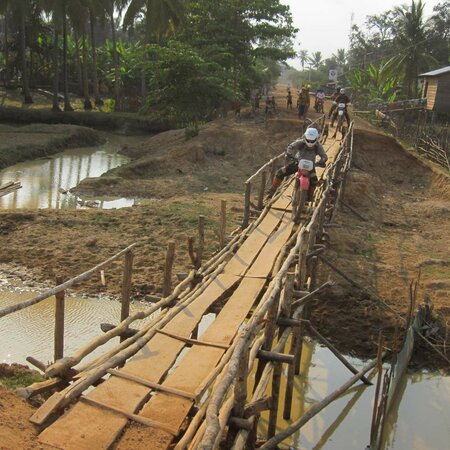
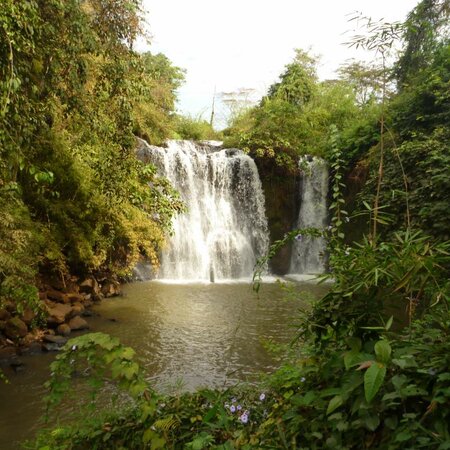
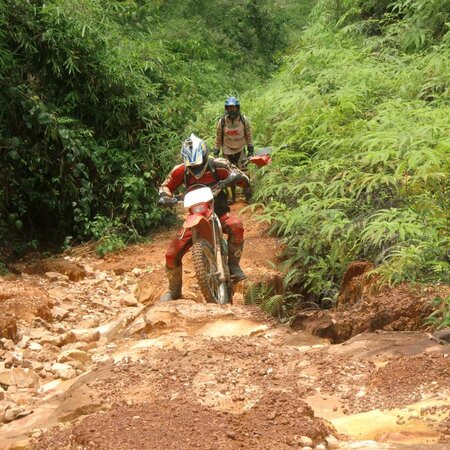
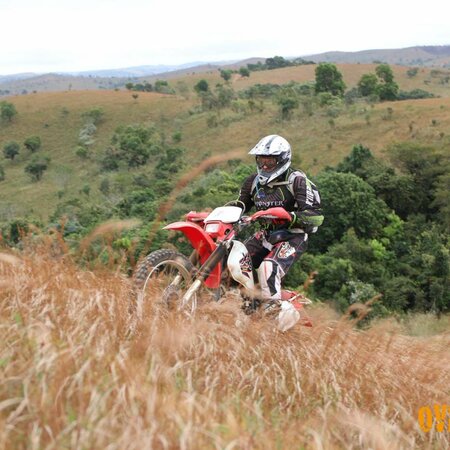
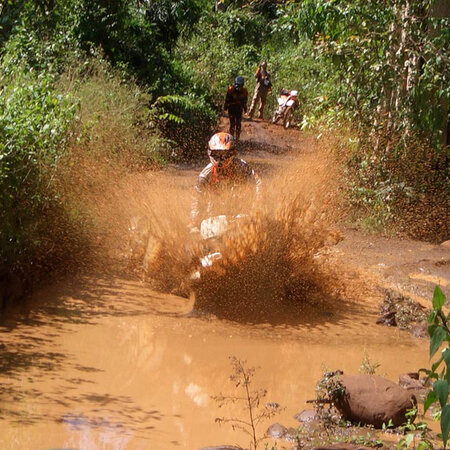
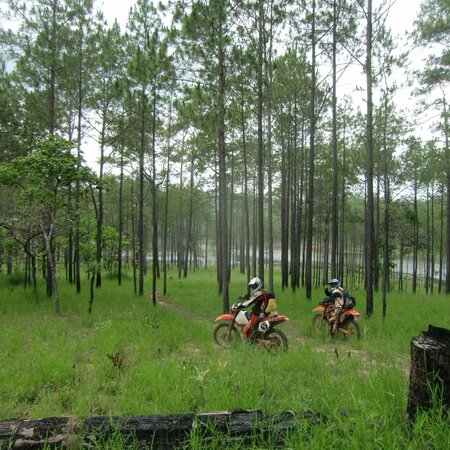
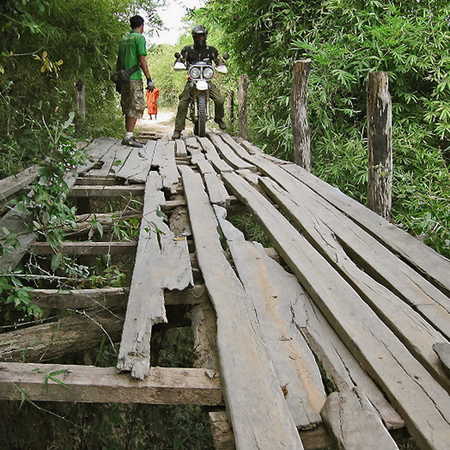
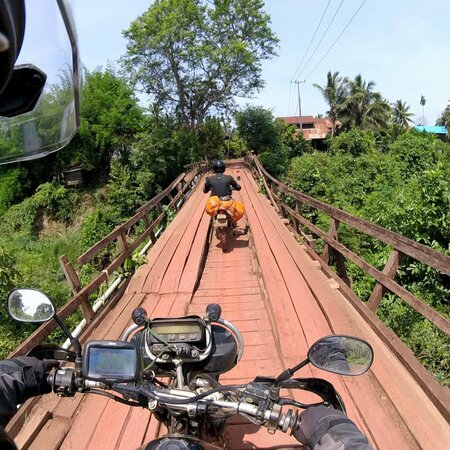
On adventurous paths over the jungles of Cambodia
4. Flora and Fauna in Cambodia
Approximately 60% of Cambodia's land area is covered with forests. Where the lowlands are not used for agriculture, monsoon and dry forests dominate, which lose their leaves during periods without rainfall. Floodplains are occupied by extensive swamps and wet savannas. Mangrove forests spread along the coast. Tropical rainforest can be found on the rain-rich western slopes of the mountains, which above 700 m transitions into evergreen mountain forest. In Cambodia, there are still stocks of tree species that have become rare elsewhere, such as the blackwood tree, the ebony tree, or the rosewood tree.
Approximately 630 protected animal species live in Cambodia. The dense forests of Cambodia away from civilization and the higher mountain areas are inhabited, among others, by Indian elephants, tigers, leopards, flying foxes, and various types of bears. A special feature of Cambodia's wildlife is the kouprey, a wild cattle species with a shoulder height of nearly 2 m. The bird and reptile life is especially rich in species; in addition to the king cobra, which can grow up to 5 m long, Cambodia is home to the highly venomous krait, which belongs to the group of colubrid snakes.
Lake Tonle Sap, with its flood zones, offers numerous water birds and other aquatic animals, including more than 850 fish species, a suitable habitat. In Angkor National Park in the north of the lake, a number of rare animal species live, such as the small muntjac deer, which only reaches a shoulder height of 65 cm. The last refuges of the Irrawaddy dolphin and the Cantor's giant softshell turtle are found in the lower reaches of the Mekong.
5. National Parks and Nature Conservation in Cambodia
As one of the first countries in Southeast Asia to be active in nature conservation, Cambodia established the Angkor National Park around the temple complex of the same name as early as 1925. By 1969, six more wildlife sanctuaries followed, primarily for large mammals. During the civil war, the facilities fell into disrepair. However, starting in 1993, 23 new protected areas and additional protected forest areas were designated, some on land controlled by the Khmer Rouge, which today cover about 43,000 km², putting approximately 25% of Cambodia’s total area under protection. However, in many protected areas, there are still access problems even after the withdrawal of the Khmer Rouge. Conservation in Cambodia also faces conflicts of interest with the growing demand for settlement space and the demand for animal organs for traditional medicine. Illegal logging, lack of will to enforce effective protection, and insufficient resources continue to hinder efforts to adequately protect Cambodia’s unique fauna and flora.
Bokor National Park
The Bokor National Park, covering about 1,500 km², is located in the Kampot Province and extends from Cambodia’s southern coast into the Elephant Mountains. The largest and touristically developed part of this national park consists of tropical rainforests with many wild animals. When exploring the park’s scenic landscapes, you can also see some beautiful waterfalls. From the mountain station at the top of Bokor Mountain, dating back to the French colonial period, there is a fantastic view of the tropical greenery of the national park. Trekking tours into Cambodia’s original rainforest are offered in the park. Individual travelers can rent scooters or small motorcycles to explore the park on their own.
Ream National Park
Officially named Preah Sihanouk, the park is a coastal park located southeast of the city of Sihanoukville that offers the scenic visitor extensive jungle areas, beautiful beaches, small islands with lagoons and coral reefs, as well as an impressive river delta and mountain landscape. A large area of the approximately 150 km² national park is surrounded by mangrove forests. The unspoiled natural landscapes of Ream National Park can be explored by boat, bicycle or motorcycle, and also on foot. The trekking tours and boat trips offered in this park are highly recommended as part of a round trip through Cambodia. The tours can easily be booked through a tour operator in Sihanoukville.
Virachey National Park
Virachey National Park is located in Ratanakiri Province on the border with Vietnam and Laos. It is one of Cambodia’s largest and best-developed national parks. With a bit of luck, you can spot elephants, leopards, tigers, gibbons, and even sun bears. Highlights of Virachey National Park include wild, roaring waterfalls in the middle of the jungle, especially right after the rainy season. Interesting trekking tours with an ecological focus can be booked through the approximately 3,500 km² park. Travelers will find more information at the national park’s own information center.
Phnom Kulen National Park
Located northeast of Siem Reap, Phnom Kulen National Park today protects both the sacred temple complexes of Angkor and the impressive landscape in the Phnom Kulen mountain range. The landscape park, which is just under 400 km² in size, is known not only for its archaeologically significant remnants from the Angkor era but also for its impressive waterfalls.
6. Population in Cambodia
About 16.8 million people (2024) live in Cambodia with a population density of 93 inhabitants per km². Over 90% of the population belong to the Khmer ethnic group. The largest ethnic minority, with a share of about 5% of the total population, are Vietnamese, followed by Chinese with around 1%. In the coastal area and at the lower reaches of the Mekong live members of the Cham, who belong to the Malay peoples. Various Thai peoples, now called Khmer Loeu, mainly settle in the mountainous border region with Thailand. About 20% of the total population lives in larger cities, including over 1 million inhabitants in the capital Phnom Penh. Large parts of the mountains are extremely sparsely or not at all populated, the majority of Cambodians live in the central lowlands. The official language is Khmer, other languages are French, Vietnamese, Chinese, Cham as well as various other minority languages. When traveling through Cambodia, it is at least possible in tourist areas to communicate sufficiently in English.
Theravada Buddhism, to which 95% of the population belong, is the state religion in Cambodia. Religious minorities include Muslims (about 2%) and Christians; animistic religions are also practiced.
Decades of civil war and the cruel actions of the Khmer Rouge have led to extremely poor living conditions for the population: with an estimated per capita income of 1,500 USD per year, the country is one of the poorest in the world. Medical care for the population is inadequate, and average life expectancy is 73 years. The family is the most important social security for the individual. Despite a child mortality rate of about 2% of all births and an HIV infection rate of 1.6% of the population, population growth is 1.6% annually. Nearly 80% of Cambodia's population can read and write.

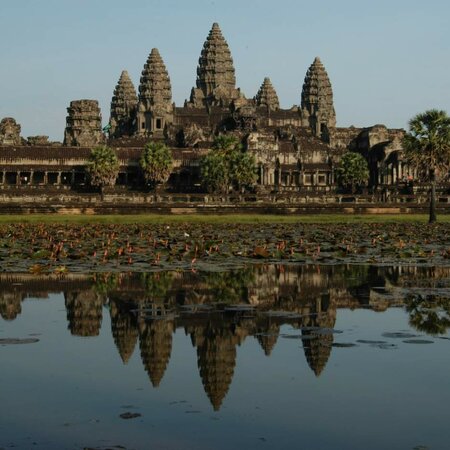
The world-famous Angkor Wat temple complex in Cambodia
7. Politics and Economy in Cambodia
Cambodia is, according to the current constitution, a constitutional, parliamentary elective monarchy. The head of state is the elected king, who primarily performs representative duties. The executive power lies with the prime minister, who is usually provided by the representative of the strongest party in the National Assembly and leads a council of ministers headed by the prime minister.
The legislative power is exercised by the bicameral parliament, which consists of the National Assembly with 123 deputies directly elected by the people for five years, and the Senate with 61 indirectly elected seats. The highest legal authority is the Supreme Court in Phnom Penh. The Cambodian legal system is a mixture of French law, royal decrees, and customary law; some regulations from the communist regime have also been retained. The administration of Cambodia is divided into 24 provinces. Despite the formal separation of powers, Cambodia's political system has authoritarian elements that excessively favor the position of the prime minister.
During the civil war and under the communist terror regime of the Khmer Rouge as well as the subsequent Vietnamese occupation, Cambodia, which once enjoyed a high standard of living, was set back by decades in its economic development. Only with the introduction of the market economy and corresponding development aid did Cambodia achieve annual economic growth of about 7 - 11% from 1993 onwards, which is mainly attributed to increasing tourism and textile exports. Despite the difficult economic situation, Cambodia is now one of the fastest-growing economies in Asia and has been admitted as a member of the Southeast Asian association of nations ASEAN.
Of the nearly 30 billion USD GDP in 2022, 25% was accounted for by agriculture, 28% by industry, and 47% by the service sector, in which tourism—with growth rates of around 30%—is set to become a significant economic factor in the future. Cambodia's export goods primarily include wood, rubber, rice, fish, tobacco, as well as apparel and footwear.
Despite international intervention, the black market in precious woods and drugs still thrives. Human trafficking (the sale of children and women into prostitution) has also not yet been completely curbed.
Off the coast of Cambodia, concessions are being granted for oil extraction. In the north, the country possesses various mineral resources such as gold, coal, gemstones, bauxite, iron, and phosphates, whose viability for mining has not yet been sufficiently explored. Since 2011, Cambodia has also had a stock exchange with the Cambodia Securities Exchange.
8. Transport network in Cambodia
Of the approximately 28,300-kilometer road network in Cambodia, not even 10 percent of the routes are paved. The transportation hub is the capital city Phnom Penh in the south of the country. From here, national roads radiate in all directions. Since the turn of the millennium, the road network has been expanded and modernized with the help of international aid funds. The most important public means of transport are coaches and minibusses, which run between the largest cities in the country.
Passenger trains play hardly any role in public transportation and have only been in operation again since 2016 in southern Cambodia. There is a total of about 600 kilometers of single-track railway lines, which are mainly used for freight transport.
The Mekong plays a major role as a transport route in the east of the country. Passenger ships regularly operate between Phnom Penh and Siem Reap. The border with Vietnam can also be crossed by boat on the Mekong. In total, about 3,000 kilometers of waterways exist on the largest river in Southeast Asia, but they are gradually being replaced by roads over land. Cambodia’s only overseas port is located in Sihanoukville on the coast.
For a trip to Cambodia, the international airports in the capital Phnom Penh and in Siem Reap are served by various airlines. There are currently (2024) no direct flights from Germany. A stopover usually takes place in Bangkok or Guangzhou.
9. Cities and Regions in Cambodia
Cambodia is divided into 23 provinces of varying sizes, whose subordinate administrative levels are the districts and communes. The capital, Phnom Penh, constitutes a special administrative region.
Phnom Penh
The settlement of the area around Phnom Penh dates back to the Khmer around 1430 with the last ruler of Angkor. The city itself only became significant during the French colonial period, when both the royal seat and the colonial administration of Cambodia were moved to Phnom Penh and the entire city was rebuilt by the French. About 2.1 million inhabitants live in Cambodia’s capital on an area of 376 km² (as of 2024). The city lies in the south of the country on the Tonle Sap River, a tributary of the Mekong. Phnom Penh has a university and a technical institute and is connected to other countries via an international airport. Cambodia’s economy is also concentrated in the capital. The city's port is accessible for smaller sea-going vessels via the Mekong. In Phnom Penh. Due to its many sights and a now well-developed nightlife with numerous restaurants, the capital is, after Angkor, one of the most important tourist destinations in Cambodia. Architectural highlights include both traditional structures such as the wats, stupas and pavilions, as well as buildings from the French colonial period and the New Khmer Architecture consisting of the Olympic Stadium and the Tonle Sap promenade. The Central Market, in the Art Deco style of the 1930s, is also worth seeing.
Siem Reap
Due to the nearby temple complex of Angkor Wat, one of the touristic highlights of any trip to Cambodia, Siem Reap is probably the best-known province of Cambodia. It is located in the northwest of the country and has just over a million inhabitants (2024). The south of the province, with its fertile lowlands and numerous rice fields, borders Tonle Sap Lake – the largest freshwater reservoir in Southeast Asia, with enormous fish stocks and some floating villages. Also in the southern part is the provincial capital of the same name, Siem Reap, with a population of about 180,000 – just a few kilometers north of Tonle Sap Lake. The city offers ample accommodation for visitors to the nearby temple complex. The gently hilly north of the province is covered with dense forest. The Siem Reap River winds through here, flowing south into Tonle Sap Lake.
Sihanoukville
The port city on the Gulf of Siam is, with about 100,000 inhabitants, the fifth largest city in Cambodia and at the same time the capital of the province of the same name, Sihanoukville. Even during the French colonial era, the city was considered Cambodia’s “Côte d’Azur” and was a popular recreation spot for the French working in the colonial administration. Relics of French colonial villas still recall this period. Besides beautiful sandy beaches, Sihanoukville also has Cambodia’s only deep-sea port.
Battambang
With about 200,000 inhabitants, Battambang is the second largest city and administrative capital of the province of the same name, which is known for its fertile conditions for rice cultivation. In addition to the tropical postcard landscape in which the city is embedded, the Hindu temples Wat Ek Phnom and Wat Banan, the Buddhist monastery Phnom Sampeau, and French colonial architecture are worth seeing. The Bahá'í have established a generous house of worship in Battambang. In the 19th century, the province of Battambang was temporarily part of neighboring Siam, now Thailand.
10. Culture and Sights in Cambodia
Cambodia’s culture is deeply rooted in the culture of the ancient Khmer Empire. The strong Indian influence at that time is evident in architecture and iconography, but also in religion, dance, and literature. Today’s Khmer people still identify with their ancient culture and use it at the same time as a showcase for tourism. Therefore, maintaining and preserving traditional culture and the associated shrines and monuments is of great importance in Cambodia, which is ultimately expressed in the temple complexes of Angkor, declared a cultural-historical protected area and national park as early as 1925. Music, traditional dances, and the popular shadow plays also display the characteristics of the unique Cambodian culture, which is preserved both in its original form to this day and forms the basis for new developments. The revival of Cambodian art and culture, started in 1979, is reflected in state-sponsored restoration of monuments and shrines, as well as the reopening of two art schools and in the exhibitions of artworks at the National Museum in Phnom Penh, which escaped destruction by the Khmer Rouge.
Among the most famous sights in Cambodia are undoubtedly the historic temple complexes in the province of Siem Reap, some of which are UNESCO World Heritage sites, above all the complex Angkor Wat. The ruins of Angkor Wat, which are a must-see on any trip through Cambodia, speak of a period between the 9th and 15th centuries, during which more than a million people lived in the vast temple complex. Angkor Wat is Cambodia’s national symbol and appears both on the national flag and on Cambodian banknotes. Historical records mention that Angkor Wat was built in the 12th century under the command of King Suyavarman II. Originally it was a Hindu temple, but in the 13th century, the belief system changed, and Angkor Wat became a Buddhist temple. The five towers in the form of lotus blossoms are the main feature of the complex, which, including the surrounding moat, covers an area of about 2 km². The large area with the tropical vegetation of the surrounding jungle offers enchanting and mystical impressions of a past world that no one should miss on a journey through Cambodia.
Early in the morning, the road from Siem Reap is already busy, because many tourists are on their way to Angkor Wat to admire the spectacular setting of the complex at sunrise. Cambodia’s most famous and largest temple is between 5:00 and 5:30 am a tourist magnet like no other attraction in Cambodia. In the middle of the temple complex, countless tourists wait by a large lotus pond for a special spectacle: before the backdrop of the lotus-shaped temple gates, a colorful display reveals itself to observers within seconds. Suddenly, it gets bright out of deep darkness, and for a brief moment, the sky turns a light pink. A new day begins!
About one kilometer north of Angkor Wat is the temple complex Angkor Thom, which was built by the important Khmer king Jayavarman VII and is also counted among Cambodia's famous temples. Angkor Thom is bounded by a moat about 100 m wide and a square wall with sides of 3 km. Angkor Thom is accessible via 5 gates in total, with the south gate being the best preserved. Framed by gods and demons made of stone, a bridge leads over the moat. From here, you go directly to the central temple of Angkor Thom – Bayon. To explore the entire complex of more than 3 km² and to discover its rich cultural history in peace, at least half a day is necessary. A highlight of the tour are the mysterious bas-reliefs in Bayon temple, which tell of everyday Khmer life and also provide depictions of the brutal war scenes of that era. While Angkor Wat is still more influenced by Hinduism, it is the Buddhist details here that captivate visitors.
Nature lovers will also get their money’s worth, especially in the impressive national parks of Cambodia, with partly untouched jungle landscapes and mangrove forests. On Cambodia’s coasts, and especially on the small offshore islands, there are maritime gems with beautiful beaches, lagoons, and coral reefs. A particular highlight on the island of Koh Rong is plankton diving at night, where participants experience the spectacular illumination of the sea by fluorescent or phosphorescent microorganisms.
11. Public holidays with fixed date in Cambodia
| 1 Jan | New Year's Day |
| 7 Jan | Day of Liberation |
| 8 March | International Women's Day |
| 1 May | Labor Day |
| 18 Jun | Birthday of the former Queen |
| 24 Sept | Constitution and Coronation Day |
| 31 Oct | Birthday of former King Sihanouk |
| 9 Nov | Independence Day |
| 10 Dec | Human Rights Day |
12. Medical Advice for Cambodia
For legal reasons, as a tour operator we are not permitted to provide binding medical advice for Cambodia and therefore refer you to the information of the Federal Foreign Office of the Federal Republic of Germany, the Robert Koch Institute and the German Society for Tropical Medicine and International Health e.V.
13. Travel Advice for Cambodia
Current travel and safety advisories, information on entry and exit as well as special criminal law advice and behavioral recommendations for your stay in Cambodia can be obtained from the Federal Foreign Office of the Federal Republic of Germany.
14. Foreign Representation in Cambodia
| Embassy of the Federal Republic of Germany in Phnom Penh | |
| Jurisdiction/ Consular district: |
Kingdom of Cambodia |
| Location: | Phnom Penh |
| Street address: | No. 76-78 Rue Yougoslavie (= Street 214), 12258 Phnom Penh |
| Mailing address: | Embassy of the Federal Republic of Germany, P.O. Box 60, 12258 Phnom Penh, Kingdom of Cambodia |
| Phone: | +855 23 21 61 93, +855 23 21 63 81, for emergencies +855-(0)10-990 002 |
| Fax: | +855 23 21 70 16, +49 30 1817 671 74 |
| E-Mail: | Contact form |
| Website: | http://www.phnom-penh.diplo.de |
| Official languages in host country: |
English and French |
| Embassy of the Kingdom of Cambodia in Berlin | |
| Location: | Berlin |
| Street address: | Lichtensteinallee 1 |
| Mailing address: | Benjamin-Vogelsdorff-Strasse 2, 13187 Berlin |
| Phone: | 030 254 00 70 |
| Fax: | 030 257 995 57 |
| E-Mail: | [email protected] |
| Website: | http://www.kambodscha-botschaft.de |
15. Information sources for Cambodia
German Weather Service
Federal Foreign Office of the Federal Republic of Germany
Wikipedia