Tunisia from 2.050 €

Germany from 299 €

Peru from 2.379 €

South Africa from 869 €

Namibia from 1.129 €

Greece from 1.579 €

Switzerland from 1.289 €

Senegal from 4.729 €

Mauritania from 4.729 €

Nigeria from 9.899 €

India from 2.469 €

France from 270 €

Spain from 1.239 €

Italy from 1.079 €

Chile from 2.819 €

Morocco from 2.059 €

Kenya from 1.899 €

Austria from 2.679 €

Tanzania from 2.369 €

Ukraine from 2.060 €

Cameroon from 9.899 €

Congo (DR) from 9.899 €

Western Sahara from 4.729 €

Balkan from 669 €

China from 8.899 €

Travel Information Spain

Sun, beach, and unforgettable tapas experiences!

Everything you need to know about Spain

Travel map of France by the tour operator Overcross

Travel map of Spain by the tour operator Overcross


  1. General travel information for Spain
  2. Travel climate in Spain
  3. Geography in Spain
  4. Flora and fauna in Spain
  5. National parks and nature conservation in Spain
  6. Population in Spain
  7. Politics and economy in Spain
  8. Transport network in Spain
  9. Cities and regions in Spain
  10. Culture and sights in Spain
  11. Holidays in Spain
  12. Medical information for Spain
  13. Travel information for Spain
  14. Foreign representations in Spain
  15. Information sources for Spain


1. General travel information for Spain

Continent: Europe
Geographical location: Western Europe, located in the northern hemisphere between the Atlantic and the Mediterranean
Highest elevation on the mainland: Mulhacén (3482 m above sea level)
Longest river: Teijo (1007 km)
Form of government: Parliamentary hereditary monarchy
System of government: Parliamentary democracy
Languages: Spanish
Neighbouring countries: Portugal, France and Morocco
Capital: Madrid
Area: Approx. 506,000 km² (Europe only)
Population: Approx. 47 million people (2023)
Population density: 92 inhabitants per km²
Religions: Approx. 92% formally adherents of Christianity (Roman Catholic, but around 16% non-believers among them), 4% Muslims, 9.5% atheists, less than 1% Protestants, Jehovah's Witnesses
Currency: Euro; You can find current exchange rates for our travel destinations at oanda.com
Travel climate: Oceanic-Continental, Mediterranean travel climate along the Mediterranean coast
Time zone: UTC +1
Dialing code: +34
Country code: ES
Electricity: In Spain, socket types C, F and L are used. The mains voltage is 230V with a 50Hz alternating interval. A travel plug adapter can be advantageous locally. An overview of sockets and plugs used in our travel destinations can be found at wikipedia.de

back to top of page


2. Travel climate in Spain

In the interior of Spain, there is an oceanic-continental climate with hot, dry summers and cold, rainy winters, with regular snowfall in the north.
In the area of the northern Atlantic coast, the climate is much more moderate, with very mild winters and tolerable summer temperatures. Here, too, most of the precipitation falls in the cold season.
In contrast, the south of Spain with the Mediterranean coast has an explicitly Mediterranean climate with mild winter temperatures and hot summers, with most precipitation occurring in spring and autumn, which can be stormy right on the coast and on the Balearic Islands.
The Canary Islands already have a subtropical climate with no distinct winter season and consistently pleasant temperatures between 18 and 24 °C.
In the high altitudes of the Pyrenees, the Cantabrian and Iberian mountains, the Castilian Divide, and the Baetic Cordillera, the climate is characterized by long, cold winters and short, cool summers.

Travel climate chart for Madrid by tour operator Overcross


Travel climate chart for Santander by tour operator Overcross


Travel climate chart for Almeria by tour operator Overcross


Travel climate chart for Sevilla by tour operator Overcross


back to top of page


3. Geography in Spain

The travel destination Spain is located in Southwestern Europe and extends over the majority of the Iberian Peninsula. The kingdom, with an area of approximately 506,000 km², is after Russia, Ukraine, and France the fourth largest country in Europe. Land borders exist in the northeast with France and Andorra, and in the west with Portugal. In the north and northwest as well as the extreme southwest, Spain borders the Atlantic Ocean and in the east and southeast the Mediterranean Sea. The coastline without islands is about 3,150 km, about half of which is the Mediterranean coast. The national territory also includes the Balearic Islands with the well-known travel destination Mallorca, the Canary Islands, and in North Africa the small territories of Ceuta and Melilla. The Gibraltar Peninsula at the extreme southern tip of the Iberian Peninsula has been administered by Great Britain since 1704.
Spain, or the entire Iberian Peninsula, is intersected by several mountain ranges that run mainly from west to east. On the northern Atlantic coast, the Cantabrian Mountains stretch with peaks up to 2,600 m a.s.l. (Picos de Europa). In the east, the Cantabrian Mountains merge into the Pyrenees, whose highest peak is Pico de Aneto at 3404 m a.s.l. and which separates the Iberian Peninsula from France or the rest of Europe.
Approximately in the middle of Spain, the Central System runs in several blocks, which have elevations of up to 2,600 m a.s.l. To the west, the mountain range continues in Portugal as the Serra da Estrela. Further south, the approximately 1,300 m high Sierra Morena separates the central highlands from the depression of the Guadalquivir.
Finally, along the Mediterranean coast, the Betic Cordillera runs from Gibraltar to south of Valencia and further to the Balearic Islands, where it continues in the Serra de Tramuntana on Mallorca. In the mountains of the Betic Cordillera, on the Sierra Nevada with the Mulhacén, lies the highest elevation of the Iberian Peninsula at 3,482 m a.s.l.
Between the mountain chains run the river systems of the Duero, Tajo, Guadiana, and Guadalquivir, which flow into the Atlantic and have their origin in the Iberian System.
The Iberian System east of the Central System, with heights up to 2,300 meters, is the only mountain range in Spain to have a northwest to southeast orientation and forms a natural watershed between the river system of the Ebro in the east, which drains into the Mediterranean Sea, and the westward flowing rivers, all of which flow into the Atlantic.
The center of the Iberian Peninsula is occupied by an extensive high plateau called the Meseta, which is divided by the ridge of the Central System into a slightly higher northern and a lower southern part.
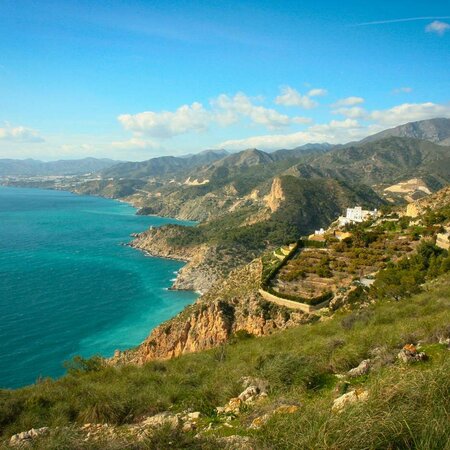
In mountainous Spain, only the river valleys of the Guadalquivir and the Ebro form lower-lying depressions; also, the coasts of Spain are largely rocky and not shaped by extensive lowlands, which, among other things, creates the scenic appeal of the coastal travel regions in Spain.
On the Canary Islands, whose origin is due to the volcanic activity of the Mid-Atlantic Ridge, is found with the volcano Teide on Tenerife the highest peak on Spanish territory at 3,715 m a.s.l.

back to top of page
 

In der Sierra Nevada

In the Sierra Nevada


4. Flora and Fauna in Spain

The southern half of Spain is characterized by Mediterranean vegetation with plants such as lavender, myrtle, laurel, cistus, or mastic. Ferns, broom, and heather species are also widespread. Typical tree species found in Spain include the stone pine and other types of pine, various types of oaks such as holm oak and cork oak, as well as eucalyptus trees. Palms on the Mediterranean coasts contribute to the southern flair of these popular travel destinations.
In the mountainous regions, one encounters coniferous trees or beeches, and in lower areas sweet chestnuts, hazelnut, ash, linden, or maple. In many parts of the country, except the rainy Atlantic coast, trees have a hard time reestablishing themselves after clear-cutting because of dry periods and temperature fluctuations.
The Balearic Islands already have a distinctly Mediterranean flora with the characteristic maquis of mastic shrubs, dwarf palms, broom, rosemary, strawberry trees, or juniper trees. On the volcanic substrate of the Canary Islands, its own diverse vegetation has developed or survived thanks to favorable climatic conditions in the various altitudes, such as the laurel forests that have already disappeared elsewhere in Europe due to the Ice Age.
Especially in the hot south of Spain, crops are intensively cultivated with corresponding irrigation measures, which in the long term lead to lasting disturbances in the groundwater balance.

Spanish wildlife has been partly influenced by Africa and some animal species, such as the common genet, migrated from there to the Iberian Peninsula. The Pyrenees form a natural barrier for migration to the rest of Europe, which is why some species of wolves and bears have survived in Spain, whereas they have been eradicated elsewhere in Europe. Additionally, a rare, protected species is the Iberian lynx. The Egyptian mongoose is the only mongoose species in Europe and occurs only in Spain, Portugal, and more recently in Italy.
Numerous mammal species familiar from Central Europe are also frequently encountered when traveling through Spain, including red deer, wild goats, squirrels, hares, rabbits, wild boars, and foxes. In the mountainous regions, Pyrenean chamois, Iberian ibex, mouflons, and marmots are native. Among the many birds living on the Iberian Peninsula are large birds such as buzzards, imperial and golden eagles, bearded, monk, griffon, and Egyptian vultures, pheasants, as well as flamingos living in wetlands. As in all countries with hot and dry climates, Spain is also home to a large number of reptiles, including lizards, geckos, skinks, slow worms, snakes, land and sea turtles, as well as special species such as the loggerhead sea turtle, Canary Island lizards, El Hierro giant lizard, or the ocellated lizard, the largest lizard species in Europe with body lengths of up to 90 cm.
From time to time, especially southern Spanish regions are invaded by locusts flying in from Africa. The Barbary macaques of Gibraltar are a well-known tourist attraction, and from many coastal towns, boat trips for observing marine mammals and the diverse underwater world off the coasts of Spain are offered.

back to top of page


5. National Parks and Nature Conservation in Spain

Nature conservation was already established in Spain in 1916 with the enactment of the National Park Law. After a temporary halt to conservation activities at the outbreak of the Spanish Civil War and under Franco's dictatorship, the Spanish government has been increasingly striving since 1970—most recently with the Law on Natural Heritage and Biodiversity of 2007—to protect and preserve the partly unique landscape, fauna, and flora of Spain, as well as to implement European and international nature conservation directives. On the Spanish mainland, 15 national parks have now been established. The largest of these is the Sierra Nevada National Park, located on the Baetic Cordillera in southern Spain, with an area of about 86,000 km². In the Cantabrian Mountains in northern Spain lies the almost 70,000 km² Picos de Europa National Park in the eponymous and strongly karstified mountain massif, which is well known for its caves. At the mouth of the Guadalquivir in Andalusia is the approximately 50,000 km² Doñana National Park in Spain's largest wetland area. A 34,000 km² section of the scenically impressive Castilian watershed is protected by the Sierra de Guadarrama National Park near Madrid. In Extremadura in western Spain lies the impressive, almost 18,000 km² bird sanctuary Monfragüe. Spain's oldest national park is the Ordesa y Monte Perdido National Park, established as early as 1918 in the Pyrenees around the 3,355-metre-high Monte Perdido on an area of 15,600 km². In 1955, the similarly sized national parks Aigüestortes i Estany de Sant Maurici were added in the Pyrenees. In addition to several islands off the coast of Galicia protected by the Atlantic Islands of Galicia National Park and the relatively small Tablas de Daimiel National Park for the protection of a wetland in the Spanish Mancha, there are other national parks and protected areas in the Balearic and Canary Islands.

back to top of page


6. Population in Spain

The Spanish population has experienced enormous growth in recent decades, particularly due to pronounced immigration, reaching almost 47 million inhabitants (2023). The growth rate is about 0.3%. Today, the Spanish population has a foreigner share of about 12%, which mainly consists of immigrants from Romania, the states of the Maghreb, or Latin America. In addition, there are also Britons and Germans among the immigrants, for whom Spain has become a popular place to retire. Among the minority populations of Spain are the Spanish Roma, known as Gitanos, who immigrated to Spain since about the 16th century and today number about 600,000 to 800,000 people living in Spain.
Although over 90% of Spaniards officially belong to the Roman Catholic Church, around 20% of the population describe themselves as non-religious or atheist. This is partly because Spanish law does not provide for the act of leaving the church, so many non-believers are still officially recorded in the church registers.
Although the Spanish language, which developed from Castilian, is the official language throughout the territory of Spain, Catalan, Galician, and Basque are also spoken regionally, even for official purposes. In Catalonia, most schools and universities even teach primarily in Catalan. As foreign languages, both English and French are established in Spain, so when traveling through Spain, adequate communication in one of these two foreign languages is usually possible.

back to top of page
 

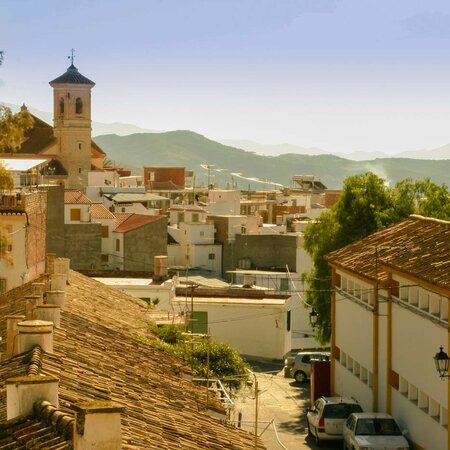
Village in Andalusia

Village in Andalusia


7. Politics and Economy in Spain

Spain has a hereditary monarchy with a parliamentary-democratic system of government in the form of a parliamentary monarchy. According to the constitution, Spain is a social and democratic state governed by the rule of law, guided by the principles of freedom, justice, equality, and political pluralism. State power emanates from the Spanish people, who are the bearers of national sovereignty. The head of state and at the same time commander-in-chief of the armed forces is the king. Otherwise, the king’s functions are predominantly representative, similar to the political role of the German Federal President. He confirms laws and is responsible for the appointment and dismissal of the prime minister elected by the House of Representatives. The prime minister assumes the function of head of government. The legislative function lies with the parliament, which consists of two chambers. The House of Representatives has a maximum of 400 seats, which are filled by general, free, equal, direct and secret elections. The Senate, with about 250 members, most of whom are elected by the people, is responsible not only for legislation but also for approving the state budget and controlling the government.

Through the economic reform of 1959, the democratic transition after the end of the dictatorship, accession to the European Community, and participation in the European Economic and Monetary Union, the foundations for a long-lasting economic upswing were established in Spain. The successive modernization and liberalization of the country’s industry led to the emergence of several internationally renowned and successfully operating companies such as Iberia, Seat, Telefónica, Zara, or Endesa. Spain’s opening to international competition resulted in extensive foreign direct investment. However, traditionally operating sectors of manufacturing industry such as in the Basque Country also had to accept considerable losses as a result.
Growth in recent years was also largely driven by a loan-backed real estate boom, whose bubble burst in the course of the financial crisis from 2007 onward, forcing Spain, after the collapse of several financial institutions, to utilize the euro bailout fund for 18 months during which Spain received a total of 41.4 billion euros to support struggling credit institutions.
After a recession initiated by the financial crisis of 2009, GDP growth has been on the rise again since 2014—initially with 1.4% and 3.2% in 2015. The most important sectors of Spain’s tourism destination economy, alongside tourism and all related industries, are construction, communications and information technology, metalworking industry, mechanical engineering, agriculture, and petrochemicals. The unemployment rate, which had risen to over 26% in 2012 during the recession, recovered to about 12% in 2023. One persistent problem is the high youth unemployment rate of almost 30% (2023).

back to top of page


8. Transport network in Spain

Spain has a well-developed road and highway network stretching 663,795 kilometers, with predominantly asphalted roads. Among the main roads, there are both free and toll highways in addition to national roads, with highway sections in urban areas generally being free to use, while longer routes between cities require payment. For a trip through Spain by off-road vehicle or motorcycle, it is important to know that in Spain there are customary behaviors among drivers that differ from the official traffic rules, where the flow of traffic is often prioritized over actual right of way. For example, it is advisable not to insist on your right of way when turning right if a left-merging vehicle is approaching, and in general to let drivers of less maneuverable vehicles such as trucks go ahead. Parking any car or motorcycle on sidewalks or pedestrian areas is prohibited, and even partially occupying such a parking space will result in immediate towing. However, in Spain it is entirely normal for motorcyclists to weave between slowly moving or stationary rows of cars.

Of the more than 15,000 km of Spain’s railway tracks, about 3,000 km belong to the country’s high-speed network, on which high-speed trains such as the French TGV, the Spanish AVE, or the Siemens-developed Velaro operate between all major cities. Therefore, one can travel very comfortably by train across long distances in Spain. Urban rail transport within metropolitan areas is also very well developed. Only remote places far away from large cities and tourist centers are more difficult to reach by rail. For these, travelers to Spain have access to an excellent long-distance bus network, often with dedicated bus stations.

Of Spain’s approximately 40 airports, many have international flight connections, allowing travelers to easily reach their starting and departure points in Spain directly from their home country. These include the capital airport Madrid, Barcelona Airport, Palma de Mallorca Airport, Málaga Airport, Alicante Airport, Valencia Airport, Girona Airport, Bilbao Airport, Almería Airport, Zaragoza Airport, San Sebastián Airport, and La Palma Airport on the Canary Islands.

As a traditional seafaring nation, Spain naturally has a number of major ports along its coasts, some of which are of national importance. The most important seaports are located on the Mediterranean in Algeciras, Barcelona, and Valencia, and on the Atlantic in Bilbao and Gijón. On the Canary Islands, the port of Santa Cruz on Tenerife is particularly important for cruise travel, as it can accommodate all types and sizes of vessels and also serves as a major supply port for transatlantic passenger and pleasure craft traffic. Due to the construction of many reservoirs on Spain’s major rivers, the Guadalquivir is the only navigable river in Spain, although only between the Atlantic and Seville. This section of the Guadalquivir can also be traversed by ocean-going vessels, which is why the port of Seville was the main transshipment point for Spanish maritime trade in the 16th century.

back to top of page


9. Cities and Regions in Spain

The Spanish mainland is governed in 15 regions, which, although not sovereign states, nevertheless have a level of autonomy comparable to the German federal states. For example, each region determines additional holidays independently of those set by the national government, which is why one should check the applicable holiday regulations before traveling through Spain.
The most well-known Spanish regions are the Basque Country, Andalusia, Asturias, Cantabria, Navarre, the Madrid Region, Catalonia and Galicia. In addition to the mainland regions, there are also the travel regions of the Balearic and Canary Islands as well as the autonomous Spanish exclaves Ceuta and Melilla on the North African coast. The regions themselves are governed in provinces, although seven regions do not have any further administrative division. The autonomous status of the Basque Country and Catalonia has long been subject to unresolved conflicts, which in the Basque Country have been accompanied by terror and violence in the past.
The largest cities in the country are the Spanish capital Madrid and the capital of Catalonia, Barcelona, with 3.2 and 1.6 million inhabitants respectively. Next come the cities of Valencia, Seville, Zaragoza, and Málaga with populations between 800,000 and 600,000.

Madrid
The Spanish capital Madrid has, since historical times, formed the geographic, political, and cultural center of Spain and was both the capital of the former Kingdom of Castile as well as the capital today of the autonomous region of Madrid, which emerged in part from it. In addition to the seat of the Spanish government, important administrative and military authorities as well as the King's Palace and the Archdiocese of Madrid with the Catholic Archbishop are located in the Spanish capital. The city has also gained both national and international importance as a trade and financial center. Madrid is home to six public universities as well as various other educational and cultural institutions. Due to the excellent international flight connections to Madrid Airport, the Spanish capital is the starting point and sightseeing destination for many trips to Spain.
Hardly any traces remain from the founding period of Madrid in the 9th century. While the cityscape of Madrid was initially shaped mainly by the Spanish Habsburgs and Bourbons, the capital underwent extensive remodeling at the beginning of the 19th century under King Joseph Bonaparte. After the destruction during the Spanish Civil War, the dictator Francisco Franco, who emerged from the turmoil, had the city rebuilt or remodeled according to his plans. With the economic reform, the number of skyscrapers steadily increased from 1959 up to the financial crisis of 2007. Over the course of the 20th century, the population of the city increased sixfold from around 500,000 to over three million. Today, Madrid, with over 3.2 million inhabitants (2023), is the third largest city in the European Union.
Although a large part of Madrid's historic buildings was destroyed during the city's eventful history, the city still offers a rich cultural heritage with architectural monuments from many stylistic epochs as well as historic districts, squares, and streets. The Plaza Mayor, laid out in the 15th century as a marketplace in the center of the Old Town, remains the liveliest square in the city to this day. From the Plaza de la Puerta del Sol, the six national highways, laid out radially in all directions, lead into the country, marking both the center of the city and of all Spain. On Plaza de Cibeles are three of Madrid's greatest sights: the Fountain of Cybele, Palacio de Comunicaciones, and the Bank of Spain. The magnificent Calle de Alcalá starts at Puerta del Sol and features numerous representative historicist buildings up to Plaza de Cibeles. The baroque Royal Palace (Palacio Real) is one of the largest palaces in Western Europe and is nearly twice the size of Buckingham Palace or the Palace of Versailles. Built in 1919 using various historical architectural styles, Palacio de Cibeles has been the seat of the city administration of Madrid since 2007. Retiro Park is a generously designed green space, once laid out as a royal garden and today open to the public for recreation and leisure activities. A crowd-pleaser in the park is the Crystal Palace, which is made almost entirely of glass.

Barcelona
With over 1.6 million inhabitants, Spain's second largest city lies on the Mediterranean in the center of Catalonia, whose capital is Barcelona. Although the founding of Barcelona can be traced back to the more than 2,000-year-old Iberian settlement of Barkeno, only a few facts are known about Barcelona's origins. After the Romans settled the place called Barcino, the city's checkered history of power began with the rise of the Visigoths and then the Moors, with power changing several times between the medieval dynasties of the Carolingians, Franks, and Habsburgs as a result of various conquests, dynastic successions, and uprisings. Barcelona, which had already flourished in the Middle Ages as a significant trading center in the western Mediterranean, experienced renewed economic growth in the mid-19th century as a center of Spain's industrial development, which significantly contributed to Barcelona's wealth and political influence. The city expanded and was, among other things, enlarged by a new district with an isomorphic grid pattern. Barcelona was host of several international exhibitions, including the 1888 World's Fair and the equally significant Exposición Internacional de Barcelona in 1929. In 1938, as a result of the Civil War, Barcelona became the target of numerous heavy air raids with considerable destruction. Modern Barcelona, in the course of Spain’s political renewal, developed into a popular tourist destination with steadily increasing visitor numbers and was the venue for the 1992 Olympic Games.
In addition to the historic old town, the Gothic Quarter, where many beautiful architectural testimonies of the medieval royal and merchant city, such as the Cathedral of Saint Eulàlia, the Royal Square, or the Town Hall, can be found, significant monuments from the early industrialization period are also worth seeing. These include the Palau Nacional or the planned Eixample district with the Basilica Sagrada Família and numerous villas and houses inspired by Art Nouveau in the special Modernisme style, some of which are UNESCO World Heritage Sites. Several squares, magnificent boulevards, and promenades such as Plaça de Catalunya, Passeig de Gràcia, the market square Mercat de la Boqueria, or La Rambla invite you to linger and stroll in Barcelona. The port is home to the modern leisure and shopping center Maremagnum, which, among other things, houses the largest oceanarium dedicated to Mediterranean fauna. With the internationally well-connected airport, Barcelona is an ideal starting point for a trip through southern Spain.

Valencia
Spain's third largest city, Valencia, is located in the eastern part of the country on the Costa del Azahar of the Mediterranean Sea. The city at the mouth of the Turia has just under 800,000 inhabitants (2023). Like many cities on the western Mediterranean coasts, Valencia can look back on a history of foundation and conquest stretching back to ancient times, with numerous military conflicts and associated changes in power. In the 15th century, the city developed into one of the largest Mediterranean ports and an important commercial and financial center, which was economically based, among other things, on the local silk weaving industry.
In the second half of the 19th century, as in other Spanish cities, the confining city walls were torn down, and new districts with wide, grid-like streets emerged in the west and south. Some blocks of medieval houses in the old town also made way for the construction of the two large squares Plaza del Ayuntamiento and Plaza de la Reina. At the beginning of the 20th century, as in Barcelona, numerous new buildings reflected the Modernisme derived from Art Nouveau, which can still be seen today in the facades of many middle-class residential buildings, the Estación del Norte train station, and the Mercado Central and Mercado de Colón market halls. The Spanish Civil War and the associated bombardments by Franco's air force also left their mark on Valencia.
Through a unique urban development project, the Turia River, which repeatedly caused severe flooding, was diverted around the city in the early 1970s. The former riverbed was converted into a park that runs through the entire city and offers numerous sports and leisure activities.
Valencia's architectural sights also include the medieval cathedral, the silk exchange, and the bullring. The city has three beaches on the Costa de Valencia and is a popular destination for language and city tours.

Palma de Mallorca
Palma is the capital of the Spanish Mediterranean island of Mallorca and both the seat of government and the supply center of the autonomous community of the Balearic Islands. With around 400,000 inhabitants, Palma ranks eighth among Spain's largest cities. With its international airport and port for ferries and cruise ships, the city is the first point of contact for trips to the popular Balearic island of Mallorca. From here, the countless seaside resorts, tourist attractions, and sights can easily be reached by public transport as well. Especially impressive natural attractions are found in the Sierra de Tramuntana, north of Palma.
The city, founded by the Romans as early as 123 BC, has, away from mass tourism, some sights to offer such as the widely visible La Seu Cathedral and the Llotja de Palma from the 15th century, as well as Castell de Bellver or the many buildings in the Modernisme style. The old town of Palma, with the lively Plaça Major as its center, is known for its numerous narrow alleys, some of which are connected only by stairs. Outside the city center, there are numerous beaches and promenades along the coast.

back to top of page


10. Culture and Sights in Spain 

Due to settlement in prehistoric and early historic times first by Iberians, Celts and Basques, and later by Phoenicians, Romans and Visigoths, the Iberian Peninsula experienced a diverse cultural development and an extensive cultural heritage, which was further enriched by Latin American cultural assets through Spanish conquests in South America. Unique art, world-famous museums, spectacular architecture and excellent cuisine make Spain a European cultural paradise, and traditional folk festivals and customs make Spanish culture known beyond the country's borders today.
Starting with world-famous Spanish artists like El Greco, Joan Miró and Pablo Picasso, architects like Antonio Gaudi, writers such as Miquel de Cervantes with the world-famous book Don Quixote, the music of Andalusia and the world-renowned Flamenco dance, up to the nowadays controversial bullfights, Spanish culture has made a decisive contribution to European art and cultural history.
Spain’s culture is showcased today through numerous folk festivals such as the folklore festival in Seville dominated by Flamenco, the Fiestas del Pilar in Zaragoza, or the New Year’s festival in Madrid, the visits to which during travels through Spain provide unforgettable cultural experiences, as well as by internationally known singers like Enrique Iglesias.
Spanish flair and lifestyle are particularly enjoyable in the squares and boulevards of the major cities.
Besides the cultural and cultural-historical highlights, the diverse and varied landscape of Spain between the Atlantic and the Mediterranean delights visitors on a journey through the country. Some of the most beautiful natural landscapes in the country have been made accessible through national parks. The highlands of the Pyrenees and other Spanish mountain ranges are popular destinations for hikers, mountaineers, climbers and winter sports enthusiasts. The Mediterranean coastlines with the mountains rising behind, such as the Costa Brava, Costa Blanca or Costa del Sol, are popular holiday destinations for sun-seeking beach vacationers.

back to top of page


11. National Holidays with Fixed Dates in Spain

The individual Spanish regions have additional holidays or different holiday dates

1 Jan New Year
6 Jan Epiphany
Friday before Easter Good Friday
Sunday after Good Friday Easter
1 May Labour Day
15 Aug Assumption of Mary
12 Oct National Holiday
1 Nov All Saints' Day
6 Dec Constitution Day
8 Dec Immaculate Conception
25 Dec Christmas

back to top of page


12. Medical Information for Spain

For legal reasons, as a tour operator we are not permitted to provide binding medical advice for Spain and therefore refer to the information of the German Foreign Office, the Robert Koch Institute and the German Society for Tropical Medicine and International Health e.V.

back to top of page


13. Travel Information for Spain

Current travel and safety information, details on entry and exit as well as special criminal law notes and behavioral recommendations for your stay in Spain can be obtained from the Federal Foreign Office of the Federal Republic of Germany.

back to top of page


14. Foreign representation in Spain

Embassy of the Federal Republic of Germany in Madrid (There are additional (general) consulates in Barcelona, Las Palmas de Gran Canaria, Málaga, Palma de Mallorca as well as honorary consulates in Almería, Alicante, Bilbao, Cádiz, Mao-Mahón/Menorca, Lanzarote, Puerto de la Cruz, San Sebastián, Santa Cruz de La Palma, Valencia, Vigo and Zaragoza).
Jurisdiction/
Consular district:
Spain and Andorra.
Location: Madrid
Street address: Calle de Fortuny, 8, 28010 Madrid
Postal address: Embajada de la República Federal de Alemania, Calle de Fortuny, 8, 28010 Madrid, Spain
Telephone: +34 91 557 90 00
Fax: +34 91 310 21 04
E-Mail: Contact form
Website: http://www.madrid.diplo.de
Official languages
in the host country:
Spanish; for Andorra: Spanish and French


Embassy of the Kingdom of Spain in Berlin
(There are additional honorary consulates in Hamburg, Düsseldorf, Frankfurt am Main, Stuttgart, Dresden and Munich, among others)
Location: Berlin
Street address: Lichtensteinallee 1
Postal address: Lichtensteinallee 1, 10787 Berlin
Telephone: 030 254 00 70
Fax: 030 257 995 57
E-Mail: [email protected]
Website: http://www.spanischebotschaft.de


back to top of page


15. Information sources for Spain

German Weather Service
Federal Foreign Office of the Federal Republic of Germany
Wikipedia

back to top of page

Karte von Spain

×

Send request

Adventure

How did you
hear about us?

Ask a Route Expert