Everything you need to know about Nicaragua
Travel map of Nicaragua by tour operator OVERCROSS
- General Information
- Climate
- Flora and Fauna
- National Parks and Nature Conservation
- Medical Information
- Population
- Politics and Economy
- Transport Network
- Cities and Regions
- Culture, Sights
- Holidays
- Travel Advice
- Foreign Representations
- Sources and Links
1. General Information
Continent: Central America
Geographical location: Middle America, between Atlantic and Pacific
Highest elevation: Mogoton, 2,438 m
Form of government: Republic
System of government: Presidential system
Languages: Spanish, Creole (Caribbean English), Indigenous languages (Miskito, Sumu, Rama, Garífona)
Neighboring countries: Honduras, Costa Rica
Capital: Managua
Area: 129,494 km²
Population: 5,772,518
Population density: 44.5 inhabitants per km²
Religions: 80% Catholic,
Currency: Córdoba Oro (NIO)
Climate: humid warm to tropical
Time zone: UTC -6
Area code: + 505
Country code: NI
Electricity: 110 volts AC / bring travel adapter (for USA/Central America)
2. Climate
Best time to travel November to March.
| Managua | Temp. °C min/max | Sunshine hours / day | Rainy days | |
| Jan | 20 | 31 | 7 | 3 |
| Feb | 21 | 32 | 8 | 1 |
| Mar | 22 | 34 | 8 | 1 |
| Apr | 23 | 34 | 7 | 1 |
| May | 23 | 34 | 6 | 7 |
| Jun | 23 | 31 | 4 | 19 |
| Jul | 22 | 31 | 5 | 19 |
| Aug | 23 | 31 | 6 | 17 |
| Sep | 22 | 31 | 6 | 20 |
| Oct | 22 | 30 | 6 | 19 |
| Nov | 21 | 31 | 7 | 11 |
| Dec | 20 | 31 | 6 | 2 |
The climate of Nicaragua ranges from the humid-warm to the tropical zone, with temperatures in the lowlands and on the coast remaining stable at an average of 25 °C, while in the highlands they fluctuate between 15 and 20 °C. Precipitation varies greatly from region to region. The amount of precipitation is highest on the Caribbean coast, while the Pacific lowlands and the western highlands are spared from the moist trade winds, which already release their moisture further east. The dry season on the Pacific side lasts from November to April, while on the Caribbean coast it is only from February to April. The winter season or rainy season on the Pacific side is between May and November and the wettest months are September and October, when sea turtles come to the beach. Summer or dry season is from November to April. On the Caribbean side, especially along the Río San Juan, it is rainy all year round.
3. Flora and Fauna
The Caribbean lowlands in eastern Nicaragua and the eastern slopes of the mountains are largely covered by evergreen rainforest with a great diversity of species. In the central mountains of the country, the rainforest transitions to mountain forest at an altitude of about 600 m; above about 900 m, mixed forests predominate, which then transition to pine forests. Mangrove forests and extensive swamps are found along the coast. In areas where the rainforest has been cleared, pine forests now grow.
The wildlife of Nicaragua is rich in species; in the rainforest areas, for example, pumas, jaguars, ocelots, various species of monkeys and many reptiles such as alligators and snakes (e.g. boa constrictor) live. In the diverse birdlife you will find parrots, hummingbirds, toucans and pelicans, among others.
4. National Parks and Nature Conservation
Species richness and incredible diversity play an important role in the nature, flora and fauna of Nicaragua. Unfortunately, environmental awareness of the country's rich natural treasures is often little to not present at all. Fortunately, there are still some nature reserves and national parks that give rare animal and plant species a chance of survival:
- Volcano Mombacho National Park
- Pilas - El Hoyo Nature Reserve
- Charco Verde Reserve
- Volcano Concepción
5. Medical Information
For detailed information on required vaccinations and general medical advice, it is recommended to contact the Tropeninstitut. You can also find information on the website of the Federal Foreign Office.
6. Population
About 5.77 million people live in the Republic of Nicaragua, with the fertile coastal plains in the west of the country being very densely populated, while in the eastern half of the country (Caribbean lowlands) only about one tenth of the population lives. Slightly less than two thirds of the people live in cities; by far the largest city is the capital Managua on the shore of the lake of the same name, in whose metropolitan area about 1.38 million people live. Other larger cities are León (395,000 inhabitants in the metropolitan area), Masaya (315,000, metropolitan area) and Chinandega (440,000, metropolitan area).
The official and colloquial language is Spanish. In addition, Creole English and the various languages of the indigenous tribes are spoken (e.g., Rama, Misquito, Sumo). 85% of the population are Catholic Christians. Protestants (Moravian Church) form a religious minority.
The average life expectancy is 74 years. There is a six-year compulsory education for children, the literacy rate is about 80%.
7. Politics and Economy
Although Columbus discovered the area of today's Nicaragua as early as 1502, it was not until 1524 that the country was conquered by the Spaniard Francesco de Hernández de Córdoba. He already founded the two cities León and Granada - today the second and third largest in Nicaragua. The first Central American diocese was established in León. In 1821, Nicaragua became independent. The USA occupied the country from 1912 to 1925 and then again until 1933. When they withdrew, a legacy remained, the “US-aligned” Anastasio Somoza Garcia. The Somoza clan ruled Nicaragua dictatorially for more than four decades. This was followed by a civil war that lasted until 1990. Since then, in the country that calls itself a “presidential republic,” things have become considerably quieter.
During the long decades in which dictatorship and civil war plagued the country, the economy suffered greatly. The country’s natural resources are only partially exploited. The focus is mainly on the extraction of copper, silver, gold and semi-precious stones. However, it is not mining but mainly agriculture that provides exports, offering cotton and coffee, sugar cane and bananas, tobacco and cocoa. After coffee and cotton, meat is among the country’s most important exports. Corn and rice, millet and cassava, plus the ubiquitous beans, are grown for the domestic market. Cattle breeding has declined in recent years, but efforts are underway to boost this sector again. The same goes for the fishing industry, which has so far had little significance. However, lobsters and crabs are exported. Tourism hardly plays an economic role.
8. Transport Network
The Pan-American Highway runs through Nicaragua, including the cities of Managua, Granada and Rivas. At the Peñas Blancas border crossing it meets the territory of Costa Rica. The road network is relatively well developed in the southwest. The road from Lovago/Acoyapa to San Carlos and from León to Poneloya on the Pacific coast has been newly built and is in very good condition.
An inland airline operates between Managua, Bluefields, Puerto Cabezas, San Carlos and the Corn Islands. On the Caribbean coast, in Lake Nicaragua and on the Río San Juan there are regular shipping connections. The former railway line from Chinandega via the capital Managua to Granada on Lake Nicaragua, as well as a branch line from Masaya to Diriamba and from León to El Sauce is no longer in operation. In Granada, one can still visit the former train station and a steam locomotive together with some wagons (museum).
There have been plans for the construction of a canal through Nicaragua for centuries. These have gained renewed attention since the late 1990s, as the Panama Canal is no longer suitable for all ships.
9. Cities and Regions
The largest cities in Nicaragua
City
Inhabitants
Managua 1,140,506 León 150,327 Chinandega 128,616 Masaya 123,473 Granada 92,629
10. Culture, Sights
León
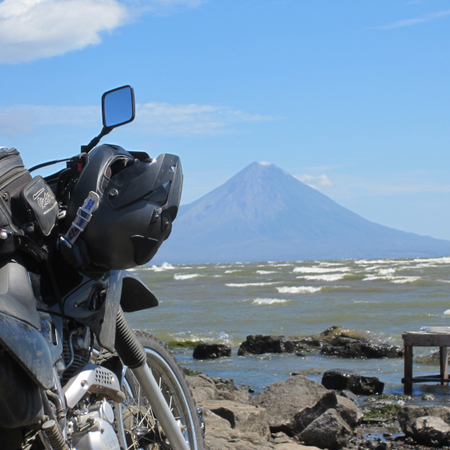
León has about 150,000 inhabitants and is thus the second largest city in Nicaragua. The city is located in the east of the country on the Pacific Ocean. León is among the most beautiful cities in Nicaragua. It was built in a colonial style and still the city radiates a charm reminiscent of its wealthy times. For centuries, León has been the intellectual center of the country, where liberal ideas originated. In the late seventies, the city was the center of revolutionary struggles. Not far away is the coast of the Pacific Ocean and the volcano Momotombo displays its perfect cone outside the city.
Granada
Granada has about 110,000 inhabitants and is thus the third largest city in the country. Granada is situated in the southeast of Nicaragua. Granada is probably one of the most beautiful cities in Nicaragua. Despite numerous destructions in its history, it is today a colonial gem. Thanks to its location at the foot of the Mombacho volcano and on the shore of Lake Nicaragua with its islands, the city can not only offer itself, but also many beautiful excursions in the surrounding area.
Isla de Ometepe
back to top of page
11. Holidays
| Holiday | Date |
| New Year | January 1 |
| Maundy Thursday, Good Friday | Thursday and Friday before Easter |
| Day of National Hero Juan Santamaría | April 11 |
| Labor Day | May 1 |
| Anniversary of the Sandinista Revolution | July 19 |
| Battle of San Jacinto | September 14 |
| Independence Day | September 15 |
| All Souls’ Day | November 2 |
| Immaculate Conception | December 8 |
| Christmas | December 25 |
12. Travel Information
For current safety information, always consult the Foreign Office before you travel.
13. Foreign Representations
German Embassy in Managua
Embajada de la República Federal de Deutschland, Apartado Postal 29, Managua, Nicaragua.
+505 22 55 69 20, +505 22 55 69 21, +505 22 55 69 22
[email protected]
http://www.managua.diplo.de
14. Sources and Links
http://www.laender-lexikon.de/Nicaragua
http://de.wikipedia.org/wiki/Nicaragua