Everything you need to know about Mongolia
Travel map of Mongolia by the tour operator Overcross
- General travel information for Mongolia
- Travel climate in Mongolia
- Geography of Mongolia
- Flora and fauna in Mongolia
- National parks and nature conservation in Mongolia
- Population in Mongolia
- Politics and economy in Mongolia
- Transportation network in Mongolia
- Cities and regions in Mongolia
- Culture and sights in Mongolia
- Holidays in Mongolia
- Medical information for Mongolia
- Travel advice for Mongolia
- Foreign representation in Mongolia
- Information sources for Mongolia
1. General travel information for Mongolia
| Continent: | Asia |
| Geographical location: | Central Asia north of the Himalayas, located in the northern hemisphere |
| Highest elevation: | Khüiten in the Altai Mountains (4374 m above sea level) |
| Longest river: | Orkhon (1400 km) |
| Form of government: | Parliamentary republic |
| System of government: | Parliamentary democracy |
| Languages: | Mongolian |
| Neighboring countries: | Russia and China |
| Capital: | Ulaanbaatar |
| Area: | Approx. 1,564,000 km² |
| Population: | Approx. 3.37 million people (2023) |
| Population density: | Approx. 2 inhabitants per km² |
| Religions: | Mainly Buddhism, Lamaism and Shamanism, minorities of Islam, Christianity and ethnic religions. |
| Currency: | Tugrik, 1 EUR is about 3,640 MNT; The current exchange rates for our travel countries can be found at oanda.com |
| Travel climate: | Continental to arid climate with extreme temperature contrasts |
| Time zone: | UTC+7 to UTC+8 |
| Dialing code: | +976 |
| Country code: | MN |
| Power: | In Mongolia, plug types C and E are used. The mains voltage is 230V with a 50Hz cycle. A travel plug adapter is recommended. An overview of power sockets and plugs used in our travel countries can be found at wikipedia.de |
2. Travel Climate in Mongolia
Mongolia has a distinct and dry continental climate with partly considerable temperature contrasts between summer and winter temperatures as well as between day and night temperatures. While the average daytime temperatures in winter do not rise above -25 °C, they reach a good 20 °C in summer, resulting in a temperature difference of almost 50° C, far exceeding the temperature contrasts known from Central Europe. The fluctuations in temperature between day and night can exceed 30° C. The average annual precipitation does not go beyond 220 mm, and in the Gobi Desert it is even less than 100 mm per year. Most of the precipitation falls from May to September and reaches its highest levels with over 400 mm in the north of the country.


3. Geography of Mongolia
The Mongolian state territory, which covers over 1.5 million km², is located northeast of the Tibetan Himalayas between China and Russia. In the west of the country lies Kazakhstan, but Mongolia does not share a border with it. In the south and east, the dry plateaus of the Gobi shape the landscape of Mongolia, with average elevations of about 1600 m above sea level. From the north, the foothills of the mountain ranges of Russia extend far into the central region of Mongolia and form, with the Changai Mountains rising up to 3900 m, the Tannu-Ola Mountains, and the Sayan Mountains, some separate mountain massifs. From the west, the mountain range of the over 4000 m high Altai extends as the Mongolian Altai, which continues as the Gobi Altai, far into the country’s interior towards the Mongolian Plateau. The Chüiten Peak of the Altai Mountains, located on the border with China, is, at 4374 m above sea level, the highest elevation in Mongolia. The high mountain regions of Mongolia are partly glaciated.
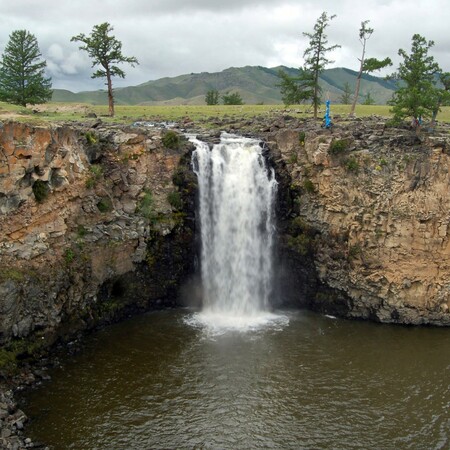
Numerous rivers such as the Selenga and Orkhon drain the country northward into Lake Baikal and, with the Onon, over a considerable distance eastward to the Sea of Okhotsk, as well as via the river system of the Herlen into the endorheic lowlands of Central Asia. A small part of the Tannu and Sayan Mountains discharges its precipitation via the Shishid Gol to the Kara Sea in northern Siberia. In winter, the rivers of Mongolia freeze and are partly used as roads in the plains. With the melt, sometimes vast amounts of water are transported through riverbeds in spring.
There are almost 4000 lakes in Mongolia, which generally have a water surface of less than 5 km² and are often fed by glaciers. They are mostly located far from any industrial centers and therefore have very clear water. Alongside the multitude of smaller bodies of water, the 3350 km² saltwater lake Uvs Nuur and the 2760 km² freshwater lake Khövsgöl Nuur are also located in the northwest of Mongolia, both of which are important stopover sites for migratory birds. Khövsgöl Nuur is one of the most significant freshwater lakes in the world. The bodies of water in Mongolia are increasingly affected by desertification and are slowly drying up.
Mongolian steppe landscape
4. Flora and Fauna in Mongolia
Due to the pronounced gradient of precipitation in Mongolia from north to south, as well as the climate-influencing mountain barriers, the different types of vegetation in Mongolia are distinctly zonally distributed. From north to south, one can first distinguish alpine vegetation zones of mountain taiga and forest steppe with boreal coniferous forest, which transition southwards into dry steppes with grasses and shrubs and then into the desert steppes and deserts of the Gobi. The relatively small proportion of forest areas on the slopes of the northern mountains consists mainly of spruces, firs, Siberian stone pines, and larches. In the mountain forest steppe, birches and birch-larch mixed forests can also be found, while the river meadows are predominantly covered with aspens, poplars, birches, and desert elms. Onion plants, feather grass, and numerous types of wormwood form the vegetation of the Mongolian steppes, where in the spring and summer months many lilies, orchids, and herbs also bloom. The edelweiss, which is protected in Europe due to its rarity, covers entire meadows in Mongolia. Typical for the sparse desert vegetation of Mongolia are the saxaul bushes, which grow in islands, and whose wood is used by nomads for making fire and the porous bark as a water reservoir. Mongolia is also known for its diversity of medicinal plants, foremost among them hawthorn and blue monkshood, the latter of which is also highly poisonous.
The interesting wildlife of Mongolia is represented by many mammal species, including those like lynx, wolf, and brown bear, which are threatened with extinction in Europe or have already disappeared. In addition, one can encounter red deer and pikas in the mountains, as well as the maral deer, found mainly in the Altai Mountains, which belong to the largest deer species in the world and also graze in the parks of the capital Ulaanbaatar. The snow leopard, threatened with extinction, can only be found with a few individuals in the Altai Mountains. Ibex, gazelles, and marmots live in the steppes together with a few individuals of the likewise severely endangered ungulate species Mongolian saiga, which has a characteristic trunk-like nose. The last populations of wild camels, wild asses, Argali wild sheep, and Przewalski wild horse also remain native to the steppes and deserts of the Gobi. The rare Gobi bear is the only brown bear that lives in the desert. The enormous yak now exists only in domesticated form and plays an important role as a pack and riding animal, as well as providing milk, meat, wool, hide, and fuel (dung) for the Mongolians. In addition to regular sheep and goats, grazing animals also include special breeds such as the cashmere goat and blue sheep.
Various reptiles such as snakes, lizards, and desert runners also inhabit the Gobi. Numerous fossil finds of dinosaurs prove that today's territory of Mongolia was once the habitat of giant lizards.
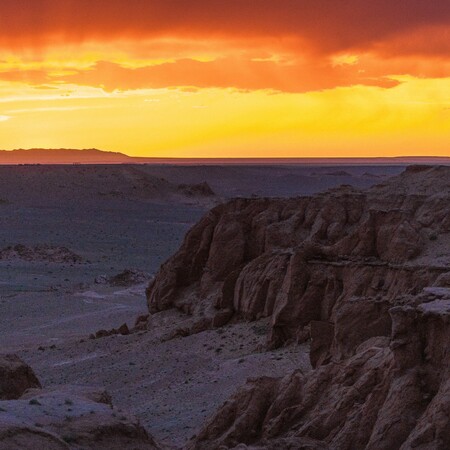
Among the best-known large birds in Mongolia are the golden eagle as well as the cinereous vulture and the bearded vulture, which is both namesake and inhabitant of the famous Bearded Vulture Gorge in the eastern foothills of the Altai Mountains. Standing waters are inhabited by wild geese and ducks, swans, great crested grebes, pelicans, cormorants, and seagulls. On a journey through the steppes and deserts of Mongolia, one must be wary of the venomous tarantula, which belongs to the wolf spiders, as well as the Halys pit viper, which belongs to the vipers.
The waters of Mongolia are rich in various species of fish such as carp, loaches, pike, perch, lenok, taimen, and various types of grayling. The Baikal sturgeon has its spawning grounds in the upper reaches of the Orkhon and Selenga rivers, to which it migrates more than 300 km upstream.
5. National Parks and Nature Conservation in Mongolia
Both in terms of nature conservation and in efforts towards sustainable and resource-conserving natural development, Mongolia is today among the most progressive countries in the world. During the growth-oriented socialist planned economy, Mongolia's nature and landscape were severely affected by erosion, overgrazing, and desertification. Mining, industry, and the military have also contributed locally to serious environmental damage. Due to its unique location at the border between the densely forested boreal zone and the dry steppes and deserts of the Gobi in the interior of Central Asia, and shaped by the exceptionally large climate contrasts, a unique landscape, flora, and fauna have developed in Mongolia. The special need for protection of these has now been recognized by the inhabitants of the country and implemented with a series of modern laws and the "Biodiversity Conservation Action Plan for Mongolia" as well as further measures. These include in particular the designation of 24 national parks with a total area of approx. 96,000 km² as well as 18 nature conservation areas with a total area of approx. 109,000 km². In addition, there are 20 nature reserves with an area of approx. 20,000 km² and another 9 natural monuments with an area of more than 1,000 km², several of which are now UNESCO World Heritage Sites. However, the progressive nature conservation in Mongolia cannot hide the considerable and existing environmental problems, which arise from emissions from outdated power plants and industrial facilities, pollution and drying up of water bodies, insufficient waste disposal, overgrazing, and uncontrolled logging.
The most worthwhile national parks to visit on a trip through Mongolia are the Tavan Bogd National Park in the Altai, the Tsambagaraw Lul National Park, located at several glaciers and in the habitat of the snow leopard, the Gurwansajkhan National Park with fossil dinosaur bones, huge sand dunes and bizarre rock formations in the Gobi Desert, the Chustain-Nuruu National Park south of Ulaanbaatar with the last wild horses, and also the largest lake areas of Mongolia in the northwest with the Uws Nuur National Park, the Khövsgöl Nuur National Park and the Khar Us Nuur National Park.
6. Population in Mongolia
In Mongolia, a little over 3.37 million inhabitants live on a national territory of over 1.5 million km². With only 2 inhabitants per km², Mongolia is therefore one of the most sparsely populated areas of the world inhabited by people. After population development in the 1950s to 1990s experienced an increase of over 100% due to the growth-oriented policies of the socialist people's republic, fertility dropped abruptly with the introduction of the free market economy. The annual population growth is now estimated at below 1.3%. About 85% of the population belong to the Mongol ethnic group, who have emerged from various Turkic peoples since the 8th century and today are mainly distinguished only by their language dialect. Minorities of other Turkic peoples, such as Kazakhs and Tuvans, mainly live in the west of Mongolia. In addition, immigrant Russians and Han are mainly active in the cities or as skilled workers in mining. Traditionally, and due to the extreme climatic and soil conditions, the Mongols, who are mostly engaged in animal husbandry, lead a nomadic lifestyle outside the larger cities. The Khalkha-Mongolian language, as the most important among the Mongolian dialects, is used by most Mongols as a colloquial and native language. The remaining minorities in the west of Mongolia mainly speak Kazakh or Tuvan as well as various other Turkic languages. During socialism, Russian was for a long time the first foreign language to be learned at Mongolian schools. Since 2005, English has instead been taught as the official first foreign language, so that, when traveling through Mongolia, adequate communication in English can be expected. About 1% of Mongols also understand the German language. Originating from shamanism, the original religion of the Central Asian steppe dwellers, many elements of this religion were adopted into the Tibetan Buddhism that is predominant among the Mongolian population today.
Christianity was never of great importance in Mongolia. Only the so-called Nestorians constituted a Christian minority in historical times. At the beginning of the 20th century, there were strong missionary attempts by European and American priests, who, however, were deported by the Soviets during the socialist people's republic. With the end of socialism, mainly evangelical missionaries returned. According to surveys, up to 7% of the population describe themselves as Christians, but probably refer less to the religion itself than to the high standard of living that comes with the Christian countries of origin.
River landscape at Selengra
7. Politics and Economy in Mongolia
According to the constitution, which came into force in 1992 and is modeled after the French constitution with the fundamental values of democracy, justice, freedom, equality, national unity, and respect for the law, Mongolia is a parliamentary democracy. The basic values of the state are democracy, justice, freedom, equality, national unity, and respect for the law. The unicameral parliament, called the State Great Khural, consists of 76 members and is elected every four years. The president is also elected directly for four years, with a one-time possible extension, and serves as both head of state, commander-in-chief of the armed forces, and chairman of the national security council. The judiciary is independent from the executive and legislative branches and is exercised and supervised in the final instance by the Supreme Court.
Economically, Mongolia has undergone a slow transition from a centrally planned economy to a market economy, but is still largely oriented toward the agricultural sector. Beginning in 2003, following a long period of stagnation, Mongolia’s economic growth rose up to 17% in 2011, which is attributed to the increase in the service sector and rising prices for copper and gold. Copper is Mongolia’s main export product, which is extracted in the world’s fourth-largest copper mine in the Burengiin Mountains. Currently (2023), GDP growth is stabilizing at around 4.3%. However, the growth in recent years has bypassed the poorer segment of the population. About 30% of residents live below the extreme poverty line, similar to the situation at the end of the planned economy era. The difficult years of reform have increased the share of the private sector to 80%, but have also widened social disparities and the urban-rural divide. Due to the extreme climatic differences and challenging soil conditions, most agricultural products are produced through livestock farming, such as meat, wool, milk, hides, and leather.
Although Mongolia holds significant mineral resources of coal, copper, uranium, oil, gold, silver, fluorspar, molybdenum, zinc, and diamonds, only about one-third of these have been explored to date. However, increased activities and corresponding economic growth in the mining sector are expected in the coming years.
8. Transport network in Mongolia
Of the 6,500 km of paved roads that made up Mongolia’s road network in 2023, less than half were asphalted, and most smaller settlements are still only accessible via dirt tracks. However, significant investments are planned for the coming years to improve the road network. In this process, provincial capitals in particular are being connected to the capital by asphalt roads. Private buses and minibuses are the main means of travel within the country.
The Trans-Mongolian Railway makes up the main part of Mongolia’s approximately 2,000 km rail network, which is used mainly for freight transport. The railway runs across Mongolia from the Russian border to the Chinese border and forms part of the route from Moscow to Beijing. Besides the capital Ulaanbaatar, important industrial cities like Erdenet, Darkhan, and Baganuur are connected to the Trans-Mongolian Railway. Choibalsan is connected to the Trans-Siberian Railway at Borzya by a rail line but has no internal Mongolian rail connection. Other railway projects, such as a connection from Sainshand to the industrial city of Choibalsan and a coal railway from Uhaa Khudag to the Chinese border, are planned to develop significant coal and ore deposits. Due to the still sparse road and rail networks, about 30% of cargo is transported by camel.
The country’s only international airport, which serves as the starting and ending point for a trip through Mongolia, is Chinggis Khaan International Airport, located about 15 km from the capital Ulaanbaatar. From here, there are regular flights to Frankfurt, Berlin, Istanbul, and Moscow as well as to Beijing, Seoul, Hong Kong, Bangkok, Tokyo, and other major Asian cities.
9. Cities and Regions in Mongolia
Mongolia is administered in 22 provinces, so-called Aimags, of which the capital Ulaanbaatar forms its own administrative district within the central province Töv. The provinces are divided into districts and municipalities. Over half of the Mongolian population lives in the 5 largest cities of Mongolia.
Ulaanbaatar
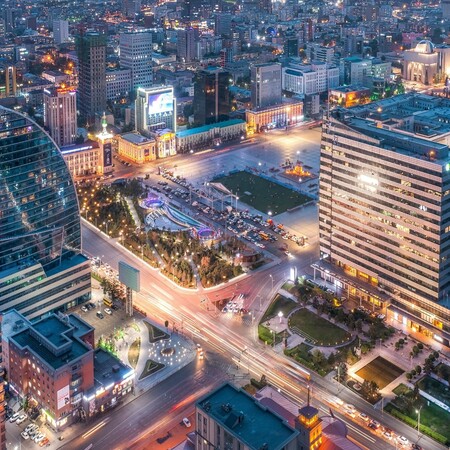
Over 1.5 million inhabitants of Mongolia live in the capital Ulaanbaatar alone, which forms the political, economic, and cultural center of Mongolia. Sükhbaatar Square, with its monument of the same name, the parliament building, city hall, house of culture, state opera, and the Mongolian Stock Exchange, forms the center of the city, which architecturally balances modernity and tradition. Also of tourist importance are the Museum of Natural History with an important collection of fossilized dinosaur skeletons, the winter palace of the last Mongolian emperor Bogd Khan with impressive temple complexes, and the Zaisan Memorial located on a hill south of the city, which commemorates the Second World War and offers a beautiful view over Ulaanbaatar. The public library displays a unique collection of Sanskrit manuscripts from the 11th century. The Buddhist temple museums and the Gandan Monastery are also worth seeing.
Erdenet
With just under 100,000 inhabitants (2023), Erdenet is the second largest city in Mongolia, located at the foot of the Burengiin mountain range about 240 km northwest of the capital Ulaanbaatar. Erdenet is home to the fourth largest copper mine in the world, which generates the main share of Mongolia's export volume and tax revenue. In the 1980s, the life of the city was shaped by Russian miners and engineers. The founding of a large carpet factory also dates back to this period. In addition, the Mongolian University of Science and Technology is located in Erdenet. As the capital of Orkhon Province, the city has little to offer in terms of sights as an industrial and commercial town.
Darkhan
With just under 80,000 inhabitants (2023), the third largest city in Mongolia and capital of Darkhan-Uul Province is an industrial location established only in 1961 as part of socialist planned economy to ensure the production of goods for northern Mongolia. The name Darkhan means “blacksmith” and signals the task envisaged for the city by the Soviets. Apart from typical Soviet industrial-style prefabricated architecture, a Buddhist temple complex, the Kharagiin Monastery housed in an old wooden building in the city center, and the Museum of Traditional Folk Art with collections of archaeological artifacts, traditional garments, and cultural objects, the city does not offer any particular attractions.
Choibalsan
At the current location of Mongolia’s fourth largest city with about 42,000 inhabitants on the Cherlen river, there was a caravan stop for centuries. In the nineteenth century, the campsite developed into a city, which became an economic focal point in eastern Mongolia in the twentieth century. With the withdrawal of Russian workers after the political changes, large parts of the economy collapsed, resulting in the city having one of the highest unemployment rates in the country.
10. Culture and Sights in Mongolia
Mongolian culture has its origins in the lifestyle of various nomadic peoples who were united into a Mongol Empire by Genghis Khan. During the spread of Buddhism, the earlier folk dances of the nomads, which travelers through the Mongol world empire reported on, were essentially lost. Some dance ceremonies such as the Tsam, which was performed by monks to appease wild deities, are still practiced in Mongolia today, while the performance of other dances from the early nomadic culture such as the Bielgee, in which scenes from everyday nomadic life are depicted, can only be observed in some remote regions of western Mongolia. However, traditional Mongolian music, with the typical horsehead fiddle as a style-defining instrument, is still cultivated today and such concerts occasionally attract large crowds of listeners.
With Buddhism, Mongolia became a site for the practice of Buddhist art. Painting and sculpture mainly served to create representations as objects of meditation for clergy or as objects of supplication for laypeople. The art of mandala was widespread, where as a contemplative exercise depictions of samsara were created with sand.
With the introduction of socialism, Western cultural influences became increasingly noticeable in Mongolia, especially in music. Although pop music was frowned upon during the socialist era, the protest songs of the pop group Genghis Khan contributed significantly to the end of socialist rule in Mongolia, which also produced some remarkable writers such as the author Galsan Tschinag, who was awarded several German literary prizes.
Among the notable cultural monuments of Mongolia are, among others, the Altai Mountains' rock paintings, which belong to the UNESCO World Heritage, found both at the sacred Mount Shiveet Khairkhan and along the Goloog River, and together with other megalithic sculptures, ancient burial sites, and stone monuments, are mainly attributed to the early cultures of the Huns and Turkic peoples.
The cultural landscape of the Orkhon Valley also belongs to the World Heritage sites of Mongolia, with proven campsites of Stone Age hunters and gatherers, Bronze and Iron Age burial sites, medieval memorials with Turkish and Chinese inscriptions, as well as the remains of the Uighur capital Char Balgas and the medieval Mongol capital Karakorum. The ruins of the former capital Xanadu of Mongol ruler Kublai Khan are located in the autonomous region of Inner Mongolia, which already belongs to Chinese territory. In the Khentii Mountains in northern Mongolia is the sacred mountain Burkhan Khaldun, with the presumed birthplace and burial site of Genghis Khan. The 2,445 m high mountain, at which more than 800 graves have been found, held great spiritual significance for the Mongol Empire of the 12th and 13th centuries.
In addition to the cultural sights, it is above all the impressions of the breathtaking natural landscapes of Mongolia during a journey through the country that are recommended, which can be experienced, among other things, during the visit to various national parks. A visit to the Daurian landscapes extending from eastern Mongolia into Russian Siberia and northeastern China, with the unique ecosystem of the Daurian steppe, the hot springs of the Changai Mountains, as well as the lava cave Taliin Agui near Shiliin Bogd, is certainly worthwhile.
11. Public holidays with fixed dates in Mongolia
| 1 Jan | New Year |
| 13 Jan | Constitution Day |
| 5-7 Feb | Chinese New Year |
| 8 Mar | International Women's Day |
| 1 Jun | International Children's Day |
| 11-15 Jul | National holiday |
| 26 Nov | Republic Day |
| 27 Nov | Genghis Khan Day |
| 29 Dec | Independence Day |
12. Medical Information for Mongolia
For legal reasons, as a tour operator we are not permitted to provide binding medical advice for Mongolia and therefore refer to the information of the Federal Foreign Office of the Federal Republic of Germany, the Robert Koch Institute, and the German Society for Tropical Medicine and International Health e.V.
13. Travel Information for Mongolia
Current travel and safety information, entry and exit information, as well as special criminal law notes and behavioral recommendations for your stay in Mongolia can be obtained from the Federal Foreign Office of the Federal Republic of Germany.
14. Foreign Representation in Mongolia
| Embassy of the Federal Republic of Germany in Ulaanbaatar (There are also honorary consulates in Hermannstadt and Timișoara) | |
| District of jurisdiction/ Consular district: |
Mongolia |
| City: | Ulaanbaatar |
| Street address: | Baga Toiruu - 2, United Nations Street 16, Ulaanbaatar 14201 |
| Mailing address: | Embassy of the Federal Republic of Germany, C. - P.O. Box 708, Ulaanbaatar 15160, Mongolia |
| Telephone: | +976 7013 3900 |
| Fax: | +49 30 1817 671 77 |
| Email: | Contact form |
| Website: | http://www.ulan-bator.diplo.de |
| Official languages in the host country: |
Mongolian, English |
| Embassy of Mongolia in Berlin (There are also honorary consulates in Cologne, Frankfurt and Munich) | |
| City: | Berlin |
| Street address: | Hausvogteiplatz 14 |
| Mailing address: | Hausvogteiplatz 14, 10117 Berlin |
| Telephone: | 030 474 80 60 |
| Fax: | 030 474 806 16 |
| Email: | [email protected] |
| Website: | http://www.berlin.embassy.mn |
15. Sources of Information for Mongolia
German Weather Service
Federal Foreign Office of the Federal Republic of Germany
Wikipedia