Travel Information Indonesia

Tropical paradise of colors and cultures

Everything you need to know about Indonesia

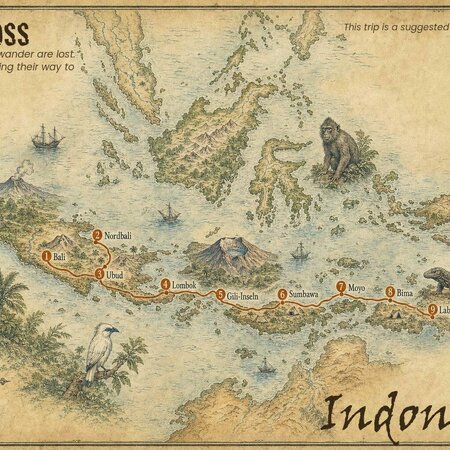
Travel map of Indonesia by the tour operator Overcross

Travel map of Indonesia by the tour operator Overcross


  1. General travel information for Indonesia
  2. Travel climate in Indonesia
  3. Geography in Indonesia
  4. Flora and fauna in Indonesia
  5. National parks and nature conservation in Indonesia
  6. Population in Indonesia
  7. Politics and economy in Indonesia
  8. Transport network in Indonesia
  9. Cities and regions in Indonesia
  10. Culture and sights in Indonesia
  11. Public holidays in Indonesia
  12. Medical information for Indonesia
  13. Travel advice for Indonesia
  14. Foreign representation in Indonesia
  15. Information sources for Indonesia


1. General travel information for Indonesia

Continent: Asia
Geographical location: Southeast Asia, island nation located between the Malay Peninsula, the Philippines, and Australia in the Indian Ocean
Highest elevation: Puncak Jaya on New Guinea (4,884 m above sea level)
Longest river: Kapuas (1,143 km)
Form of government: Republic
System of government: Presidential democracy
Languages: The official national language is Indonesian (Bahasa Indonesian)
Neighboring countries: Malaysia, Singapore, Philippines, Palau, Papua New Guinea, East Timor, Australia
Capital: Jakarta
Area: Approx. 2 million km²
Population: Approx. 276 million people (2023)
Population density: 135 people per km²
Religions: Approx. 87% Islam, 10% Christians, 2% Hinduism, 1% Buddhism and Taoism, 1% Confucianism, natural religions
Currency: Rupiah (IDR); One euro is approx. 17,500 IDR. The current exchange rates for our travel countries can be found at oanda.com
Travel climate: tropical, humid-hot
Time zone: UTC +7 to UTC +9
Area code: +62
Country code: ID/IDN
Electricity: In Indonesia, socket types C, F and G are used. The mains voltage is 230V with 50Hz AC frequency. An overview of sockets and plugs used in our travel countries can be found at wikipedia.de

back to top of page


2. Travel climate in Indonesia

Due to its geographical location on both sides of the Equator, Indonesia has a distinctly tropical climate with monsoon winds that bring a dry climate with little rain from June to September, and from December to March moist air masses and heavy rainfall. The northern islands of the Indonesian archipelago such as Borneo, Sumatra, Papua, and the Moluccas are characterized by ever-humid tropical climate with constant temperatures. With average daytime temperatures of 25°C to 27°C and a relative humidity of 95%, tropical sultriness prevails. The annual precipitation amounts range between 2,000 mm and 4,000 mm.
The climate on Java, the Lesser Sunda Islands, and the Aru Islands, in contrast, is mainly determined by the monsoon. It causes consistently high daytime temperatures, which can, however, drop to as low as 12°C at night. The dry air of the northeast monsoon results in a dry season (winter monsoon), during which the trees shed their leaves and go through a kind of resting phase, leading to light, green forests with a pronounced herb layer (monsoon forests). The southwest monsoon, on the other hand, absorbs moisture over the warm sea and brings heavy precipitation over the mainland, which can reach up to 50 mm per day and often leads to flooding.
 

Climate travel diagram for Jakarta by the tour operator Overcross


Climate travel diagram for Ambon (Moluccas) by the tour operator Overcross


Climate travel diagram for Merauke (New Guinea) by the tour operator Overcross


back to top of page


3. Geography in Indonesia

The country Indonesia is spread over a total of 17,508 islands with a total area of 1,904,569 km². The largest islands are Sumatra, Java, Borneo, Sulawesi, and New Guinea. In addition, most parts of the Greater and Lesser Sunda Islands, the Moluccas, as well as West New Guinea belong to Indonesian territory. Due to this, the southern parts of the country are already counted as part of the Australian continent. North of Indonesia lie Malaysia, Singapore, the Philippines, and Palau, east Papua New Guinea and East Timor, south Australia and to the west and south the Indian Ocean. Toward the Malay Peninsula with western Malaysia and Singapore, Indonesia is separated by the Strait of Malacca, and toward the Philippine islands, the border runs through the Celebes Sea. The Indonesian archipelago is crisscrossed by many straits, shallow marginal seas, and sea basins, some of which form important waterways. The terrain is volcanically shaped and therefore very mountainous. The highest mountain is the 4,884 m high summit of Puncak Jaya on New Guinea. The islands mostly drain through short rivers to the Indian Ocean; only on Borneo, larger rivers with longer courses are found, such as the Kapuas with a length of 1,143 km. Despite threats from earthquakes, tsunamis, and frequent volcanic eruptions, some islands, especially Java, are densely populated due to very fertile soils that enable intensive agriculture.

back to top of page
 

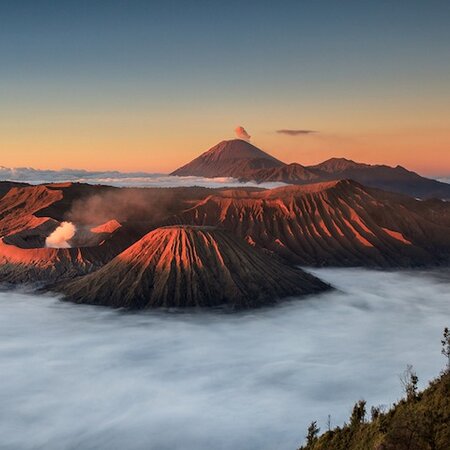
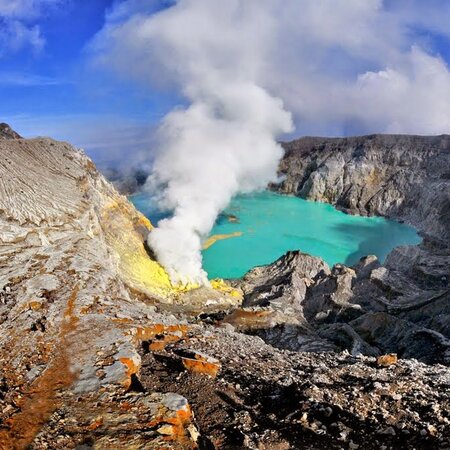
Volcanic landscape in Indonesia

Volcanic landscape in Indonesia


4. Flora and Fauna in Indonesia

Due to the special island location on both sides of the equator, the associated climate conditions, and the fertile volcanic landscapes, Indonesia is one of the biodiversity hotspots of the earth, which is reflected in the enormous variety of animal species and endemic organisms. Indonesia also has the largest rainforest areas in the world, where many rare plants such as orchids or rafflesias are found. In parts of eastern Sumatra and southern and western Borneo there are large peat and freshwater swamp forests. The coasts are often lined with mangrove forests, while conifers grow in the mountains.
Besides these valuable forest ecosystems, the island kingdom harbors large stocks of tropical corals in its numerous straits and lagoons. In the so-called coral triangle, between Malaysia, East Timor, the Philippines, Papua New Guinea and the Solomon Islands, about 75% of all known coral species and more than 3,000 fish species, turtles, many dolphins and whales, as well as large sharks and rays live. The "Wallace Line", a dividing line between Borneo and Sulawesi and southward between Bali and Lombok, distinguishes the western, Asian from the eastern, Australian flora and fauna. It was found that certain Asian mammals such as elephants, tigers, tapirs, and orangutans are only found on Borneo, Java, and Bali, but not on Sulawesi, the Moluccas, and the Lesser Sunda Islands, which is due to the land connection with the Asian continent on one hand and with the Australian continent on the other hand many millions of years ago. This led to, for example, the tree kangaroo being native only to West New Guinea, while the Sumatran tiger, orangutans, and the Sumatran elephant inhabit Sumatra. The critically endangered Javan rhinoceros and wild cattle, called banteng, live on Java. The Komodo dragon is the longest monitor lizard in the world and is found exclusively on the Lesser Sunda Islands. On Sulawesi, the civet cat, the crested macaque, and the tiny tarsier monkey are at home. The bird of paradise is typical for New Guinea.

Elephants in Sumatra

Elephants in Sumatra

back to top of page


5. National Parks and Nature Conservation in Indonesia

Numerous conservation organizations from Indonesia and Western countries are committed to preserving the local environment. These efforts have, among other things, led to the designation of a total of 56 national parks and other protected areas with a total area of about 170,000 km² in Indonesia. Nevertheless, large areas of primary forest, especially in the lowland rainforest of Sumatra, are still being cleared and converted into palm oil plantations in Indonesia.
The most important national parks in Indonesia include, among others, the:

Komodo National Park
The Komodo National Park, which covers 1,817 km², is located in the area of the Lesser Sunda Islands and is a UNESCO World Natural Heritage Site. It protects, among other things, the Komodo dragons endemic to this area.

Bromo-Tengger-Semeru National Park
The Bromo-Tengger-Semeru National Park is located in East Java and is home to the two active volcanoes Bromo and Semeru.

Gunung Leuser National Park
The Gunung Leuser National Park, which is part of the UNESCO World Natural Heritage, is with almost 10,000 km² one of the largest national parks in Indonesia. It is located in the north of Sumatra and protects, among other things, extensive rainforest areas with the critically endangered orangutans.

Kerinci-Seblat National Park
Also on Sumatra is the largest national park, with almost 15,000 km², which, as part of the UNESCO World Natural Heritage, protects numerous endangered animal species such as the Sumatran tiger or the Sumatran rhino in a unique volcanic landscape.

Tanjung Puting National Park
The Tanjung Puting National Park in Kalimantan in the south of the island of Borneo, covering more than 4,000 km², was already established during the Dutch colonial period. The park, under the special protection of UNESCO, is home to orangutans, which can be observed here particularly well, as well as numerous other monkeys such as the also endangered proboscis monkey in unspoiled nature.

back to top of page


6. Population in Indonesia

Fossil finds of the Java Man prove that the area of present-day Indonesia was already settled by early humans 1.8 million years ago. Today's Indonesian population originally descends from Austronesian peoples who came to the country in several waves of immigration before the start of our era.
In recent decades, the population of Indonesia has grown from 70 million inhabitants at the end of the Dutch colonial period to over 276 million inhabitants (2023). Although population growth has slowed, the Indonesian population is still growing by 1% annually. The population density of the Indonesian islands varies greatly and is about 135 inhabitants per km² overall. Java is the most densely populated due to its fertile soil and the capital city alone, with over 10 million inhabitants, has over 1,000 inhabitants per km².
According to the Indonesian census of 2020, almost 360 different peoples live in Indonesia, most of whom are of Malay origin. The general term "Indonesian" was not introduced until the end of the Dutch colonial period to replace the previously common tribal names. The peoples with the most members are the Javanese, with over 41% of the population, followed by the Sundanese with over 15%, and the Malays, Madurese, and Batak, each with more than 3% of the population. The shares of the remaining ethnic groups each make up less than 3% of the total Indonesian population.
With approximately 200 million Muslims, Indonesia has the highest proportion of Muslim population in the world. 87% of the Indonesian population are Muslims, only 10% belong to Christianity, and only about 1-2% are Hindus and Buddhists. In addition to the official national language Bahasa Indonesia, around 742 different regional languages are spoken. Especially the youth speaks English fluently, and particularly in the larger cities one can communicate well in English.

Market scene in Indonesia

Market scene in Indonesia

back to top of page


7. Politics and Economy in Indonesia

Indonesia is a presidential republic, the president is elected directly by the people for five years, and re-election is only possible once. He is both head of state, head of government, and commander-in-chief of the armed forces. He also appoints the cabinet.
The legislature is made up of a bicameral parliament with 550 deputies and 128 regional representatives as the second chamber, which, however, only have the right to be heard and to make proposals in the legislative process. Indonesia has a multi-party system with a diverse range of parties. Since the elections of 2004, Indonesia has been recognized internationally as a democratic state, but is considered an incomplete democracy. Due to the strong regional autonomy and secessionist tendencies, caused by its multi-ethnic state character, all national governments have so far faced the challenge of forging a common nation from ethnic diversity, which remains a guiding principle of Indonesian politics today.

Indonesia is the economic heavyweight of ASEAN (Association of South East Asian Nations), and as an emerging country, is among its initiators. The ASEAN community, similar to the EU, aims to go beyond an economic community, and to be understood as a socio-cultural association as well as a security community, which is why the promotion of regional integration within ASEAN is Indonesia's top priority. Indonesia has a pronounced service and agricultural economy with a relatively small proportion of industrial production. Indonesia is one of the world's main exporters of coal, tin, nickel, copper, bauxite, and gold. In addition, there are large timber reserves and agricultural products such as palm oil, rubber, cocoa, tea, coffee, and tobacco are exported. For staple foods such as rice, corn, soybeans, and sugar, the country is partly dependent on imports.
The unemployment rate was recently about 5.5%, about 9.6% of the population lives below the national poverty line. The Indonesian economy proved robust in the face of the global financial crisis of 2008/2009. Annual growth is currently around 5%.

back to top of page


8. Transport network in Indonesia

Indonesia has a road network of about 500,000 km, of which only 280,000 km are paved. Many roads, despite considerable investments, are in poor condition, which among other things means that the risk of accidents on Indonesian roads is very high. Although the proportion of automobiles in Indonesian road traffic is constantly increasing, motorcycles and scooters are present everywhere as the most important means of transport.
Although the first railway line in Indonesia was put into operation as early as 1867, rail transport across the entire archipelago today, with a network of just over 8,000 km, is rather insignificant and outdated. There is no money for modernization, so many routes, trains, locomotives, and station buildings still date from the Dutch colonial era. The best train connections are on the main island of Java. Here, passenger trains run regularly between the major cities and also to tourist destinations, so that Java can be explored relatively well by train.
As an island state with economically significant international sea trade and transshipment ports, Indonesia has over 2,000 seaports. The most important ports are located in Jakarta and Surabaya. In addition, the ports of Makassar (Sulawesi) and Belawan (Sumatra) are also important passenger and transshipment ports. The national shipping company Pelni operates a wide variety of passenger and ferry connections to about 100 ports throughout the archipelago, which are served both on fixed schedules and by charter.
Due to its expanse and geography, many places in the Indonesian archipelago can only be reached by plane. After the liberalization of the market in 1999, there was therefore strong growth in air traffic throughout Indonesia. However, many Indonesian airlines save on safety, which has led to several accidents.
International airports are located in Jakarta, Yogyakarta, Surabaya, Surakarta on Java, Denpasar on Bali, Makassar and Manado on Sulawesi, Medan, Banda Aceh, and Pekan Baru on Sumatra, Pontianak on Borneo.

back to top of page


9. Cities and Regions in Indonesia

The island nation of Indonesia is currently administered in 34 provinces as well as two special regions and the capital district of Jakarta, which are in turn divided into 501 regency districts. However, restructuring of this division is underway or being planned.
For travelers in Indonesia, though, the various island regions are more significant than the administrative division. Accordingly, the Indonesian archipelago is divided into the main islands Java – the center of the country, with the capital Jakarta and other major cities, the most densely populated part of the archipelago. The tourist hotspot Bali, probably the best-known island for most package tourists. The wild and rugged Sumatra – the sixth largest island in the world possesses magnificent but highly endangered natural treasures. The Indonesian part of Borneo, called Kalimantan – uncharted jungle, mighty rivers, settlement area of the orangutans and a paradise for adventurers. Sulawesi – the island is geographically very elongated and is home to various social structures and a spectacular landscape. Lesser Sunda Islands (Flores · Lombok · Komodo · Timor) – the island group in the southeast of Indonesia, largely unexplored and almost unknown to the outside world, is inhabited by a multitude of ethnic groups. Moluccas – the former spice islands of the Portuguese West Papua – the Indonesian part of New Guinea with the highest mountain in Indonesia, the 4,884 m high Puncak Jaya.

The largest and most important city in Indonesia is the capital Jakarta, which serves as the commercial and financial center. Other important cities are Surabaya, Medan and Bandung.

Jakarta
More than 10 million people of Malay, Arab, Indian, Dutch and Chinese descent live in Indonesia's capital. It is the largest city in Southeast Asia and, with more than 34 million residents in the surrounding area, also the second largest metropolitan region. Jakarta is the political, economic, and cultural center of the country as well as a transportation hub with universities, colleges, theaters, and museums. In particular, many historical buildings from the colonial era are still located at the Grand Canal and the Independence Square. Chinatown with the old Chinese quarter Glodok is also worth seeing. Because of the existing risks of earthquakes and floods, there are considerations to relocate the capital of Indonesia to Borneo.

Surabaya
After Jakarta, Surabaya is the second largest city in Indonesia, with almost 3 million residents of various ethnic groups. The port city has large shipyards and numerous specialized schools for nautical training. It is also the base of the Indonesian Navy.

Medan
The third largest city in Indonesia, with over 2 million residents, expands over a coastal plain in the northeast of the island of Sumatra. On the coast or the Strait of Malacca is the important seaport Belawan, while the city center is located about 20 km inland. Some buildings in Dutch colonial style have been preserved in the city, such as the old town hall, the post office, and the Tirtanadi water tower. In and around Jl. Ahmad Yani, there is a multitude of interesting commercial buildings in Art Deco and Jugendstil style, some of which remain unrestored. The Maimun Palace (Istana Maimun) was built between 1887 and 1891, during the lifetime of the last ruling Sultan of Deli. The Grand Mosque (Masjid Raya) was built in 1906 in Moroccan style by the Dutch architect Dingemans. About 70 km from the city is the Orangutan Rehabilitation Center in Bukit Lawang, on the edge of the Gunung Leuser National Park.

Bandung
The provincial capital of West Java has about 2.5 million residents and is also called the City of Flowers. A number of technical universities are based in Bandung. The city has a stock of tropical Art Deco architecture from the 1920s. The most significant Art Deco buildings in the city are the Villa Isola, the Grand Hotel Preanger and the Savoy Homann Bidakara Hotel; in addition, there are many other very impressive buildings of this architectural style.

back to top of page


10. Culture and Attractions in Indonesia 

Over the course of history, Indonesia has been subject to various cultural influences and, due to the diversity of the Indonesian peoples, there are major differences between the cultures of the individual regions.
Indonesian culture (music, literature, painting) was first shaped by Buddhism in the 9th and 10th centuries, and from the 13th century increasingly by Hinduism. As early as the 2nd century AD, India established trade relations with Java, bringing Indian cultural influences to this region. In the 5th century, the first Hindu kingdom emerged in Indonesia, a second, the kingdom of Majapahit, became significant from 1300 onwards and increasingly took over rule over the Buddhist kingdom of Srivijaya, which had arisen in the 7th century in Sumatra and was the center of Mahayana Buddhism. The Buddhist Sailendra dynasty also established the kingdom of Mataram on Java in the 9th century. Indian Buddhism, Hinduism, and the animist religions of Java each brought their own architectural styles, which are seen, among others, in the world's largest Buddhist building in Borobudur and the Hindu temple complexes of Prambanan and on the Dieng Plateau in Java. Hinduism and Buddhism have survived to this day only on the islands of Bali and Lombok, where an indigenous, but predominantly Hindu-influenced, mixed culture has developed.
The first Chinese cultural influences were brought to Indonesia by porcelain and silk traders. Later, Chinese people also worked in the numerous gold mines of Indonesia and presumably influenced, with their bazaar architecture, the architectural style of various regions of Indonesia, such as the typical longhouses in Borneo.
From the 15th century, more and more Arab traders visited Indonesia and the conversion to Islam began. This also introduced traditional Islamic customs to Indonesia.
Indonesian culture, for example, gave rise to the well-known batik textile dyeing technique, which, even today, artistically decorates textiles using elaborate techniques with a variety of floral and bird motifs, spirals, and imaginative structures, and represents an export product of Indonesia.
The origin of the Pawukon or Wuku calendar, with a cycle of 210 days, also dates back to the time of the Javanese primal religions.
Modern cultural life in Indonesia has its focus in the urban centers of Jakarta, Surabaya, Yogyakarta, Bandung, and other cities in Java as well as Ubud in Bali. The young, active art scene is gaining worldwide recognition. At the same time, however, old cultural forms such as dance, shadow puppetry, and gamelan music are also maintained.

The diverse attractions of the island nation Indonesia can only be presented in excerpts. Each island has its own particular natural beauties and cultural monuments and, in particular, the numerous national parks are recommended for visits.

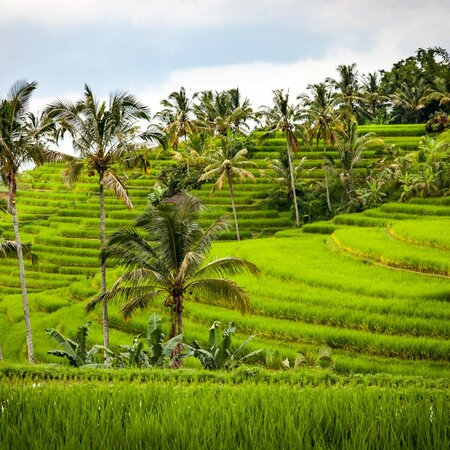
  • Bali: terraced rice paddies on mountain slopes, volcanic landscapes, tropical vegetation, long sandy beaches, dazzling temple festivals and friendly people in a colorful culture.
  • Java: Hindu and Buddhist temple complexes (e.g., the UNESCO World Heritage Site Borobudur), national parks in the mountains and on the coast, often still active volcanoes (the most famous is Mount Bromo), kilometer-long sandy beaches, synthesis of various cultures. The city of Yogyakarta houses many attractions, for example, buildings from the Dutch colonial period.
  • Sumatra: many national parks, mountains with volcanoes and mountain lakes
  • Lombok: the quieter, more untouched Bali
  • Gili Islands: 3 small islands where no motorized vehicles are to be found. Small cafés line the coast, reggae is played, and the main means of transportation are horse-drawn carriages. Here you can relax.

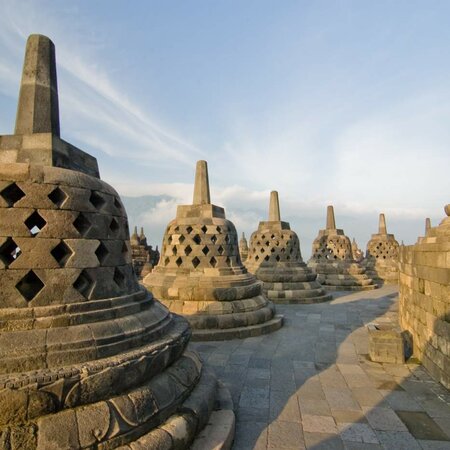
Buddhist temple in Borobodur on Java/Indonesia

Buddhist temple in Borobodur on Java/Indonesia

back to top of page


11. Public holidays with fixed dates in Indonesia

Most holidays in Indonesia are Islamic and do not have a fixed date. The dates of the Islamic holidays are based on the Islamic lunar calendar and therefore change each year
 

1 Jan New Year
1 May Labour Day
1 June Pancasila
17 Aug. Independence Day
24 Dec. Christmas Eve
25 Dec Christmas

back to top of page


12. Medical advice for Indonesia

For legal reasons, as a tour operator, we are not allowed to provide binding medical advice for Indonesia and therefore refer to the information from the Federal Foreign Office of the Federal Republic of Germany, the Robert Koch Institute and the German Society for Tropical Medicine and International Health e.V.

back to top of page


13. Travel advice for Indonesia

Current travel and safety information, information on entry and exit as well as special criminal law advice and behavioural recommendations for your stay in Indonesia can be obtained from the Federal Foreign Office of the Federal Republic of Germany.

back to top of page


14. Foreign representation in Indonesia

Embassy of the Federal Republic of Germany in Jakarta (There are additional consulates general in Makassar, Medan, Sanur and Surabaya.)
Administrative district/
Consular district:
Indonesia
Location: Jakarta
Street address: Jalan M. H. Thamrin No. 1, Jakarta
Postal address: Embassy of the Federal Republic of Germany, Jalan M. H. Thamrin No. 1, Jakarta 10310, Indonesia
Telephone: +62 21 39 85 50 00, for emergencies +62 811 152526
Fax: +62 21 398 55130
E-mail: Contact form
Website: http://www.jakarta.diplo.de/
Official languages
in host country:
Indonesian (Bahasa Indonesia); Timor-Leste: Tetum, Portuguese


Embassy of the Republic of Indonesia in Berlin
(There are additional honorary consulates in Hamburg, Bremen, Frankfurt am Main, Stuttgart and Munich)
Location: Berlin
Street address: Lehrter Straße 16-17
Postal address: Lehrter Straße 16-17, 10557 Berlin
Telephone: 030 47 80 70
Fax: 030 447 371 42
E-mail: [email protected]
Website: http://www.kemlu.go.id/berlin


back to top of page


15. Information sources for Indonesia

German Weather Service
Federal Foreign Office of the Federal Republic of Germany
Wikipedia

back to top of page

Karte von Indonesia

×

Send request

Adventure

How did you
hear about us?

Ask a Route Expert

How do you want to travel?