Everything you need to know about Ethiopia
Travel map of Ethiopia by the tour operator Overcross
- General information for Ethiopia
- Climate in Ethiopia
- Geography in Ethiopia
- Flora and fauna in Ethiopia
- National parks and nature conservation in Ethiopia
- Population in Ethiopia
- Politics and economy in Ethiopia
- Transport network in Ethiopia
- Cities and regions in Ethiopia
- Culture and sights in Ethiopia
- Holidays in Ethiopia
- Medical information for Ethiopia
- Travel information for Ethiopia
- Foreign representation in Ethiopia
- Sources of information for Ethiopia
1. General information for Ethiopia
| Continent: | Africa |
| Geographical location: | Eastern Africa, located on the northern hemisphere above the equator |
| Highest elevation: | Ras Dashen Tetata (4620 m a.s.l.) |
| Longest river: | Blue Nile (length 1783 km) |
| Form of government: | Parliamentary Federal Republic |
| System of government: | Parliamentary system |
| Languages: | Amharic |
| Neighboring countries: | Eritrea, Sudan, South Sudan, Kenya, Somalia, Djibouti, |
| Capital: | Addis Ababa |
| Area: | Approx. 1,104,300 km² |
| Inhabitants: | Approx. 117,000,000 people (2023) |
| Population density: | 106 inhabitants per km² |
| Religions: | Approx. 63% followers of Christianity (43% Ethiopian Orthodox, 20% Protestant), 34% Muslims, 3% traditional African and other religions |
| Currency: | Ethiopian Birr (ETB); 1 EUR is about 55 ETB. Find the current exchange rates at oanda.com |
| Climate: | Hot in low-lying regions, cool in higher regions |
| Time zone: | UTC + 3 |
| Country code: | +251 |
| Country code: | ETH |
| Electricity: | In Ethiopia, sockets of type C, F, D, J and L are used. The mains voltage is 3 x 220V with 50Hz alternating interval. A travel adapter is recommended. An overview of the sockets and plugs used in our travel countries can be found at wikipedia.de |
2. Climate in Ethiopia
In Ethiopia, depending on altitude, three climate zones can be distinguished. The tropical hot zone, which extends up to 1800 m a.s.l., has average daytime temperatures of about 27 °C, with rather low rainfall below 500mm/year. Above 1800 m up to about 2500 m altitude there is a moderately warm climate with average temperatures of 22 °C and annual rainfall of 500 to 1500 mm. The capital, Addis Ababa, which is at about 2400 m elevation, has average midday temperatures between 8 and 24 °C. Above 2500 m a.s.l. the daily mean temperature is only 16 °C, and the amount of rainfall increases up to 1800 mm per year.
The main rainy season is between mid-June and September, with additional frequent rainfall occurring between February and March.
Ethiopia is often affected by extreme weather events such as prolonged droughts or heavy rainfall associated with storms.


3. Geography in Ethiopia
Ethiopia is located in East Africa above the equator. With an area of over 1.1 million km², Ethiopia is one of the ten largest countries in Africa. In the north, Ethiopia borders Eritrea, in the west Sudan and South Sudan, in the south Kenya and in the southeast to east the countries Somalia, Djibouti and Eritrea.
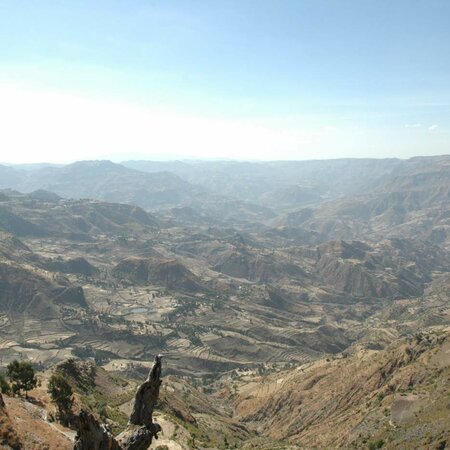
Ethiopia's landscape, due to its elevation (50% of the country's area lies above 1200 m), is characterized by pronounced uplands with steep relief and escarpments on the plateau edges and river incisions. The largest part of Ethiopia is occupied by the Abyssinian Highlands, in which the capital Addis Ababa is also located at about 2370 m above sea level. The highest mountain of the highlands is, among several other four-thousanders, Ras Dashen with a summit height of 4533 m. Through the middle of the country stretches the Great Rift Valley in a northeast-southwest direction, on whose southeastern side the Somali Highlands adjoin. A particular feature is the Koba Depression (or Afar Depression) at Lake Karum west of the border with Eritrea, which lies 116 m below sea level and, due to pronounced volcanic activity with temperatures above 40°C, is one of the hottest places on earth.
A large part of the rainfall, which mainly occurs in the Abyssinian Highlands, is taken up by Lake Tana, which releases its excess water to the Blue Nile. Ethiopia is thus part of the main catchment area of the Nile. Other outflows occur via the Awash, Juba and Ganale rivers into the Gulf of Aden.

Landscape at Lake Tana in Ethiopia
4. Flora and Fauna in Ethiopia
Due to the varied topography and resulting different climatic conditions, Ethiopia is home to a diverse plant and animal world. From desert and savanna to evergreen rainforests and high alpine regions, a wide variety of habitats have become established here. As one of the eight so-called centers of origin of the earth, Ethiopian flora comprises about 7,000 higher plant species, of which about twelve percent are endemic to Ethiopia. Ethiopia is the country of origin of coffee and various cereals, such as teff, as well as the enset (also called "false banana"). More than 20 different cultivated plants come from this country. Typical tree species of Ethiopia are the umbrella acacia, the baobab tree, juniper, and the mulberry fig tree. Extensive deforestation had already led at the beginning of the 20th century to the replacement of thinned forests with fast-growing eucalyptus, which today is the most widespread tree species in Ethiopia. A similar situation exists with the mimosa prosopis, which was settled in parts of the Afar region. The undergrowth known as kolla, which also includes the intoxicating khat shrub and myrrh, consists mainly of thornbushes and desert shrubs. Savanna grasses form the treeless grassland in the temperate zones.
Among the numerous animal species, 30 species of mammals, 23 species of birds, as well as additional reptiles and amphibians are endemic to Ethiopia. These include, among others, the Ethiopian wolf, the Ethiopian ibex, the Ethiopian highland hare, the Soemmerring's gazelle, the gelada, and the mountain nyala, the thick-billed raven, the blue-winged goose, Rouget's rail, and the wattled ibis. Most of these animals, however, can now only be observed in designated national parks. The greater kudu, Grant's gazelle, hartebeest, as well as the plains zebra are still present here in sufficient numbers. However, the African wild ass, which is also native to Ethiopia, is now threatened with extinction. Besides a rich birdlife consisting of flamingos, herons, snipes, pigeons, helmeted guinea fowls, bustards, partridges, hornbills, eagles, hawks, and vultures, to which small breeding populations of the shoebill also belong, the Ethiopian national parks also feature, alongside larger reptiles such as the crocodile and the leopard tortoise, a variety of venomous snakes such as the Egyptian sand viper, the Egyptian cobra, the African tree snake, and the black mamba.
5. National Parks and Nature Conservation in Ethiopia
In Ethiopia, over the past 80 years, more than 100 protected areas have been designated to protect its unique nature, 15 of which have national park status:
The Gambela National Park, an approximately 5000 km² large swamp area in the western lowlands of Ethiopia;
The also 5000 km² large Kafta-Sherao National Park on the Tekeze River and the Simien National Park in northern Ethiopia, which belongs to the UNESCO World Natural Heritage because of its impressive mountain landscape;
The desert-like, 4731 km² large Yangudi-Rassa National Park and the Awash National Park, shaped by the Fantale volcano, in the Afar region north of the capital Addis Ababa;
The Alatish National Park, covering 2665 km², created only in 2006 on the border with Sudan;
The 2500 km² large Yabello National Park and the approximately equally large Nechisar National Park and Maze National Park in the southwest of Ethiopia,
The Mago National Park, which lies in the southwestern savannah of Ethiopia on the Mago River, covers 2100 km² and is inhabited by the Mursi, as well as the not far away Chebera-Churchura National Park,
The Abijatta-Shalla National Park, located in the Great Rift Valley in the Oromia region on 887 km² by the lakes of the same name, and the 2500 km² large, mountainous Bale Mountains National Park, as well as Omo National Park, located in the southeast with the highest wildlife density in Ethiopia, on the Omo River over an area of about 4000 km²;
The Geraille National Park located in the very south of Ethiopia in the Somali region;

Blue Nile Falls near Bahir Dar in Ethiopia
6. Population in Ethiopia
Ethiopia has experienced a rapidly increasing population growth since the beginning of the 20th century. Between 1987 and 2023 alone, the population more than doubled from 44 million inhabitants to over 117 million due to rising life expectancy, with over 45% of the people living in Ethiopia being under 15 years old.
Ethiopia is a multi-ethnic state with 120 ethnic groups, which are distinguished, among other things, by their language and settlement areas, and whose size ranges from several million to a few hundred people.
The Oromo, who live in the south, east and west of the country, and who were formerly known as "Galla," constitute the largest ethnic group by number with a population share of 34 percent. The Oromo belong to the Cushitic language group, which also includes the Somali, Afar, Agau in the lowland areas and northern highlands, as well as the Sidama, Hadiyya, and others in the southern highlands. The Omotic language group in southwestern Ethiopia includes Wolaytta, Gamo, Kaffa, and numerous smaller groups. In the west of the country, in the border areas with Sudan and South Sudan, there are also smaller minorities who speak Nilo-Saharan languages. Since the end of the 19th century, however, the country has been politically and culturally dominated by the Amhara. Although they officially represent only about 27 percent of the population, their language, Amharic, is the official language and is widely used as a lingua franca, especially in cities. In addition, over 80 other languages are spoken in Ethiopia. English is used as the language of instruction in most secondary schools.
1.2% of the population have foreign roots and are mostly refugees from Eritrea, Somalia, and South Sudan.
7. Politics and Economy in Ethiopia
In 1975, the constitutional monarchy with the Imperial Council of Abyssinia as parliament was abolished in Ethiopia. After a transitional period with a transformation into a socialist people's republic, Ethiopia has been a federal republic since 1991, confirmed by the constitution in 1995. The president is elected by parliament and has mainly representative duties. The actual head of government is usually the representative of the strongest party in parliament and appoints the members of the Council of Ministers. Parliament consists of two chambers: the Federal House with 198 seats and the House of People's Representatives with 548 seats, whose members are directly elected by the people for a term of five years. The highest judicial authority is the Supreme Court in the capital Addis Ababa, and in addition the Constitutional Council monitors compliance with the federal constitution.
Ethiopia's rapidly growing economic performance reached the highest economic growth in the world in 2015 at 10.2 percent, with annual growth rates between eight and twelve percent of the gross domestic product. Although progress has been made in poverty reduction and infrastructure development, a significant part of the population still lives below the absolute poverty line. Ethiopia's foreign trade essentially consists of the export of coffee, with Germany being the largest customer. However, the share of agriculture in the gross domestic product has declined in recent years in favor of a strongly growing service sector. Due to favorable conditions for energy production in many areas, the prospects are good for making Ethiopia a major exporter of clean and affordable renewable energy. The country's abundantly available fossil energy resources such as coal or natural gas, however, are hardly used. The up-and-coming tourism industry in Ethiopia, which develops and markets the country’s many tourist attractions and now generates 6.4% of the gross domestic product, also contributes to economic growth.
8. Transport Network in Ethiopia
All major cities in Ethiopia are now accessible via good asphalt roads. As of 2023, Ethiopia had over 140,000 kilometers of roads, around 15,000 km of which are paved, thanks to a massive road construction program. Each year, about 11 percent new roads are added. Road traffic in Ethiopia is considered unsafe due to the many accidents.
Buses run between almost all locations in Ethiopia.
Since 2016, there has been a 756 km long, continuously electrified railway line, which runs from Sebeta just west of Addis Ababa via Awash to Dewele on the border with Djibouti and from there continues to the container port of Djibouti City on the Gulf of Tadjoura, connecting Ethiopia, which has no access to the sea, with the Indian Ocean. In addition, further railway lines such as from Mekele to Weldiya and a 391 km long single-track connecting line between the two rail lines from Awash to Weldiya are under construction.
In addition to 15 domestic airports, Ethiopia has two international airports, but only Bole International Airport in the capital Addis Ababa offers around 110 international scheduled destinations, while only one international flight connection to Djibouti exists from Dire Dawa. However, the exhausted capacity of the capital's airport in Addis Ababa is to be significantly expanded in the near future.

Ethiopia's capital Addis Ababa
9. Cities and Regions in Ethiopia
In 1991, the historical provinces in Ethiopia were dissolved, and the country was reorganized into new regions or federal states based on ethnic criteria according to the principle of ethnic federalism. The province of Eritrea peacefully withdrew from the union in 1993 after an independence war until 1991. Since 1998, there have been nine autonomous regions and two independent cities (Addis Ababa and Dire Dawa). Six of the regions (Tigray, Amhara, Oromia, Somali, Afar, and Harar) are named after the ethnic groups living in them, while the remaining three (Benishangul-Gumuz, Gambela, and the Southern Nations, Nationalities, and Peoples' Region) are ethnically mixed and therefore assigned to several indigenous ethnic groups.
The largest cities in Ethiopia are located in the center and in the northern half of the country:
Addis Ababa
The capital of Ethiopia is located in the central highlands at about 2,400 meters above sea level and extends with approximately 4.5 million inhabitants (2023) over an area of roughly 530 km² at the foot of Mount Entoto. Addis Ababa is not only the political capital but also the economic and social center of Ethiopia. Wide boulevards run through the city, and multi-story buildings stand next to traditional one- or two-story houses, open squares, and wooded areas that are mainly covered with eucalyptus trees. Due to its high altitude, the climate in Addis Ababa is mild. Addis Ababa has a university founded in 1950 and several research institutions as well as art and music schools. Ethiopia’s capital is home to various African organizations and bodies such as the United Nations Economic Commission for Africa and the African Union, as well as several consulates, which is why Addis Ababa is also unofficially considered the capital of Africa. As a cosmopolitan city, Addis Ababa offers a wide range of hotels and accommodations in various styles and price ranges. The cultural highlights of the city include the university, the Menelik Mausoleum with the mortal remains of past emperors and martyrs, St. George’s Cathedral with a collection of modern artworks by the famous Ethiopian artist Afewerk Tekle, who also designed the windows of the impressive Africa Hall, the Holy Trinity Cathedral, the Hager Fikir Theatre, and the Red Terror Martyrs’ Memorial Museum, a memorial to the victims of the Marxist Derg regime. Also worth experiencing are Addis Ababa’s largest market, the Mercato, and the fantastic panoramic view from the 3,000-meter-high Entoto over the entire city and the surrounding countryside.
Gonder
In the mountainous region of Amhara, at an altitude of 2,133 meters above sea level and covering an area of almost 300 km², lies Ethiopia’s second largest city with about 350,000 inhabitants. Gonder, founded by Emperor Fasilides, was the capital of Ethiopia from 1636 to 1855 and has numerous palaces, castles, and churches. Worth seeing is the nearby fortified city of Fasil Ghebbi with many magnificent buildings of various emperors of former Abyssinia. Just outside Gonder is also the former bath of Emperor Fasilides, one of the venues of the Timkat ceremonies, during which, among other things, the baptism of Jesus in the Jordan is commemorated. Also worth visiting is the Debre Berhane Selassie Church, whose walls and ceilings are completely decorated with frescoes that have become a popular motif on Ethiopian art objects.
Mek’ele
With 340,000 inhabitants (2023), the rapidly growing capital of the Tigray region in the far north is the third largest city in Ethiopia. In addition to a university, Mek’ele is home to the Ethiopian vehicle manufacturer Mesfin.
Adama
The capital of the Oromia administrative region, with nearly 350,000 inhabitants, is about the same size as Mek’ele. The city, formerly known as Nazret, emerged during the construction of the railway line from Addis Ababa to Djibouti in 1917 and is now a center for processing agricultural and livestock products from the surrounding area.
Bahir Dar
The capital of the Ethiopian province of Amhara on Lake Tana has about 400,000 inhabitants (2023) and features an airport, a university, and about 20 Christian Orthodox monasteries. Near Bahir Dar is one of the palaces of Haile Selassie, the last Abyssinian emperor, as well as the Tisissat waterfall of the Blue Nile.
Dire Dawa
The city of Dire Dawa, which also emerged during the construction of the Addis Ababa - Djibouti railway line, has, due to disputes over its assignment as the capital either to the Somali region or Oromia, the status of an independent city, just like the capital Addis Ababa. Having grown to almost 400,000 inhabitants, Dire Dawa forms, not least because of its relative proximity to the international ports of Djibouti and Berbera in Somaliland, the second most important economic hub of Ethiopia after the metropolitan area of the capital Addis Ababa and also has an airport.

Sulfur mineralization in the Erta Ale volcanic region in Ethiopia
10. Culture and Sights in Ethiopia
Although geographically counted as sub-Saharan Africa, large parts of Ethiopia have been heavily influenced by the Middle East in their historical and cultural development. For example, painting and the creation of fine handicrafts, which are untypical for sub-Saharan Africa, have their roots in the ancient North African and Near Eastern cultural area. Since the end of the 19th century, the country has been dominated politically and culturally by the Amhara. Although they officially make up only about 27 percent of the population, their language, Amharic, is the official language and is widely used, especially in cities, as a lingua franca.
Through its Christian traditions and historical isolation, Ethiopia is culturally quite distinct from other African countries south of the Sahara. This is reflected in the country's architecture and art, including in Ethiopian cuisine.
One of the most important modern Ethiopian painters was Afewerk Tekle, who died in 2012 and created large oil paintings, sculptures, and applied art, including stamps.
The pentatonic traditional music of Ethiopia is very different from the music of the rest of Africa. It is performed by singer-poets called Azmari, who travel the country with ballad-like songs, sharing old stories and commenting on current topics. The instrumental accompaniment is played on the lyre (Krar or Beganna), the one-stringed bowed box-spike fiddle (Masinko), or flute (Washint). In addition to traditional music forms, a vibrant popular music scene developed from 1950 onwards, particularly in the big cities, which combined Western and indigenous styles.
Besides its cultural diversity, Ethiopia has a long tradition of producing outstanding long-distance runners. 20 athletes from Ethiopia have won a total of 55 Olympic medals at the Olympic Games.
Cultural sights include, among others: the palace of Emperor Fasilides in Gonder, the cathedrals and fields of steles of Axum, the rock-hewn churches of Lalibela, and the small city of Harar, declared a World Heritage site, with 90 mosques and the house of Arthur Rimbaud. In addition, Ethiopia offers a wealth of natural attractions such as the waterfalls of the Blue Nile near Bahir Dar, the remarkable national parks like the Simien National Park or the Awash National Park as well as the Danakil Depression with the unique backdrop of the Erta Ale volcanic region.

Rock-hewn church in Ethiopia near Lalibela
11. Holidays with Fixed Dates in Ethiopia
| Jan 7 | Christmas |
| Jan 20 | Epiphany |
| Mar 2 | Victory Day at the Battle of Adwa |
| May 1 | Labor Day |
| May 5 | Patriots' Day |
| May 28 | End of the Derg Regime |
| Sept 11 | Ethiopian New Year |
| Sept 27 | Meskel |
12. Medical Information for Ethiopia
For legal reasons, as a tour operator we are not permitted to provide binding medical advice and therefore refer you to the information provided by the Federal Foreign Office of the Federal Republic of Germany, the Robert Koch Institute, and the German Society for Tropical Medicine and International Health e.V.
13. Travel Information for Ethiopia
Current travel and safety advice, information on entry and exit as well as special criminal law information and behavioral recommendations for your stay in Ethiopia can be obtained from the Federal Foreign Office of the Federal Republic of Germany.
14. Foreign Representation in Ethiopia
| Embassy of the Federal Republic of Germany in Addis Ababa | |
| District/ Consular district: |
Ethiopia. The representation also supports the Embassy Djibouti (Djibouti) in legal and consular matters. |
| Location: | Addis Ababa |
| Street address: | Yeka Kifle Ketema (Khebena), Woreda 03, Addis Ababa |
| Postal address: | Embassy of the Federal Republic of Germany, P.O. Box 660, Addis Ababa, Ethiopia |
| Telephone: | +251-11-123 5139/40/41/42, Mobile number (only if the landline is down!): 0904-032 715, for emergencies +251-911-204 020, 0911-204 020 |
| Fax: | 0049-30-1817 67204 |
| Email: | Contact form |
| Website: | http://www.addis-abeba.diplo.de |
| Official languages in the host country: |
Amharic, for Djibouti: French |
| Embassy of the Democratic Federal Republic of Ethiopia in Berlin (There are further Consulates General and Honorary Consulates in Hamburg, Bremen, Frankfurt, Munich and Stuttgart) |
|
| Location: | Berlin |
| Street address: | Boothstrasse 20A |
| Postal address: | Boothstrasse 20A, 12207 Berlin |
| Telephone: | 030 77 20 60 |
| Fax: | 030 772 06 26 |
| Email: | [email protected] |
| Website: | http://www.aethiopien-botschaft.de |
15. Information Sources for Ethiopia
German Weather Service
Federal Foreign Office of the Federal Republic of Germany
Wikipedia