Everything you need to know about Romania
Travel map of Romania by the tour operator Overcross
- General travel information for Romania
- Travel climate in Romania
- Geography in Romania
- Flora and fauna in Romania
- National parks and nature conservation in Romania
- Population in Romania
- Politics and economy in Romania
- Transport network in Romania
- Cities and regions in Romania
- Culture and sights in Romania
- Holidays in Romania
- Medical information for Romania
- Travel advice for Romania
- Foreign representation in Romania
- Information sources for Romania
1. General travel information for Romania
| Continent: | Europe |
| Geographical location: | Southeastern Europe, north of the Balkans, located in the northern hemisphere |
| Highest elevation: | Moldoveanu (2544 m above sea level) |
| Longest river: | Danube (1300 km) |
| Form of government: | Republic |
| Government system: | Semi-presidential government system |
| Languages: | Romanian, Hungarian |
| Neighboring countries: | Republic of Moldova, Ukraine, Hungary, Serbia, Bulgaria |
| Capital: | Bucharest |
| Area: | Approx. 238,400 km² |
| Population: | Approx. 19.3 million people (2023) |
| Population density: | 81 people per km² |
| Religions: | Approx. 98% followers of Christianity (86% Romanian Orthodox Church, 6.7% Protestants, 5.6% Catholics), approx. 0.3% Muslims, 0.1% Jews |
| Currency: | Romanian New Leu, 1 EUR is approximately 4.9 RON; You can find current exchange rates for our travel countries at oanda.com |
| Travel climate: | temperate climate in the westerly wind zone |
| Time zone: | UTC+2 |
| Country code: | +40 |
| Country code: | RO, ROU, 642 |
| Electricity: | In Romania, as in Germany, socket types C and F are used. Mains voltage is 230V with a frequency of 50Hz. An overview of the sockets and plugs used in our travel countries can be found at wikipedia.de |
2. Travel climate in Romania
Romania is located within the temperate climate zone influenced by Atlantic westerly winds. However, the Carpathian arc forms a natural barrier that prevents the spread of Atlantic air masses into the east and south of Romania. Thus, in the Moldavia region east of the Carpathians, a continental climate with cold air currents from Ukraine prevails, whereas Transylvania to the west of the Carpathian arc is still shaped by the oceanic climate of the Atlantic winds. South of the Carpathians, in Wallachia and even more so in the Dobruja region, Mediterranean climate influences are decisive.
Due to these and also due to different altitudes, climatic differences result in the annual average temperatures within Romania varying between 11 °C in the south and 8 °C in the north, with the coldest month usually being January and the warmest month being July. The average winter temperatures are 0 °C at the Black Sea and −15 °C in the high mountains, while in summer the average temperatures in the lower regions of the country rise to more than 25 °C, with maximum values of over 40 °C.
Precipitation is strongest in the northwest of Romania and decreases toward the southeast. In the high elevations of the Carpathians, annual precipitation amounts of up to 1000 mm are measured, whereas on the Black Sea coast only 300–400 mm fall per year. On the other hand, up to 2300 hours of sunshine per year are counted on the seaside beaches.


3. Geography in Romania
Romania is located north of the Balkans and forms the transitional area between Central, Southern, and Eastern Europe. In the east, the country borders the Republic of Moldova along the Prut River, to the north it borders Ukraine, and to the northwest Hungary. In the southwest and south, the Danube forms the border river with Serbia and Bulgaria. In the southeast, the country has a 225 km long coastline on the Black Sea.
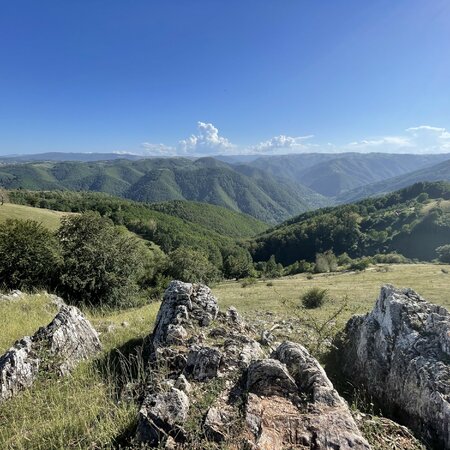
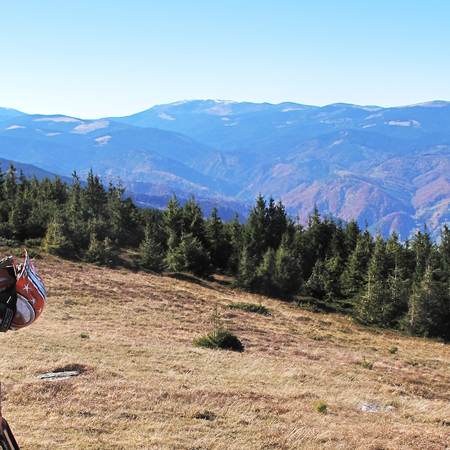
The Romanian landscape is characterized by mountains, highlands, and plains. The Carpathian arc with the 2,544 m high Moldoveanu separates the lowlands of Wallachia and Dobruja as well as the historic regions of Moldavia and Transylvania from the Transylvanian plateau, which forms the geographical center of Romania. The second highest peak in Romania is found in the Eastern Carpathians with the 2,303 m high Pietros. Further west, the Carpathian arc merges into the Banat Mountains. West of Transylvania lies the Apuseni Mountains, which decrease further west into the historic Crișana region and towards Hungary. Together with the Poiana Ruscă Mountains, these ranges form the so-called Romanian Western Carpathians. To the north, the Carpathian arc continues through Bukovina into Ukraine.
The south of Romania slopes down with Wallachia to the Pannonian Plain, which is traversed by the Danube and finds its end with Dobruja on the Black Sea. The almost 240,000 km² large country drains exclusively via the Danube and several larger tributaries such as Prut, Tisza, and Siret into the Black Sea. Some rivers, such as the Mureș or Tisza, at first flow a surprisingly long way west and south, only to move their carried waters back east via the Danube.

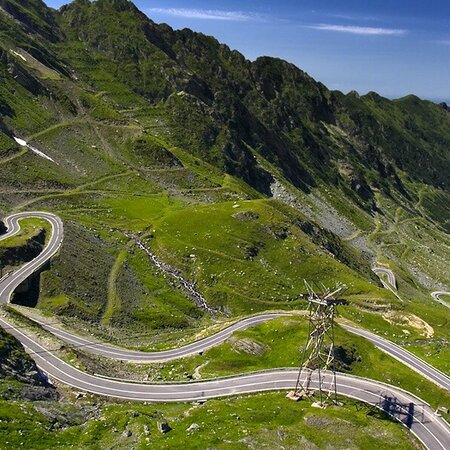
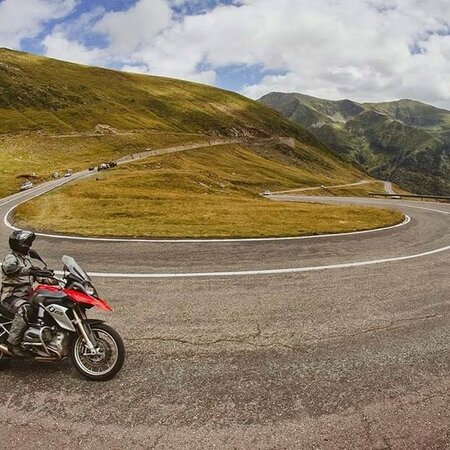
Serpentine road in the Carpathians
4. Flora and Fauna in Romania
Romania is covered by forests for 27%, which reach up to about 1,800 meters in elevation. Above that, there is grassland with mountain pastures. The various types of trees are found preferably at certain altitudes. Within the coniferous forest zone between 1,400 and 1,800 m above sea level, spruces, firs, pines, yews, and larches grow. In the beech forest zone, between 400 and 1,400 m above sea level, in addition to beeches and hornbeams, elms, ashes, and birches can also be found. The lowest forest zone, in the range of 150–400 m above sea level, is dominated by oak forests, which also contain maple trees, plane trees, willows, poplars, and lindens.
In part of the Wallachian plain and in Dobruja, original steppe landscapes still exist with scattered deciduous trees, roses, prunus, and hawthorns, which are, however, largely used for agriculture.
The Danube Delta is characterized by wetlands with reeds, cattails, water hemlock, and water lilies.
In Romania's wildlife, there are genera that are widespread throughout Europe such as golden eagles, cinereous vultures, red deer, and red foxes; in lower deciduous forests also badgers, roe deer, and wild boar can be found. Among the total of 3,600 animal species in Romania, there are also those that are already extinct or very rare elsewhere in Europe. These include the chamois, bearded vulture, brown bears (about 6,600 specimens), wolves (about 3,100 specimens), lynx (about 1,500 specimens), and otters living in the Carpathians. In 2022, the European bison, which was also extinct in Romania, was reintroduced. So far (2023), about 130 animals live completely in the wild and reproduce slowly. In the Wallachian plain, there are small populations of the great bustard.
The Danube Delta is home to numerous species of fish, amphibians, and migratory birds. Besides the rose pelican, which occurs only here in Europe, the purple heron and the black stork can also be found. The sturgeon, known for its caviar, also lives in the waters of the Danube estuary, while the common dolphin occasionally appears off the Black Sea coast.
5. National Parks and Nature Conservation in Romania
Within the framework of implementing the Europe-wide NATURA 2000 protected area network, Romania has established numerous additional protected areas following its EU accession, alongside the already existing national parks. Currently, Romania has 148 bird protection areas and 383 areas classified as special protection areas under NATURA 2000, which corresponds to approximately 23.6% of Romania's land area. The protected areas are partially integrated into the country's 13 national parks, most of which are located in the Carpathians and impressively showcase the country's natural beauty during a journey through Romania.
The Danube Delta, with an area of 5,800 km², is the second largest delta in Europe after the Volga Delta. As part of the UNESCO World Heritage, the biosphere reserve, known for its unique birdlife, hosts, among other things, the world's largest reed area in the lagoon-lined swamps and lake landscapes. Romania possesses more biogeographical regions than any other EU country, but these are increasingly threatened by booming and modernized agriculture and urban growth. Furthermore, illegal logging, which is driven by international demand for cheap wood and large foreign timber companies, especially from Austria, and is not followed by reforestation, is increasingly threatening Romania's forest stock.
Romania's largest national park is the Domogled-Cerna National Park in the Western Carpathians, with an area of about 600 km². The national park is known for its tropically tempered caves and the unique cave fauna associated with them. In the immediate vicinity is Romania's first national park. The Retezat National Park was already designated in 1935 in the high Western Carpathians over an area of about 380 km².
In the neighboring Banat region lies the 360 km² Semenic-Cheile-Carașului National Park with typical karst and forest landscapes and the breathtaking Caraș Gorge, as well as various dripstone and crystal caves, some of which can only be accessed underwater.
In the Rodna Mountains in northern Romania lies the 460 km² Rodna Mountains National Park, whose characteristic landscape features are formed by 28 glacial lakes and many, in part cascading, waterfalls.
6. Population in Romania
About 19.3 million people live in Romania today (2023). The population growth, which increased enormously after the Second World War, has been slightly declining for some time with -0.5%. Across the country as a whole, Romanians make up the largest ethnic group in Romania with almost 90% of the population. However, regionally, certain ethnic minorities may predominate in some areas. This is especially true for the main settlement areas of Hungarians in the southeast of Transylvania, the Szeklerland, as well as in the border region with Hungary, where Hungarians, who make up only 6.5% of Romania's total population, form the majority population. The former territorial disputes between Hungary and Romania have eased since the revolution of 1989.
The Roma, who are spread throughout the country, are today the third largest population group in Romania with about 3.2%. They are often socially and economically worse off than the other ethnic groups.
The once high proportion of German-speaking Saxons and Danube Swabians in Transylvania and Banat until the middle of the last century has now dropped to 0.2%. Other minorities, for which a seat in the Chamber of Deputies is allocated regardless of the votes cast, are the Ukrainians in Bukovina and Maramureș; the Russian Lipovans, the Turks and Tatars in Dobruja; Serbs and Slovaks and Czechs in Banat.
Depending on the various nationalities, different languages are used regionally in Romania, especially Hungarian, but the official language is Romanian, which is spoken by 91% of the country's population. Foreign languages taught in Romania are English and French, and in Transylvania and Banat also German. Therefore, when traveling through Romania, communication in one of these three languages is usually possible without problems.
Winter landscape in Transylvania
7. Politics and Economy in Romania
Romania has a semi-presidential system of government with the president as head of state. The president is elected directly by the people for a term of five years, which can be extended once by re-election for another five years. He represents the state, is responsible for upholding the constitution and the functioning of public authorities, and appoints the prime minister as head of government. At the same time, he mediates between the state and society and is commander-in-chief of the armed forces.
The parliament, consisting of the Chamber of Deputies and the Senate, is responsible for national legislation. The Chamber of Deputies has 329 seats and the Senate 136 seats. Members of parliament are elected for a legislative period of four years via a mixed electoral system combining personal and proportional representation. Only parties that have received more than five percent of all votes cast enter parliament. Eighteen parliamentary seats are reserved for deputies of ethnic minorities.
Due to the powers sometimes pushed to their limits by the president and head of government, Romania's democracy is considered to be partially defective or incomplete. This was reflected in the recent past, for example, in the government's efforts to limit the independence of the judiciary and intelligence services under the pretext of combating an alleged shadow state. The legislative initiative proposed by the government to pardon hundreds of officials accused of abuse of office could also only be averted by massive protests from the population.
Romania's economy first recovered from a depression during the global financial crisis in 2009 and 2010 with 2 percent growth. Thanks to sustained positive economic development, as of 2017 Romania's economy, with a GDP of around $350 billion and growth of about 4.8%, is among the fastest growing economies in Europe as well as among the strongest growth countries worldwide. Estimates suggest the service sector's share of GDP is over 52% and the industrial sector's share about 34%, while the agricultural sector, after record gains in 2004, has now shrunk to less than 5% of GDP.
Romania's diverse industrial products include electronic devices such as computers, telecommunications equipment, consumer electronics, and semiconductors, as well as vehicles, ships, various aircraft, pharmaceuticals, textiles, and food. In addition, raw products of the chemical industry and steel are produced. Romania's mineral resources include energy sources such as natural gas, crude oil, coal, as well as salt and gold. Agricultural products are cereals, wool, grapefruit, sugar, potatoes, as well as egg-, dairy-, and meat products. In the service sector, tourism records steady demand, which has triggered increased investment in this area.
The unemployment rate was about 5% in 2023 and one eighth of the Romanian population is at risk of poverty. Corruption in Romania is unfortunately a daily occurrence at many levels and is among the country's most serious problems.
8. Transport infrastructure in Romania
Romania's road network comprised about 84,000 km in 2023, of which around 50,000 km are asphalted. The planned motorway network in Romania, with a total length of 2710 km, is under construction. In 2022, around 1200 km were completed and a further 250 km are under construction. The use of motorways in Romania is subject to tolls, which requires the purchase of a corresponding vignette before the journey. While the motorways and major national roads are in good condition, the other roads, especially in border or rural regions, can hardly be compared to Western European standards. In addition, there are dangers due to slow and unlit horse-drawn carts and the fact that applicable speed limits are often ignored by the local population.
The total length of the Romanian railway network is 20,730 km, of which 3,292 km are electrified. The network and the rolling stock as a whole are in need of modernization by European comparison, with the Romanian State Railway as the operator of the network, for example, slowly meeting this need by replacing outdated long-distance trains. Important travel hubs with large passenger stations can be found not only in Bucharest, but also in Ploiești, Arad, Constanța, Cluj-Napoca, Brașov, Craiova and Timișoara. From Bucharest, for example, daily international direct connections depart to Belgrade, Budapest, Chișinău, Istanbul, Kyiv, Moscow, Prague, Bratislava, Sofia, Warsaw and Vienna.
International airports through which Romania can be reached for travel are located in Bucharest, Cluj-Napoca, Sibiu, Târgu Mureş, Baia Mare, Oradea, Satu Mare, Arad, and Constanța.
Romania's most important seaports are located in Constanta and Midia. From the Danube port of Tulcea, passenger ships regularly depart to the Danube Delta during the summer season. Private boat operators offer taxi-like crossings to Ismajil in Ukraine. In addition, there are larger inland ports for freight and cruise traffic in Braila, Galati, and Giurgiu.
9. Cities and Regions in Romania
In historical times, the present-day state territory of Romania and neighboring Hungary was divided into eight landscape regions, which today no longer have administrative significance, but are still mentioned especially in connection with the former German population in Romania. These include the region of Transylvania, the Crișana area and the Banat in the Western Carpathians, Wallachia in the southern lowlands, Dobruja between the lower Danube and the Black Sea, as well as the Principality of Moldavia and Bukovina on the slopes of the Eastern and Northern Carpathians, bordering Ukraine.
Today's Romania is administratively divided into 41 counties and the municipality of Bucharest, with each county governed by an elected county council and a directly elected president of the county council. Additionally, the central government appoints a prefect for each county, who represents the government at the local level and reviews the legality of the actions and decisions of local authorities.
The national capital Bucharest, located in Wallachia, is by far the largest city in Romania, with almost two million inhabitants on about 230 km² and is one of the eight largest cities in the European Union. Other important cities in Romania with populations between 200,000 and 300,000 are the historic Cluj-Napoca (Klausenburg) and Brașov (Kronstadt) in Transylvania, Timișoara (Temeswar) in Banat, Iași (Jassy) in Moldavia, Galați (Galatz) with Romania’s most important inland port, Constanța with the EU’s largest Black Sea port in Dobruja, and Craiova in the small Wallachia.
Bucharest
Romania’s capital Bucharest was first mentioned in 1459 and developed in the second half of the 15th century into the princely seat of Wallachia. After a turbulent history marked by destructive fires and various affiliations, first to the Ottoman Empire and later, after the Russo-Austrian-Turkish War, to Russia, Bucharest became the capital of the united principalities of Moldavia and Wallachia, whose merger after the Berlin Congress in 1878 was recognized as the independent Kingdom of Romania. In the following period, Bucharest was redeveloped into an imperial city according to Western standards, and was equipped with many technical innovations such as a railway line to Giurgiu, a tram, and electric street lighting.
Towards the end of the 19th century, Bucharest gradually developed into a center of Romanian industry and finance. During World War I, Bucharest initially lost its status as the capital to the city of Iași, but subsequently regained its importance as the capital of “Greater Romania”. Until the beginning of World War II, the city area expanded to about 8 km². Through the construction of grand boulevards and avenues modeled after the French style, Bucharest was regarded as the Paris of the East. During World War II, the city suffered large-scale destruction from multiple aerial bombings. After the war, Bucharest tripled in area—over 20 km²—due to rural depopulation as people moved into the city. Following a major earthquake in 1977, downtown Bucharest underwent radical redevelopment, with the construction of representative state and administrative buildings taking priority. The dominant element of this colossal inner-city architecture is the Palace of the Parliament, which, with a footprint of 65,000 m², is among the largest buildings in the world.
Although much historical architecture was destroyed by wars, fires, earthquakes and demolitions, Bucharest still offers a number of architectural and cultural monuments from various periods. Among the oldest monuments are the remains of the first Bucharest Princely Court Curtea Veche from the 15th and 16th centuries and the Hanul lui Manuc, an inn and caravanserai built in 1808, where the Treaty of Bucharest between Russia and Turkey was signed in 1812. In the impressive Romanian Athenaeum, built between 1885 and 1888, today houses Bucharest's concert hall. Bucharest also boasts a huge triumphal arch in the classic Roman style completed in 1936, similar to Paris. The Bucharest Royal Palace was built between 1927 and 1937 in neoclassical style. In addition to visiting numerous churches, cathedrals, and museums, spacious parks with lakes offer places to relax and unwind in Bucharest.
Life in Bucharest centers on the city's grand boulevards and avenues lined with imposing buildings and palaces, such as the Calea Victoriei, with numerous cafés and trendy locales. The Lipscani zone is a historically grown district of Bucharest with well-preserved houses from past centuries, largely inhabited by merchants, and now hosts a variety of cozy cafés and bars.
Cluj-Napoca
The city was founded by German settlers on the banks of the Small Someș River in the 13th century as the second largest city in the Kingdom of Hungary. Cluj-Napoca was for a long time the capital of the Grand Principality of Transylvania, until after World War I it first fell to Romania, which was by then recognized as an independent state, but after the separation of Northern Transylvania by the Second Vienna Award in 1940, it returned to Hungarian administration. With the German occupation of Hungary, Cluj-Napoca was directly administered by Germany from 1944 to 1945, and thus became a site of the Holocaust, with approximately 18,000 Jews from Cluj-Napoca and neighboring towns falling victim. Today, the city, with about 325,000 inhabitants, is the second largest in Romania. Furthermore, with four universities and other colleges, Cluj-Napoca is one of the country's most important scientific and economic centers and the cultural focal point of the Hungarian minority.
In Cluj-Napoca’s downtown, many historic buildings from before World War II have been preserved and, with their differing architectural styles, define the cityscape. The most famous building in medieval Gothic style is St. Michael's Church. From the early modern period, several Renaissance buildings and Baroque aristocratic palaces survive, as well as representative buildings in the Classicist, Eclectic, and Art Nouveau styles from the 19th and early 20th centuries. The Museum Square and its surrounding alleys form a popular, car-free promenade with many cafés, some in a medieval setting. The first castle of the city also stood here.
Constanța
Constanța's founding dates back to the Greeks in the 6th century BC and later became a Roman trading center on the Black Sea, where the Roman poet Ovid lived in exile. In later centuries, the city was first conquered by the Bulgarians, then fell to the Ottoman Empire, and finally was assigned to Romania as part of Northern Dobruja in 1878. During World War II, Constanța became the target of Allied bombings due to the strategic importance of its Black Sea harbor for the Axis powers.
Today, Constanța, with about 284,000 inhabitants, is Romania’s fifth largest city and the most important port city on the Black Sea in the European Union. Only a few attractions from before the Second World War remain. Still to be seen are the foundations of the ancient Greek city of Tomis and further ruins of Greek and Roman basilicas and necropolises, the spectacular casino built in 1990, a merchant house known as the Mosaic Museum with a Roman floor mosaic, and the lighthouse from the 13th century. With its surrounding beaches, the area around Constanța has become a popular destination for bathers. An aquarium with dolphinarium is also among Constanța’s tourist attractions.
Iași
First mentioned in documents in the 14th century, Iași was the capital of the Principality of Moldavia from 1565 to 1859 and later also of the newly founded principality of Romania, until it was replaced by Bucharest in 1862. During World War I, Iași again served as Romania’s provisional capital from 1916 to 1918. During World War II, the city suffered heavy bombardment by the Russians and was the scene of the horrific Iași Pogrom, in which at least 13,000 Romanian Jews were killed.
Today the university city of Iași, with almost 300,000 inhabitants, is Romania’s fourth largest city. Owing to the many Romanian personalities and artists who lived here, Iași is of considerable importance for the development of Romanian culture. The city, also known for its porcelain manufacture, is dominated at its center by the Palace of Culture, completed in 1925 in the Neo-Gothic style, which today houses, among other things, the largest art collection in the country and a library. Also worth seeing are the impressively large Metropolitan Church from the early 19th century and the Coronation Church, as well as several monasteries and other cultural monuments that line the city's central squares and streets. The almost one square kilometer-sized botanical garden is one of the largest botanical parks in Europe.
10. Culture and Sights in Romania
Due to Romania's border position between Western Europe and the Orient as well as the pronounced geographical differences between the various cultural landscapes, Romanian culture, just like that of the neighboring Republic of Moldova, is a creative synthesis of the cultural heritage of numerous ethnic and religious minorities and is characterized both in its diverse historical manifestations and in its present structure by a diversity unique in Europe.
Over the centuries in Romania, for example, Greek, Slavic, Hungarian, Turkish, Macedonian, and other musical traditions, together with truly Romanian elements, have developed into an extraordinarily rich stylistic diversity. Traditionally frequently used instruments include the cimbalom, violin, accordion, double bass, and clarinet, which are sometimes played with astonishing virtuosity even in everyday performances.
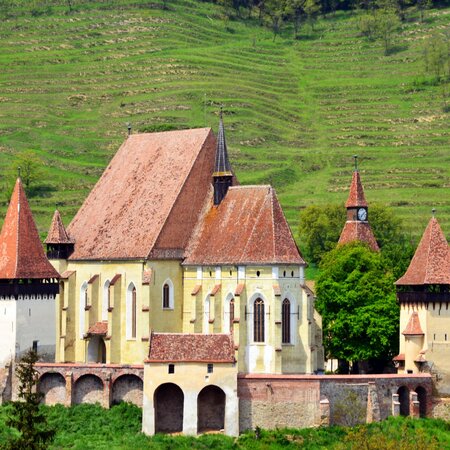
Since the fall of communism in 1989, cultural monuments of Romania such as the Moldovan monasteries with exterior paintings, Horezu Monastery, the fortified churches in Transylvania, the old town of Sighișoara, the Dacian fortress in the Orăștie Mountains, and the wooden churches in Maramureș have been added to UNESCO’s list of World Heritage Sites. The Black Church in Brașov is the easternmost Gothic cathedral in Europe and at the same time the most significant Gothic church building in Southeastern Europe. The Parliament Palace in Bucharest, built in the neoclassical style, is the largest building in Europe and one of the largest in the world. In 2007, Sibiu, with its historic city wall, the Brukenthal Palace, the Blue City Hall, the Town Hall, and the House of Arts, was the European Capital of Culture.
Romanian literature has produced several important writers, dramatists, and poets such as Mircea Cărtărescu, Eugène Ionesco, Matei Vișniec, Tristan Tzara, and Mircea Dinescu.
In addition to Romania’s numerous cultural monuments, of course the impressive natural landscapes count as highlights of any visit to Romania. Many of these unique natural sites, such as the mountain landscapes of the Carpathians and the Apuseni Mountains or the Danube Delta, are accessible in the Romanian national parks.
11. Public Holidays with Fixed Dates in Romania
| 1 Jan | New Year's Day |
| 2 Jan | Day after New Year's Day |
| 24 Jan | Union Day |
| 1 May | Labour Day |
| 1 Jun | Children's Day |
| 15 Aug | Assumption of Mary |
| 30 Nov | St. Andrew's Night |
| 1 Dec | National Day |
| 25 Dec | Christmas Day |
| 26 Dec | Second Day of Christmas |
12. Medical Information for Romania
For legal reasons, as a tour operator we are not permitted to communicate binding medical information for Romania and therefore refer to the information from the Federal Foreign Office of the Federal Republic of Germany, the Robert Koch Institute and the German Society for Tropical Medicine and International Health.
13. Travel Advice for Romania
Current travel and safety advice, information on entry and exit requirements as well as specific criminal law notices and recommendations for conduct during your stay in Romania can be obtained from the Federal Foreign Office of the Federal Republic of Germany.
14. Foreign representation in Romania
| Embassy of the Federal Republic of Germany in Bucharest (There are also honorary consulates in Sibiu and Timișoara) | |
| Jurisdiction/ Consular district: |
Romania |
| City: | Bucharest |
| Street address: | Strada Cpt. Av. Gheorghe Demetriade 6 - 8, 011849 Bucharest |
| Postal address: | Embassy of the Federal Republic of Germany, Strada Cpt. Av. Gheorghe Demetriade 6 - 8, 011849 Bucureşti, Romania |
| Telephone: | +40 21 202 98 30, +855 23 21 63 81, for emergencies +855-(0)10-990 002 |
| Fax: | +40 21 230 58 46 |
| Email: | Contact form |
| Website: | http://www.rumaenien.diplo.de |
| Official languages in the host country: |
Romanian |
| Embassy of Romania in Berlin (There are also general consulates in Bonn, Munich and Stuttgart as well as honorary consulates in Hamburg, Leipzig and Neustadt/Weinstraße) | |
| City: | Berlin |
| Street address: | Lichtensteinallee 1 |
| Postal address: | Dorotheenstraße 62 - 66, 10117 Berlin |
| Telephone: | 030 21 23 92 02 |
| Fax: | 030 2 12 39 399 |
| Email: | [email protected] |
| Website: | http://berlin.mae.ro |
15. Information sources for Romania
German Meteorological Service
Federal Foreign Office of the Federal Republic of Germany
Wikipedia