OVERVIEW
Kaokoland Motorcycle Tour: Van Zyl's Pass and Epupa Falls
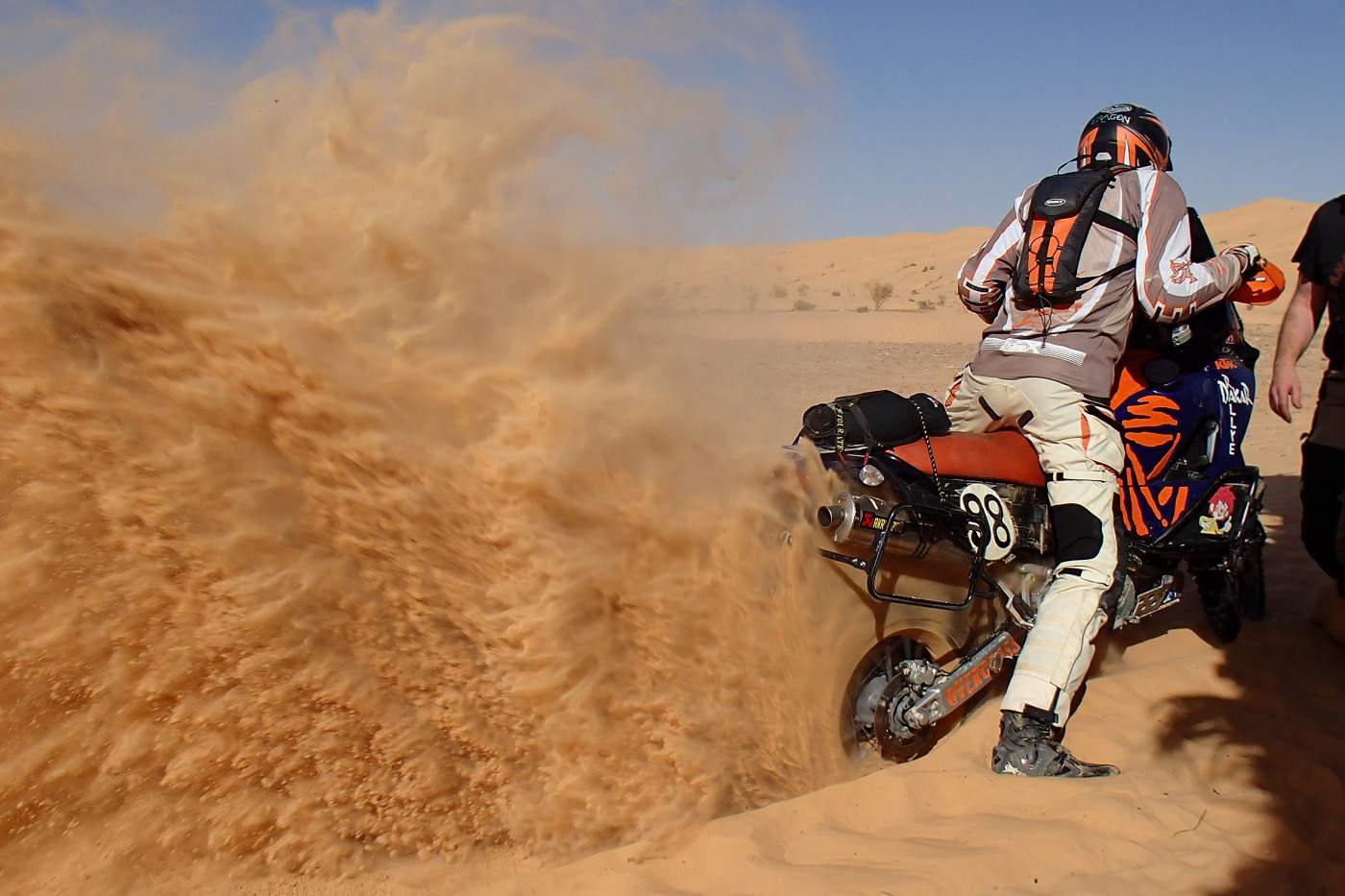
Ride the hardest enduro terrain in Africa on this guided 12-day Namibia motorcycle tour through Kaokoland. You start and end in Windhoek. In between, you cross dry riverbeds, camp next to the Kunene border river, and tackle van Zyl's Pass — the Holy Grail for enduro riders. The route takes you through Khowarib Gorge, Opuwo and the Epupa Falls. You pass Himba and Herero villages on the way north, and you ride next to desert elephants on the way back south. A 4x4 support vehicle carries your luggage and backs up the convoy with a mechanic on board. The rental enduro and an English-speaking tour guide are included in the price. Max 6 riders per departure. Level: Expert.
Introduction to the Namibia Motorcycle Trip
This Kaokoland wilderness motorcycle expedition is built for experienced enduro riders. The route runs from the capital Windhoek up into Africa's last true wilderness and back again. You cover roughly 2,200 km on the bike. About 70% of that is loose gravel, sand, rocky trail or dry riverbed.
Kaokoland has almost no tarmac. It has almost no fuel stations. It has almost no people. What it has instead: empty mountain passes, red rock canyons, elephants that walk down river courses, and Himba families who still live the way they always have. This is the kind of ride you train for.
The schedule gives you culture at the start (Himba and Herero settlements around Opuwo), a full-on enduro challenge in the middle (van Zyl's Pass, the Marienfluss, the Hoanib riverbed), and wildlife and recovery at the end (desert elephants in Purros, Sesfontein hot springs, a restored colonial fort). Two full rest stops are built in.
Every rider has the 4x4 support vehicle within radio range. Luggage stays with the 4x4 so your bike is light. The guide rides the same route and speaks English fluently. The mechanic in the support vehicle keeps the convoy moving if anything breaks.
Daily program: Kaokoland for Enduro riders
1 -- Arrival in Windhoek
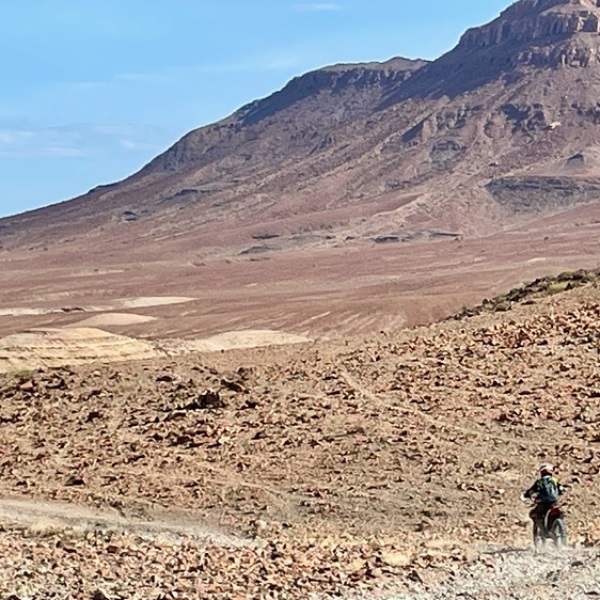
You land at Hosea Kutako International Airport in Windhoek in the morning or early afternoon. The OVERCROSS team picks you up and transfers you to the guesthouse in the city. The drive into Windhoek takes around 45 minutes.
The afternoon is yours to recover from the flight and adjust to the altitude — Windhoek sits at 1,700 metres above sea level. You can walk the main Independence Avenue, visit the Christuskirche, or grab a first Namibian beer and a plate of biltong at Joe's Beerhouse. In the evening the group meets for a welcome dinner and the first full tour briefing from your guide.
The briefing covers the route, the bikes, the daily schedule, the radio protocol and the rules for crossing rivers. You also pick up your enduro motorcycle tonight so you can get familiar with the controls before Day 2.
2 -- Windhoek to Kamanjab — Northbound Transfer Day
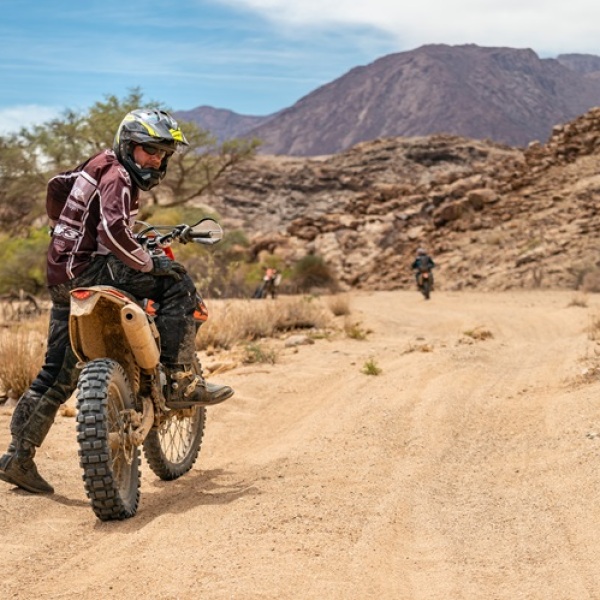
Today is a long day in the saddle to get you north fast. You leave Windhoek at first light. The route follows the B1 north through Okahandja and Otjiwarongo on fast, well-graded tarmac. Coffee stops every 150 km.
Around lunch the scenery starts to change. You turn off the main road and pick up the gravel track towards Outjo. The colour of the soil shifts from brown to deep red. You see your first warthogs, ostriches and maybe a kudu crossing the road.
You reach Kamanjab in the late afternoon. This small trading post is the last proper fuel stop before Kaokoland starts. Dinner and overnight at a guesthouse with a camping option on the property. An early night — the Khowarib Gorge off-road trail starts at dawn.
3 -- Khowarib Gorge Off-road Trail
Today the real ride starts. You leave Kamanjab on gravel heading north-west and drop into the Khowarib Gorge off-road trail. This is your first proper enduro challenge of the trip: a narrow rocky track that follows the dry riverbed through a red sandstone canyon for about 25 km.
The trail is loose and technical. Your guide rides the line first and shows the easier passages. There are several waist-deep sand sections, a few tricky rock steps, and a handful of places where you have to stand on the pegs and pick a line between boulders. The 4x4 support vehicle takes the parallel detour and meets you at the exit of the canyon.
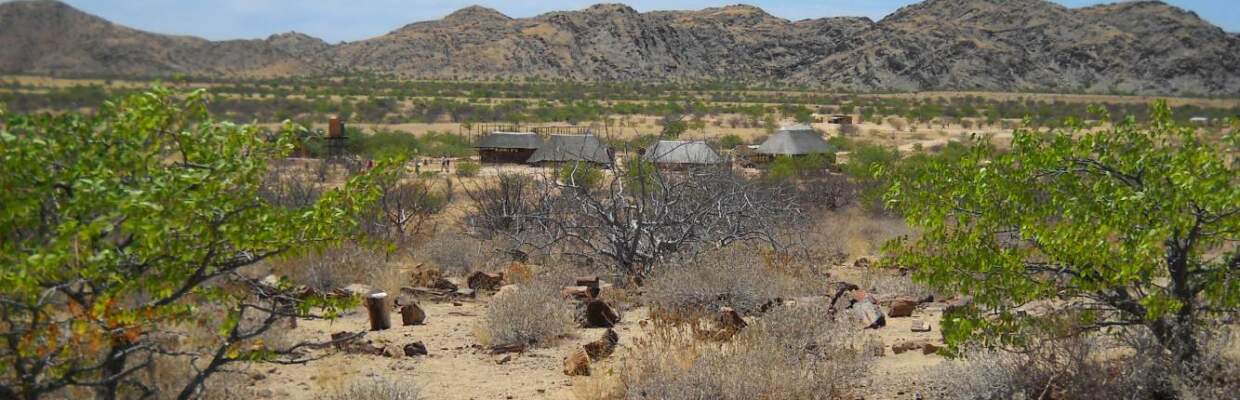
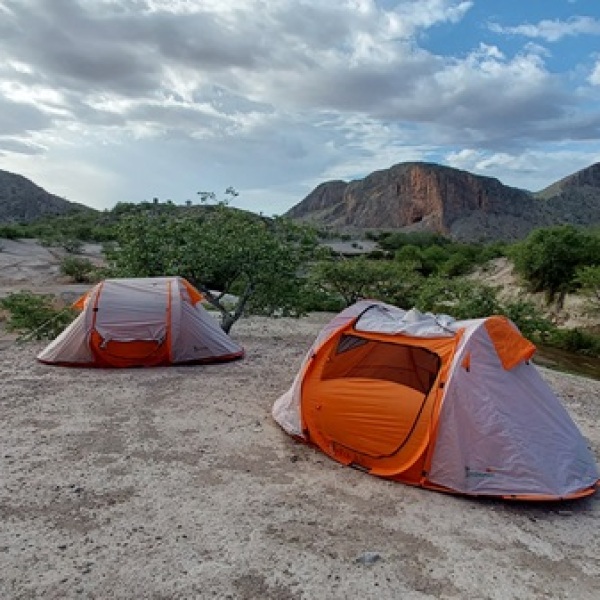
You exit the gorge into open country in the early afternoon. The rest of the day is fast gravel towards the Hoanib valley. You camp tonight in a tented camp near a dry riverbed. Dinner is prepared on the bush grill. Your first Kaokoland stars appear at 19:30 — no light pollution for 200 km in any direction.
4 -- Himba Tribe Motorcycle Tour — Opuwo
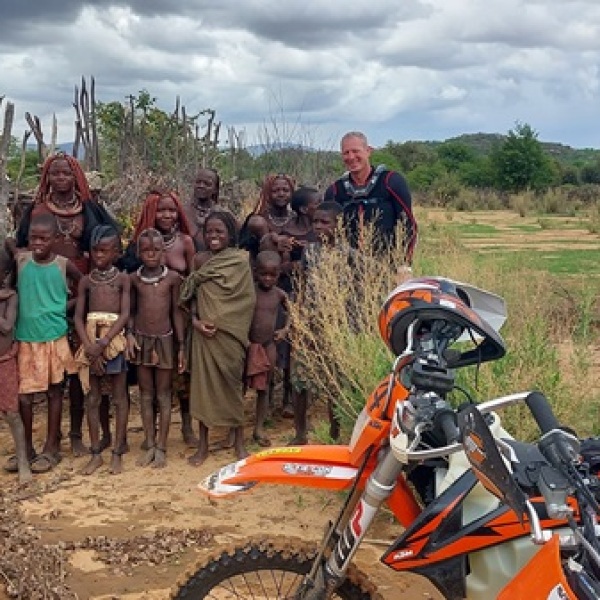
Today is the Himba tribe motorcycle tour around Opuwo. You ride through Himba and Herero settlements along the gravel road. Short stops give you the chance for conversations with local families — your guide helps with introductions and translation.
The Himba are one of the last semi-nomadic peoples in southern Africa. They cover their skin with a mix of butterfat and ochre, which gives them their distinctive red appearance and protects them from the sun. The Herero are their close neighbours with a completely different dress code — the women wear long Victorian-style dresses, a legacy of the German colonial period.
The destination is Opuwo itself. This is the capital of Kaokoland and the last proper town on the route. You refuel, you restock water and snacks, and you get a taste of the African market energy before the convoy disappears into the wilderness. The campsite sits on a ridge outside town with a wide view over the bush. Accommodation: guesthouse or camping. Meals: breakfast and dinner.
5 -- Epupa Falls Motorcycle Trip — The Kunene Border River
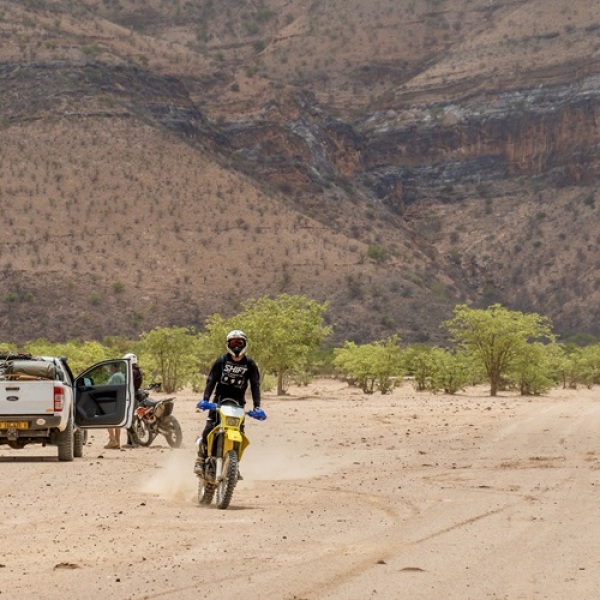
This is the Epupa Falls motorcycle trip day. You ride north out of Opuwo on rough gravel. The route passes through Mopane tree forest and red-rock country for about 180 km, then drops down into the Kunene river valley on a steep, loose descent.
The Kunene is the border river between Namibia and Angola. At the Epupa Falls the river breaks across a 500-metre-wide cataract of small islands and cascades. Baobabs grow out of the rock right at the edge of the water. You can see Angola on the other bank.
You camp tonight on the Namibian side of the falls. The afternoon is free for swimming in the safe upstream pools, walking to the main viewpoint, or just sitting under a baobab with a cold beer. Some days a Himba family from the nearby village comes by to sell handmade jewellery. Accommodation: guesthouse or camping. Meals: breakfast and dinner.
6 -- Van Zyl's Pass Motorcycle Route — The Hardest Pass in Africa
Today is the day. The van Zyl's Pass motorcycle route is the reason most riders book this tour in the first place. You leave Epupa early and ride back south towards Opuwo, then turn off onto the track that climbs to the top of the pass.
Van Zyl's Pass is a one-way downhill-only descent cut into the escarpment between the Hartmann and Marienfluss valleys. Nobody rides it up. The drop is roughly 600 metres over 10 km of broken rock, loose scree and tight switchbacks through Mopane forest. In several places the track is a staircase of boulders the size of a motorcycle wheel.
Your guide briefs every rider at the top. You descend one at a time with the guide watching each line. The 4x4 support vehicle follows at a distance — this pass is on every hardcore 4x4 bucket list too. By the bottom of the pass you are in the Marienfluss, one of the most remote valleys in Africa. The view opens up over a vast plain of golden grass. Accommodation: guesthouse or camping. Meals: breakfast and dinner.
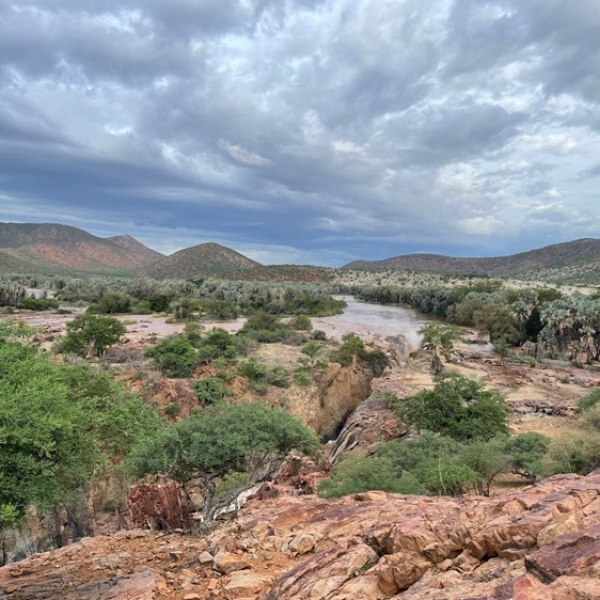
7 -- Through the Marienfluss to the Kunene River
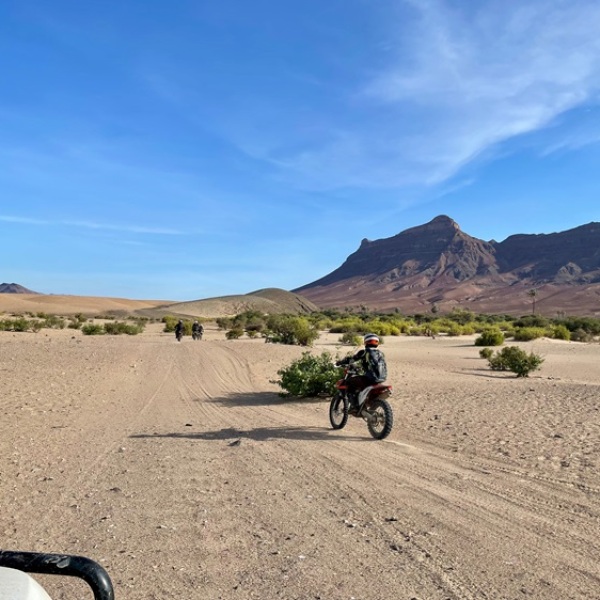
You wake up in the Marienfluss. Yesterday was rock — today is sand. The dry riverbed and the wide plain give you a long sandy stage that is completely different from the van Zyl's descent. The surface is soft, the ruts are deep in places, and momentum is everything.
The route follows the Marienfluss north and eventually rejoins the Kunene border river. Swimming in the Kunene is not an option — the river is full of crocodiles and no sane guide lets anyone in the water here. You stop at a view point, take photos, and then turn south again.
In the afternoon you leave the Kunene and ride back into the wild Kaokoland interior. You camp tonight in the bush, far from any settlement. The 4x4 sets up the kitchen; the guide builds a fire. This is the night people remember. Accommodation: guesthouse or camping. Meals: breakfast and dinner.
Der heutige Tag führt uns durch die sandige Etappe des Marienflusses, was häufig Fragen zu den Sandbedingungen und der Navigation aufwirft. Beachte auch die Abenteuer im Kaokoland und die Einschränkungen beim Baden – gerne nachfragen.
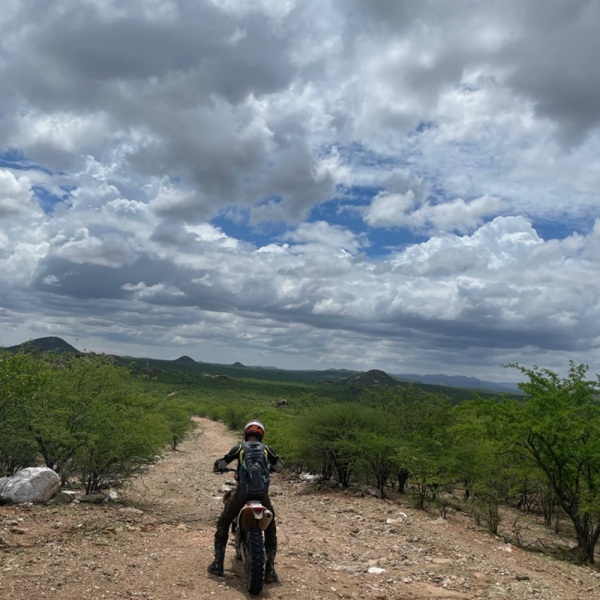
8 -- Ride with Desert Elephants — Orupembe to Purros
A day full of changes in the landscape. You leave the camp early and ride south through Orupembe. The country opens up into rolling gravel plains with the purple mountains of the Hartmann range on the horizon.
The real challenge of the day comes after Orupembe: two dry riverbeds that run east-west across your route. Both are soft sand with rocky edges. You cross the first one mid-morning and the second one around lunch. The 4x4 meets you on the far side of each with cold drinks and a snack break.
By mid-afternoon you reach Purros. This is the country of Namibia's desert elephants. These animals live their entire lives in the dry river valleys of Kaokoland and walk huge distances between water sources. If you are lucky, you ride past a small herd on the track into camp. Give them space — at least 100 metres — and stay calm. The bulls are used to vehicles but they are still wild. Accommodation: guesthouse or camping. Meals: breakfast and dinner.
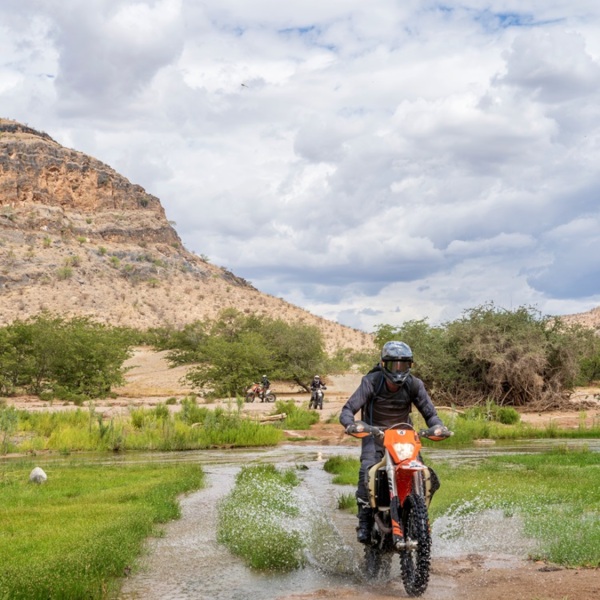
9 -- Hoanib River Motorcycle Track to Sesfontein
Today is the Hoanib River motorcycle track day. You leave Purros after breakfast and ride south-east into the Hoanib valley. The first section crosses a Mars-like gravel plain — wide open, no vegetation, deep red rock. This is some of the most surreal scenery on the entire tour.
You drop into the Hoanib riverbed itself and ride the sand in the shade of big camelthorn trees. The track has several genuine water crossings — depending on the season there is actual flowing water in places. Desert elephants use this riverbed as their main corridor. Elephant dung on the trail means elephants ahead of you. The guide will signal when to stop.
You refuel in Sesfontein. The village has a restored German colonial fort from 1905 that is worth a quick walk-through. A short ride further brings you to Warmquelle and its natural hot-spring pool — take a swim, wash off the dust, fill your bottles. Accommodation: guesthouse or camping. Meals: breakfast and dinner.
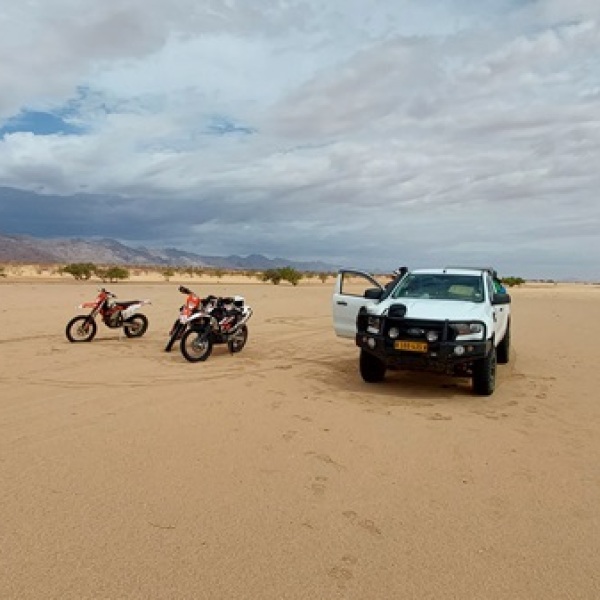
10 -- Return to Kamanjab — Jeep Tracks and Gravel Road
You leave Warmquelle and ride out of the Kaokoland wilderness for the last time. The route follows jeep tracks through animal-rich plains and a couple more dry riverbeds before it joins the main gravel road south towards Kamanjab.
This is a day of consolidation. The bikes are dusty, the riders are tired, and the rhythm of the convoy is easy. Stops for photos happen whenever someone wants them. You pass zebra, giraffe and springbok regularly. Warthogs run across the road in front of you more than once.
You reach Kamanjab in the late afternoon. The guesthouse is the same one from Day 2 and the hot shower on arrival is legendary. Dinner is a proper sit-down meal, not a bush fire. The mood is good. Accommodation: guesthouse or camping. Meals: breakfast and dinner.
11 -- Return to Windhoek — Bike Drop and City Night
The enduro part of the trip is over. Today the motorcycles are loaded onto the support vehicle and the group transfers back to Windhoek by 4x4. The drive takes roughly 6 hours via Otjiwarongo and Okahandja with lunch stops on the way.
You reach Windhoek in the late afternoon. The same guesthouse as on Day 1 is usually booked for the group. The evening is free. Most riders head back to Joe's Beerhouse for the final group dinner — twelve days of Kaokoland stories easily fill a long evening.
If you want to keep going, this is the moment to book the optional two-day side trip to the Etosha National Park. OVERCROSS can organise it on the spot. Etosha has the biggest game concentration in Namibia and is only half a day from Windhoek. Accommodation: guesthouse or camping. Meals: breakfast and dinner.
12 -- Departure or Extension Holiday
Today is either the start of your extension holiday or your transfer to Hosea Kutako International Airport for the flight home. Departure times vary by flight, so the airport transfer is not included in the base price — but your guide will organise it for you at cost.
Popular extension options we can book on request: the Etosha National Park two-day safari, a three-day Sossusvlei tour to the red dunes of the Namib desert, or a coastal add-on to Swakopmund for sandboarding and quad biking. Ask your guide during the tour and we will put it together.
PRICE
from€3709.00 / person✓ Trip includes
✕ Trip does not include
- Transfer Airport/Guesthouse
- English-speaking tour guide
- Camping variant overnight fees
- Breakfast/Dinner from the bush or restaurant. As noted in the travel itinerary.
- 4x4 escort vehicle including luggage transport