Everything you need to know about Tajikistan
Travel map of Tajikistan by the tour operator OVERCROSS
- General Information
- Climate
- Flora and Fauna
- National Parks and Conservation
- Medical Notes
- Population
- Politics and Economy
- Transport Network
- Cities and Regions
- Culture, Sights
- Holidays
- Travel Advice
- Foreign Representations
- Sources and Links
1. General Information
Continent: Asia
Geographical location: borders Uzbekistan, Kyrgyzstan, the People's Republic of China, and Afghanistan
Highest elevation: 7495 m high Pik Ismoil Somoni
Form of government: Republic
System of government: Presidential system
Languages: Tajik (Persian), Russian
Neighboring countries: Uzbekistan, Kyrgyzstan, the People's Republic of China, and Afghanistan
Capital: Dushanbe
Area: 143,100 km²
Population: 9,300,000 (July 2023)
Population density: 65 inhabitants per km²
Religions: 90% followers of Islam, approx. 3.1% Christians
Currency: Somoni (TJS)
Climate: dry subtropical climate zone
Time zone: UTC +5
Country code: +992
Country code: TJ
Electricity: 220 V. Sockets as in Germany
Opening hours: Supermarkets are usually open from 8 am to 9 pm
2. Climate
| Dushanbe | Temp. °C min/max | Sun hours / day | Rainy days | |
| Jan | -3,3 | 6,6 | 3,9 | 9 |
| Feb | -0,3 | 10,1 | 4,3 | 9 |
| Mar | 3,8 | 14,8 | 5 | 13 |
| Apr | 8,8 | 21,6 | 6,6 | 10 |
| May | 12,8 | 26,8 | 9,1 | 8 |
| Jun | 15,6 | 32,2 | 11,2 | 2 |
| Jul | 17,8 | 35,7 | 11,4 | 1 |
| Aug | 16,1 | 34,5 | 10,9 | 0 |
| Sep | 10,9 | 30,5 | 9,6 | 1 |
| Oct | 6,1 | 23,6 | 7,2 | 4 |
| Nov | 3,2 | 16,8 | 5,5 | 5 |
| Dec | 0 | 10 | 3,8 | 8 |
| Chorog | Temp. °C min/max | Sun hours / day | Rainy days | |
| Jan | -13,1 | -3,1 | 3 | 7 |
| Feb | -11 | -0,8 | 3,6 | 6 |
| Mar | -3,4 | 5 | 4,6 | 6 |
| Apr | 4,2 | 14,3 | 5,6 | 7 |
| May | 9 | 21,1 | 7 | 6 |
| Jun | 12,4 | 26,1 | 8,9 | 3 |
| Jul | 15,7 | 30,3 | 9,6 | 1 |
| Aug | 15,3 | 30,3 | 9,1 | 0 |
| Sep | 10,5 | 26,4 | 8,1 | 0 |
| Oct | 4,1 | 17,8 | 6,1 | 2 |
| Nov | -1,3 | 8 | 4 | 3 |
| Dec | -8,1 | 0,3 | 3,1 | 5 |
Tajikistan has an extremely continental weather with cold winters and hot summers. The country has areas with humid subtropical climate while in other regions temperatures can reach up to 40°C. Thus, there are large temperature differences within the country. Remarkable are the extremely low amounts of precipitation
3. Flora and Fauna

Image: ...
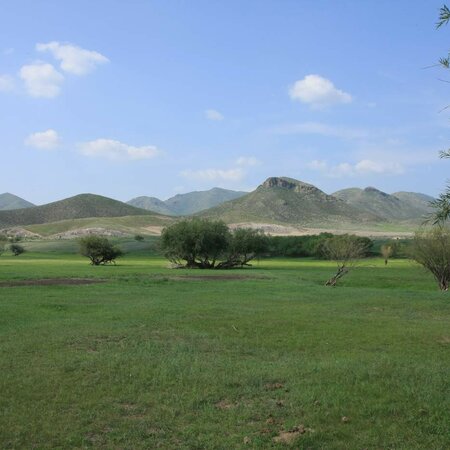
The vegetation of the mountainous region offers a very diverse plant world. In the deserts and semi-desert zones, which reach up to an altitude of 600m, there are especially drought-resistant plants. In contrast, there are also swamps and forests along some rivers. The area covered with forest makes up approx. 4% of the country. Conversely, especially in the extreme high altitudes of the Pamir, there is little vegetation where mostly only shrubs grow. However, the country also has a surprisingly large variety of flowers, with about 5,000 different species counted.
There is also a great variety and abundance of species in the animal world, depending on the region. In the desert regions live various species of lizards and rodents, while in the forests and shrub-covered regions red deer, wild cats, tigers, and jackals feel at home. In the lower mountainous areas of the Pamir brown bears and Pamir sheep live. At a somewhat higher altitude, large golden eagles feel at home in remote mountain regions.
4. National Parks and Nature Conservation
Of course, there are also national parks in Tajikistan. One of them is the Pamir National Park, which was declared a World Heritage Site by UNESCO and covers an area of 2.6 million hectares, an incredible 18% of the country's total area. Part of the Pamir Mountains is within the national park and is called the "Roof of the World." Large parts of this mountain range are glaciated. However, the national park has more to offer, as you can also find desert, steppe, grassland there. During the harsh and long winters and cool summers, among others, the special snow leopard feels at home there.
The country must always protect its special creatures in their sometimes extraordinary habitats. Thus, rare animal species such as the snow leopard, the Isabelline brown bear, the Marco Polo sheep, and many rare bird species are specially protected.
5. Medical Information
No compulsory vaccinations are required to enter the country, but it is recommended that you are vaccinated against the following diseases: tetanus, polio, typhoid, hepatitis A and B, diphtheria, and especially tuberculosis, which can occur more frequently.
From June to October, there is a malaria risk in the southwest as well as in some areas in the center of the country. During this time, it is recommended to take Nivaquine in the affected areas. To reduce the risk of infection yourself, you should only drink bottled water, avoid raw milk products, and wash fruits and vegetables. You should also stay away from stray dogs.
Ideally, you should have first aid materials ready to act directly in an emergency.
6. Population

Image: ...
About 80% of the population are Tajiks themselves. They are an Iranian people and live in Central Asia. In the east of the country, various minorities of Uzbeks and Kyrgyz live. There are also citizens from Russia, Ukraine, Germany, and other countries. However, the proportion of foreigners in the country is extremely low because after the breakup of the Soviet Union and during the subsequent civil war very many non-Tajiks left the country.
The inhabitants of Tajikistan live mainly in the west as well as in the north of the country. The capital has around 900,000 inhabitants. Due to the poor health care system, the life expectancy of the locals is only 66 years. For the same reason, infant mortality is alarmingly high at 10%. Nevertheless, the population grows annually by an average of 1.4%.
7. Politics and Economy
Tajikistan is a presidential republic in which President Emomalii Rahmon was elected directly as head of state for seven years. His area of power includes representing the republic at home and abroad, as well as appointing the cabinet and the head of government with parliament’s approval. The so-called bicameral parliament consists of the Madschlisi Namoyondagon (lower house) and Madschilisi Milli (upper house). Elections are held every five years, in which 25 members of the upper house are elected indirectly by regional representatives and eight are appointed by the president.
8. Transport Network
Due to the predominantly mountainous nature of the country, the transport network is only sufficiently developed in the northwest as well as in the southwest. In the east of the country, large areas are still completely undeveloped. Therefore, much is handled by air traffic, for example via the international airport in Dushanbe. In addition, the capital is connected to the international railway network.
9. Cities and Regions
The largest cities in Tajikistan
City
Inh.
Dushanbe
900,000
Khujand
147,483
Kulob
85,467
Qurghonteppa
64,709
Konibodom
57,792
Dushanbe is the capital of Tajikistan, the largest and at the same time most populous city
10. Culture, Sights

Image: ...
Dushanbe
Most of the country's main attractions can be found in the capital Dushanbe, where there are some interesting buildings such as the government palace or the drama theater. Also worth seeing is the National Museum where you can admire one of the largest Buddha statues in Asia, the Buddha of Chatlon. This statue is about 14 meters long and is named after the Chatlon province in the southwest of the country.
Tajik National Park
The Tajik National Park is located partially in the Pamir mountains and thus in the eastern part of the country. Geographically, the park is very diverse and consists of mountain regions over 7,000 m high, grassland, steppe, and desert. In addition, the Fedtchenko Glacier is located there, which, at just under 80km, is the longest glacier outside the polar region. The region has long, cold winters and cool summers, providing a suitable habitat for rare animal species such as brown bears, snow leopards, Siberian ibex, and wolves.
Hissar Fortress
The ruins of Hissar Fortress were built in the 13th century and destroyed again by the Soviets. Today, it is a historical and important landmark and is located not far from the capital.
11. Holidays
| Holiday | Date |
| New Year | January 1 |
| International Women's Day | March 8 |
| Nowruz (Persian New Year festival) | March 21 |
| Labour Day | May 1 |
| Victory Day | May 9 |
| Day of National Unity | June 27 |
| Eid al-Fitr (End of Ramadan) | July |
| Independence Day | September 9 |
| Eid al-Adha (Festival of Sacrifice) | End of September / Beginning of October |
| Constitution Day | December 25 |
12. Travel Advice
Long overland journeys should basically be undertaken alone, since the public transport is in very poor technical condition. However, it should be noted that, for your own safety, the journey should be discontinued at nightfall due to poor road conditions.
Tajikistan is an earthquake zone. Please do not expect adequate disaster protection. As a basic rule, check the current security situation daily for the planned route and at your destination.
13. Foreign Representations
German Embassy in Tajikistan
Dushanbe ul. Somoni 59/1 in 734064 Dushanbe
Tel. +992 43 377 30 00 or Fax +992 43 377 30 80
More information can be found here
Embassy of the Republic of Tajikistan in Germany
Perleberger Straße 43 in 10559 Berlin
Tel. 30 3479 30-0 or Fax 30 347930-20
More information here
14. Sources and Links