Everything you need to know about Tibet

- Climate
- Animals, Plants and Environmental Protection
- Population
- Language
- Religion
- Medical Matters
- Human Rights
- Cities
- Mineral Resources and Agriculture
- Roads
- Holidays
- History
|
The prevailing climate in Tibet is called a highland climate. There are major temperature fluctuations during the day and the sun shines very often. In addition, the temperature differences between North and South Tibet are very pronounced.
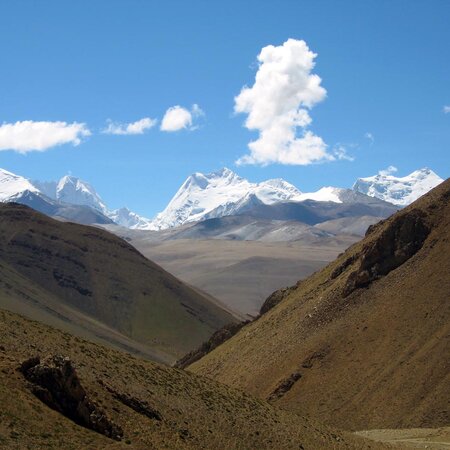
The most pleasant region is southeastern Tibet, if you are at lower elevations, where the cities of Shigatse, Lhasa and Gyantse are located. The average temperature of these cities is around 7 °C. To the north, the Tibetan plateau rises above 4500 m, where the annual average temperature drops to 0 °C, which is why northern Tibet is referred to as permafrost region.
Animals, Plants and Nature Conservation

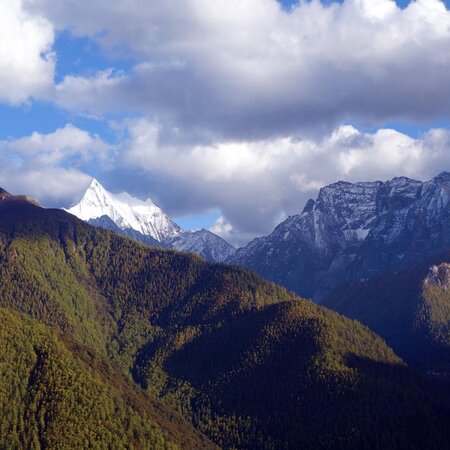
The Tibetan highlands are only sparsely vegetated, mainly with grasses and some scattered shrubs. In the lower elevations, there are forests with conifers, oaks, cypresses, poplars, maple trees and fruit trees such as apple, peach, pear, and apricot trees. Tibet is considered China's largest natural forest area.
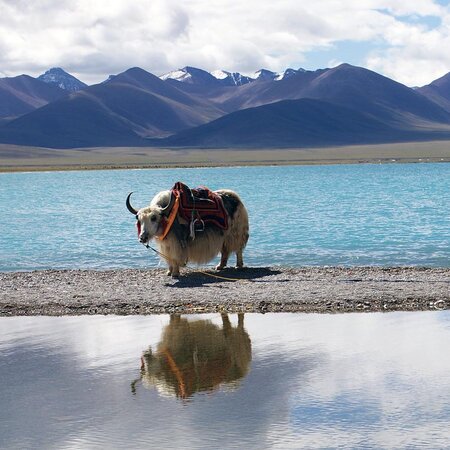
To make up for the rather barren highland regions concerning flora, the mountains are home to a variety of animals, including musk deer, sheep, goats, yaks and antelopes, and in the deep valleys also leopards, tigers, bears, wolves, foxes, monkeys, and birds such as bar-headed geese, gulls, teal ducks, pheasants and steppe chickens.

Most of Tibet's inhabitants live in the area between Lhasa and Shigatse as well as on the eastern edge of the Tibetan plateau, while the north, the central area and the west of Tibet are nearly uninhabitable. 92% of the people living in Tibet are Tibetans, about 6% Han Chinese and about 1% belong to other national minorities as well as other nationalities, including Han, Lhoba, Moinba and Hui.
The official languages are Tibetan and Chinese, and otherwise very few other languages are spoken.

Lamaist Buddhism, Tibetan Buddhism, mixes tantric Buddhism from India and elements of the original shamanism, the Bon religion. There are also some Muslims in Tibet.
Tibetan healing arts are shaped by religion, philosophy and culture. Traditionally, diagnoses of diseases are made by listening, seeing, and feeling. In addition, there are pulse diagnoses and urine and tongue diagnostics.
The methods of treating diseases cannot be compared with those we know.
There are energy point massages, healing baths and water treatments! There is also little presence of the pharmaceutical industry in Tibet, which is why mainly mineral and herbal substances are used. So as you see, medical care in Tibet cannot be compared to the German system.
There are no mandatory vaccinations for entering or leaving Tibet, but it might be worthwhile to ask a tropical physician for advice before the trip.
The human rights situation in Tibet is extremely critical. People there are sometimes not even able to practice their faith freely and are suppressed and tortured by the Chinese government, even for such minor "offenses" as carrying a picture of the Dalai Lama.
As a result of the Chinese Cultural Revolution, numerous monasteries were destroyed and monks killed.
These monasteries have been partially rebuilt, but that does not change the fact that China oppresses Tibet.

|
Lhasa |
171,719 |
|
Xikazê |
46,060 |
|
Nêdong |
32,584 |
|
Qamdo |
30,484 |
Mineral Resources and Agriculture
The government in Beijing wants to strongly promote mining in Tibet, as it would double China's zinc, lead, and copper resources. At the moment, very few mineral resources are exploited, but this is expected to change in the next five years.
Tibet also has deposits of chromium, magnesite, boron, gold, petroleum, iron, lithium, potassium chloride, aluminum and more.
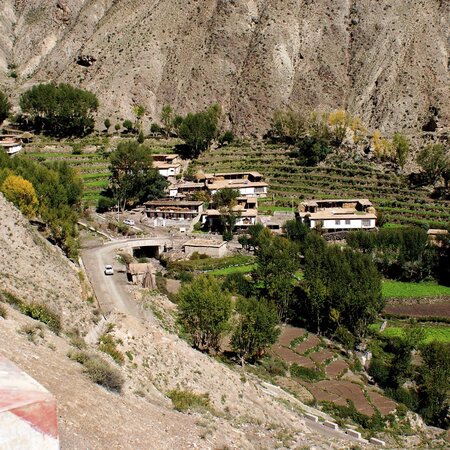
In the more southerly parts of the country, farming is still possible, but the further north one goes, the less farming exists and livestock breeding takes over.
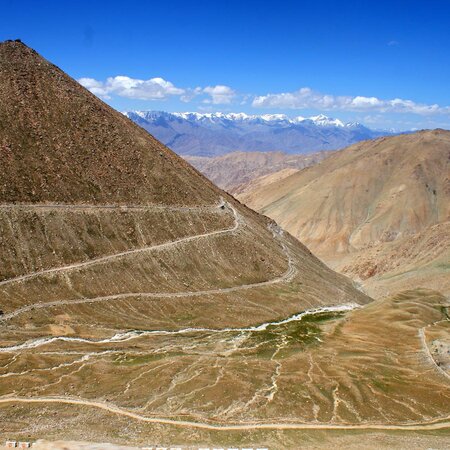
The Tibet Autonomous Region now has over 20,000 km of country roads. Nevertheless, more than a third of all villages are not connected to the road network. In Tibet long-distance traffic, there are two north-south highways, including the Qinghai-Tibet highway. In the east-west direction, there are three trunk roads, including the Sichuan-Tibet highway.
|
700 to 1000 Tibet was one of the most powerful empires on the Asian continent
13th century Both Tibet and China fell under the dominion of the Mongol Empire (Yuan Dynasty)
1642 the ruling Mongol Khan transfers governing power to the 5th Dalai Lama.
From this point onwards, Tibet was repeatedly invaded by China and Nepal, but time and again managed to become independent for short periods.
1895 the 13th Dalai Lama reigns over the country and power in Tibet is shared between the nobility, the Dalai Lama and monasteries.
1904 Britain is the colonial power in India and tries to expand its rule to Tibet. For this purpose they invade Tibet, the Dalai Lama flees into exile, and only returns in 1909 when the British troops withdraw again. Since Tibet's army was severely decimated by fighting Britain, it was easy for the Chinese to invade Tibet in turn.
1910 China invades Lhasa and the Dalai Lama flees into Indian exile again. This time, however, the occupation of Tibet is even shorter because the Chinese revolution weakens their army and Tibet's army is able to drive the Chinese out of the country. Again, the Dalai Lama returns to Tibet and announces
1913 the returning Dalai Lama declares independence.
He now begins to modernize the state.
1949 the People's Republic of China is proclaimed and the first troops march into Tibet. A year later, 40,000 Chinese soldiers march into Tibet and violently occupy the country. The Tibetan government is forced to sign the so-called 17-Point Agreement, which, among other things, stipulates that Tibet becomes part of China, but may retain its political and religious freedom. However, China ignored this treaty, which they themselves had drafted, and marched into Lhasa.
The years from 1950 to 1966 are marked by oppression and violence. On 10 March 1959, an uprising breaks out, crushed by the Chinese army with more than the necessary force of arms. Monasteries are destroyed, monks killed, and the occupying power China acts more and more ruthlessly against Tibet’s population. The Dalai Lama manages to escape into Indian exile.
1966 to 1976 was the so-called "Great Proletarian Cultural Revolution," which cost 1.2 million lives. During this period, the remaining monasteries and temple complexes of Tibet were destroyed, so that after the said Cultural Revolution only 12 monasteries remained throughout Tibet.
Living conditions in Tibet are extremely poor under Chinese rule. Even basic human rights are not respected. There are repeated uprisings, which are violently crushed. Between 1987 and 1989, the unrest is particularly severe and Beijing imposes martial law on Lhasa. The Dalai Lama strives for reconciliation and adopts the “Middle Way,” i.e., he does not demand independence, but only genuine autonomy for Tibet within the Chinese state. But negotiations with the Chinese government remain unsuccessful.
It was only in March 2008 that there were again massive protests, which were bloodily suppressed and cost a total of 200 lives. Many of the victims were monks and nuns. The Dalai Lama seeks negotiations with the Chinese government, but meets with deaf ears.