Everything you need to know about Kyrgyzstan


- General information
- Climate
- Animals, plants and national parks
- Population
- Medical advice
- Languages
- Religions
- Cities
- Human rights
- Road network
- Holidays
- Natural resources and agriculture
- Foreign missions
- Sources and links
1. General information
Continent: Asia
Geographical location: Central Asia
Highest point: Pik Semjonova Tienshanskogo, 4895 m a.s.l.
Longest river: Syrdarja, 2,210 km
Form of government: parliamentary republic
Government system: parliamentary system
Languages: Kyrgyz with Russian as second official language
Neighboring countries: Uzbekistan, Kazakhstan, Tajikistan and China
Capital: Bishkek
Area: 199,900 km²
Population: 6,035,800
Population density: 30.2 inhabitants per km²
Religions: 75% Muslims, 20% Russian Orthodox
Currency: Som
Climate: dry, continental climate
Time zone: UTC+6 (CET)
Dialing code: +996
Country code: KG
2. Climate
|
In our motorcycle travel destination Kyrgyzstan, a continental climate prevails with hot, dry summers and extremely cold winters. The temperatures fluctuate strongly throughout the day and in the southern part of Kyrgyzstan the temperature variations over the seasons are even larger, ranging between summer (45°C) and winter (-18°C).
3. Animals, Plants and National Parks
Although Kyrgyzstan has few forest areas, it is home to the largest walnut forests in the world. These forests are home to deer, bears, martens, wild boars, wolves, and lynxes. In the higher regions of the country, some of the rare snow leopards can still be found. The Argali, also called giant wild sheep, can also be found here. Marmots are widespread in the alpine meadows.

The higher regions of Kyrgyzstan are especially home to birds of prey, such as black kites, griffon vultures, and various eagles and falcons. The bee-eater can be observed throughout the country in summer.
In Kyrgyzstan, great attention is paid to nature conservation. There are 8 national parks and various other protected areas, for example, 2 biosphere reserves. In cooperation with the German Nature Conservation Association (NABU), the Gruppa Bars was established, a group provided by the state with extensive rights and police powers, responsible for the protection of snow leopards against poachers.
4. Population
Kyrgyz, who are counted among the Turkic peoples because of their language, make up 65% of the total population. In addition, Uzbeks (about 14%), Russians (12.5%), Dungans (Muslims from China, about 1%), Uighurs (1%), Tajiks (1%), Tatars (1%) and Kazakhs, who also make up about 1% of Kyrgyzstan’s population, live in the country. At the beginning of the 1990s, there were still 100,000 Germans living in Kyrgyzstan, but the number had dropped to about 12,000 by 2007, as most had emigrated back to Germany.
5. Medical information
The tour operator OVERCROSS recommends contacting a doctor before traveling to Kyrgyzstan and checking vaccination protection, since we as a tour operator are not authorized to provide information about vaccination protection.
The medical care in the country, but also in the capital, cannot be compared with Europe. We recommend bringing your own bandages, disposable syringes, and important medicines. There is also no proper rescue system here, such as in Germany with helicopters.
If you have any questions regarding the international travel health insurance, the OVERCROSS travel agency will be happy to help.
6. Languages
The official language of our motorbike travel destination Kyrgyzstan is Kyrgyz. Because Russia put massive pressure on Kyrgyzstan, Russian has also been recognized as an official language since 2001.
The Kyrgyz language is a Turkic language and is thus related to Uzbek, Kazakh, and to some extent Turkish. Russian is not a Turkic language, but an East Slavic one, but it has an important function in business and culture and also serves to communicate across cultures.
7. Religions
Since the country became a target of Islamic influence and missionary work in the 10th century, which continued until the 19th century, it has been predominantly Muslim. Most, namely 75% of the population, are Sunni Muslims, and on our enduro trips through the country, we will see some mosques. The second largest religious community in Kyrgyzstan is Russian Orthodox Christianity with a 20% share of the population. The German minority is Catholic or Protestant. There are also some Jews and Buddhists living in the country.
8. Cities
|
1. |
Bishkek |
900,000 |
|
2. |
Osh |
300,000 |
|
3. |
Jalal-Abad |
75,700 |
|
4. |
Karakol |
70,171 |
|
5. |
Tokmok |
63,047 |
Bishkek is the capital and at the same time the political, economic and cultural center of Kyrgyzstan. The city developed from a caravan station on the Silk Road and experienced several renamings over time. Today it has about 874,400 inhabitants.
9. Human rights

Kyrgyzstan has indeed agreed to the most important human rights treaties and theoretically guarantees basic rights in the constitution, but has some problems implementing this topic in practice. This is partly because there is no independent judiciary.
On our group or individual tours, there may be unjustified police road checks, including bribe payments. The conditions in many of the prisons are also described by the Foreign Office as inhumane.
10. Road Network

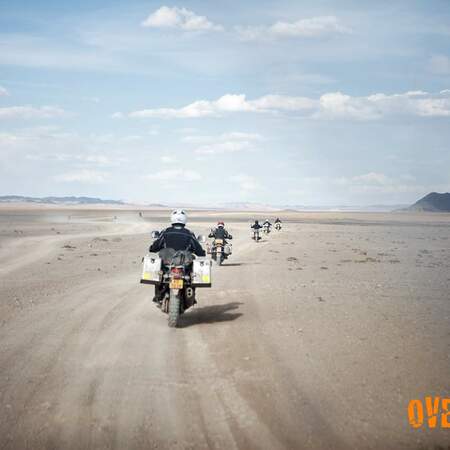
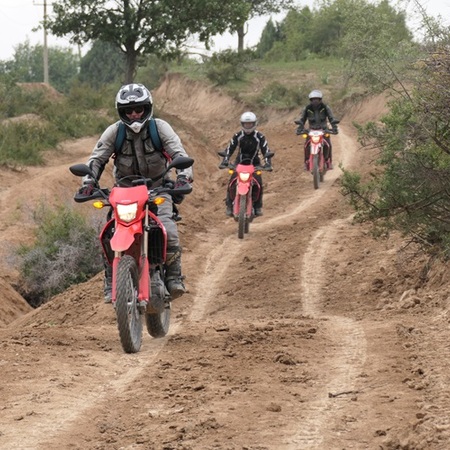
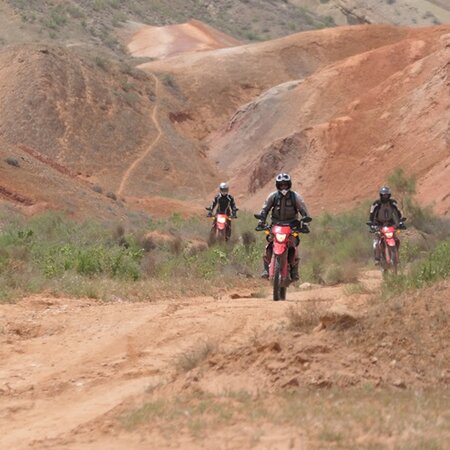
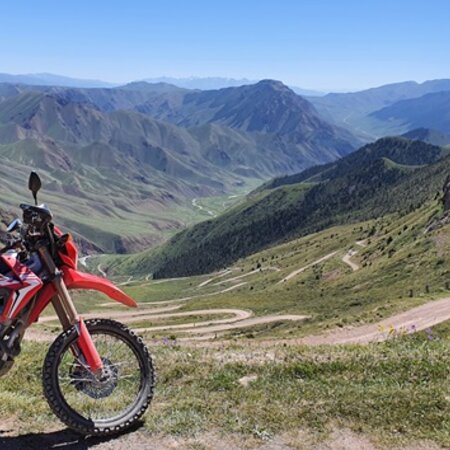
A high mountain range runs through the middle of our travel destination Kyrgyzstan, separating south from north and providing some riding fun on our enduro group or individual tour. The roads in the country are poor, so we often travel off-road across the land. Because the road builders during the Soviet era did not pay attention to the national borders, you must expect difficulties at border crossings on the main through roads in the areas of Osh, Batken, and Jalalabat.
11. Public holidays
7 Jan. Russian Orthodox Christmas.
8 March International Women's Day.
21 March Nooruz (Kyrgyz New Year).
1 May Labour Day.
5 May Constitution Day.
9 May Victory Day.
12. Mineral Resources and Agriculture
Gas, oil and coal are present in Kyrgyzstan, but the deposits are not particularly large and cannot be properly utilized due to a lack of mining facilities.
There are uranium deposits in the country, which have hardly been used so far. However, Kyrgyzstan possesses vast reserves of rare earths and gold. The country is located in the so-called "Tien Shan Gold Belt" and has one of the largest gold deposits in the world.
Agriculture forms the basis of the economy in Kyrgyzstan. In the valleys, mainly wheat, sugar beets, potatoes and vegetables are grown, and in the south of the country also tobacco and cotton. Partly due to the changeable weather, but also because there is hardly any fertilizer, agricultural machinery, or fuel in the country, it is not easy for farmers to operate productively.
13. Foreign Representations
Contact details of the embassy
| Address | Ul. Razzakowa 28, 720040 Bishkek |
|---|---|
| Phone | 00996 312 905000 |
| Fax |
00996 312 300744, 300743 +49 30 1817 67193 (for faxes from Germany) |
14. Sources and Links