Everything you need to know about Guatemala
Travel map of Guatemala by the tour operator OVERCROSS
- General Information
- Climate
- Flora and Fauna
- National Parks and Nature Conservation
- Medical Advice
- Population
- Politics and Economy
- Transport Network
- Cities and Regions
- Culture, Sights
- Holidays
- Travel Advice
- Foreign Missions
- Sources and Links
1. General Information
Continent: Central America
Geographical location: Located between the Pacific and Atlantic in the north of Central America
Highest elevation: Tajamulco, 4220 m
Form of government: Republic
System of government: Presidential system
Languages: Spanish and various Mayan languages
Neighboring countries: Belize, Mexico, Honduras, El Salvador
Capital: Guatemala City
Area: 109,021 km²
Population: 18,111,000
Population density: 166.5 inhabitants per km²
Religions: 55.5 % Catholic, 45% Protestant
Currency: Quetzal (GTQ)
Climate: humid tropical
Time zone: UTC -6
International code: +502
Country code: GT
Electricity: 120V / Bring power adapter
2. Climate
| Guatemala City | Temp. °C max/min | Sun hours / day | Rainy days | |
| Jan | 22 | 12 | 7 | 2 |
| Feb | 25 | 12 | 8 | 2 |
| Mar | 27 | 13 | 6 | 3 |
| Apr | 28 | 14 | 6 | 5 |
| May | 29 | 16 | 6 | 10 |
| Jun | 27 | 16 | 4 | 20 |
| Jul | 26 | 16 | 6 | 16 |
| Aug | 26 | 15 | 6 | 18 |
| Sep | 26 | 16 | 5 | 18 |
| Oct | 25 | 15 | 4 | 12 |
| Nov | 23 | 14 | 7 | 5 |
| Dec | 22 | 12 | 8 | 3 |
The best time to travel in Guatemala is from December to April or May. Traveling in the rainy season (May-September) is also very possible, however, visiting the Maya sites might become more strenuous due to the high humidity.
Although the Pacific coast has a continuously humid tropical climate, the temperature can drop significantly, especially in higher elevations. The country is crisscrossed by very different climate zones. In general, Guatemala, which lies between 1300 and 1800 meters, has a mild climate (18-28 degrees Celsius).
3. Flora and Fauna
A large part of northern Guatemala is covered with rainforest. However, the dry and higher part of the country in the center consists of pine savannah, while in the mountains there are mainly mountain and cloud forests. On the Pacific coast, dry forests predominate in the east and tropical rainforests in the west. The Caribbean Sea in the lowlands is bordered by tropical rainforests.
The biodiversity of Guatemala is especially evident in the forested lowlands. There, in addition to monkeys and tapirs, you can also find ocelots, peccaries, and jaguars. Among the most common reptiles are numerous species of snakes, as well as iguanas and crocodiles. For bird lovers, the rainforests offer a great variety of species. The national animal of Guatemala – the approximately 35-cm long quetzal – is, with its shimmering green feathers, the most colorful representative of the tropical rainforest in Guatemala.
4. National parks and nature conservation
Nature and environmental protection has only been a topic in Guatemala for a few years, as it was previously seen more as an economic restriction. Today, more than 10 percent of the country belongs to the Maya Biosphere Reserve; there are also 14 protected regions where mangrove forests, wetlands, lakes, lagoons, rivers, and swamps are found. Unfortunately, some of the more than 1,200 animal and 8,000 plant species are endangered – however, more and more organizations are taking care of preserving Guatemala’s natural beauty and diversity.
Four of the most famous national parks are the following:
Grutas de Lanquín: Located in the department of Alta Verapaz, the approximately 100 km long cave system features impressive stalagmites and stalactites. The sunset here is particularly beautiful, accompanied by impressive swarms of bats.
Semuc Champey
Tikal

Pacaya Volcano: The 2,552 m high active Pacaya volcano offers a unique opportunity to experience a one-of-a-kind hike. The view in good weather is gorgeous, and the most fascinating are the lava flows, which can be observed up close.

5. Medical information
For Guatemala, standard travel vaccinations (hepatitis A+B, typhoid, pertussis, tetanus,...) are recommended. For more detailed information, a visit to the Tropeninstitut is recommended.
There is a low malaria risk in Guatemala, especially in border areas with Honduras. Depending on your travel route, it may therefore be advisable to take malaria prophylaxis or carry emergency medication. In any case, effective mosquito repellent should be used consistently.
In addition, worldwide valid health insurance and reliable travel repatriation insurance are recommended.
In general, the Federal Foreign Office recommends, in case of illness, to consult the website of the German Embassy for information about doctors and hospitals in Guatemala.
6. Population

The population of Guatemala is referred to as Ladinos and consists of around 60% inhabitants of European or mixed indigenous descent. The European part of the population has its roots mainly in Spain. The rest of the population is indigenous, mostly of Maya origin. According to a survey in December 2022, Guatemalans are among the happiest people on earth.

7. Politics and Economy
Guatemala follows the system of an independent, democratic republic, but like most countries in Central America, does not have a longstanding democratic tradition.
8. Transport Network
Guatemala City is considered the transportation hub, firstly having the most modern airport in Central America and secondly being crossed by the famous main road, the Panamericana. All major cities can be reached via paved roads, but only about 30% of the road network is paved, which may make traveling between smaller towns more difficult. Public buses operate almost everywhere, but do not meet European standards and should be used with caution as they are often overcrowded and old.
A railway network currently no longer exists in Guatemala, and transport is mostly conducted by trucks or buses. More important for import and export are the two major ports, Perto Santo Tomás on the Atlantic coast near Puerto Barrios, and Puerto Quetzal on the Pacific coast.
Air traffic is handled at the 3 international airports: Guatemala City (La Aurora), Quetzaltenango, and Flores (Mundo Maya). In addition, there are a few smaller, regional airports.

9. Cities and Regions
Guatemala is divided into 22 departamentos and the capital, Guatemala City, is located in the city district of the same name, in the center of the country. Over the years, the smaller towns of Mixco, Villa Nueva and several other locations have merged into the metropolitan area of Guatemala City, which now represents the economic center of the country.

The largest cities in Guatemala
City
Pop.
Guatemala City
1,110,000
Mixco
297,039
Villa Nueva
187,700
Quetzaltenango
106,700
Escuintla
65,400
10. Culture, Sights
Semuc Champey:
A national park that is a unique natural phenomenon – turquoise-green pools fed by the Río Cahabón are lined up here, inviting visitors to cool off. Around them lies a fantastic world of plants and animals that can be easily explored on foot.
Antigua:
The former capital of Guatemala shines with beautiful Spanish architecture and invites visitors to stroll with its many colorful buildings, churches, and plazas. This colonial gem remains, culturally, culinary, and touristically, the absolute number one in Guatemala.

Lake Atitlán:
Surrounded by three volcanoes and numerous small, picturesque villages, Lake Atitlán offers a breathtaking scenery that Aldous Huxley once described as the most beautiful lake in the world. In addition to swimming, boating, or simply enjoying the view, the lake is a perfect starting point for hikes.
Tikal:
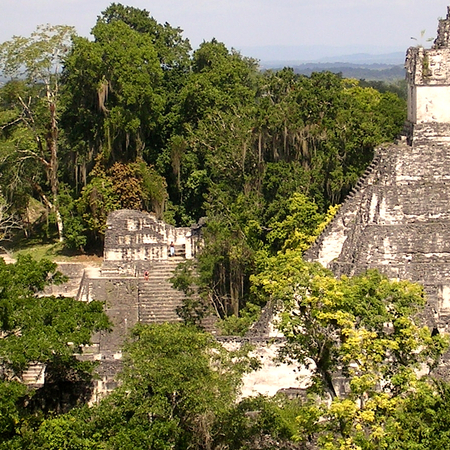
This "place of voices" contains the best-preserved Maya ruins, which are certainly among the most worth seeing in all Central America. Located in the middle of the rainforest, visitors can not only marvel at the former home of about a quarter million people, but also observe birds, monkeys, and other animals. This mystical cultural and natural heritage of humanity should be explored for at least a whole day – it’s worth it.
Flores:
The small town in the middle of Lake Petén Itzá is often only used as a stopover by visitors to the Tikal ruins, but it offers enough to serve as an independent excursion destination. Beautiful, colorful colonial houses, hotels, restaurants, and bars invite you to stroll over cobblestones and linger. The sunset, especially with a cocktail or a beer, is fantastic. Almost daily, local delicacies can be sampled at street stalls for little money – a true taste experience!

Market in Chichicastenango:
The famous indigenous highland market in Chichicastenango – simply called Chichi – offers everything a tourist could desire: not only traditional, handcrafted products, local food, and souvenirs of all kinds, but also cultural rituals that make this colorful place an unforgettable experience. Surrounded by volcanoes and the beauty of the highlands, you can enjoy an almost mystical shopping stroll of a very different kind and you’re sure to leave Chichi with a keepsake.


11. Holidays
| Holiday | Date |
| New Year | 1 January |
| Good Friday, Holy Saturday, Easter Monday | Friday and Saturday before and Monday after Easter |
| May Day / Labor Day | 1 May |
| Memorial Day in honor of the military | 30 June |
| Assumption of Mary | 15 August |
| Independence Day | 15 September |
| Day of the Revolution | 2 October |
| All Saints' Day | 1 November |
| Christmas | 24 / 25 December |
12. Travel Information

Cash withdrawals of the local currency and US dollars are possible with credit card at ATMs. With EC card, however, this is only possible to a limited extent and with EC cards from the V-Pay system, cash withdrawals are not possible at all. In many cities you can often pay directly with US dollars. Euros can be exchanged in Guatemala City and Antigua. In smaller towns, exchanging US dollars can sometimes also be problematic.
A copy of your ID should be carried at all times, but the original documents should always be kept safe; in case of theft, definitely contact the police.
13. Foreign Missions
German Embassy in Guatemala City:
Guatemala City Avenida La Reforma 9-55, Zona 10, Edificio Reforma 10, Nivel 10, Ciudad de Guatemala.
Embassy of the Republic of Guatemala in Germany:
Berlin, Joachim-Karnatz-Allee 45-47, 2nd floor
14. Sources and Links