Travel Information Costa Rica

Nature paradise between volcanoes and tropical rainforest

Everything you need to know about Costa Rica


Travel map of Costa Rica by tour operator OVERCROSS

Travel map of Costa Rica by tour operator OVERCROSS


Costa Rica country info luxury travel Costa Rica


1. General Information


Continent: Central America
Geographical location: Central America, between Atlantic and Pacific, bordering Panama to the south, Nicaragua to the north
Highest point:  Cerro Chirripó, 3819 m
Form of government: Democratic presidential republic
System of government: Presidential democracy
Languages: Spanish, partly English and English-based Creole
Neighboring countries: Panama, Nicaragua
Capital: San José
Area: 51,100 km²
Population: 5,170,252 (2023)
Population density: 101 inhabitants per km²
Religions: 76% Catholic, 14% Protestant
Currency: Colón (CRC)
Climate: tropical to subtropical. Dry season December to April, rainy season May to November
Time zone:  UTC -6
Dialing code: + 506
Country code: CR
Electricity: 110 volt AC / bring power adapter (for USA/Central America)
Opening hours: Supermarkets are usually open from 8 am - 8 pm (mostly also on Sundays), banks 8:30 am - 4 pm

back to top of page


Flora in Costa Rica luxury trip


2. Climate

Best time to travel: December to April (dry season)

The climate is tropical to subtropical and depends on the respective altitude, moreover the country is divided into an ever-wet Atlantic region and an alternately wet Pacific region.

Basically, Costa Rica can be visited all year round! There are two seasons: the rainy season (approx. May to November) and the dry season (approx. December to April). In the rainy season, there are usually 2-3 real "tropical downpours" in the afternoon, otherwise it is sunny. The heaviest rainfall occurs in October and November. Generally, the Atlantic side has higher precipitation, with the Caribbean side being relatively dry June-October and January to March.


San José Temp. °C min/max Sun hours / day Rainy days
Jan 24 14 7 3
Feb 24 15 8 1
Mar 26 16 8 1
Apr 26 16 7 4
May 27 17 5 15
Jun 26 17 4 19
Jul 25 17 4 20
Aug 26 17 5 21
Sep 27 16 5 22
Oct 26 16 5 22
Nov 25 16 5 10
Dec 24 15 6 4


Puntarenas, Pacific coast Temp. °C min/max Sun hours / day Rainy days
Jan 34 22 9 2
Feb 35 23 9 1
Mar 35 23 9 1
Apr 35 24 8 2
May 33 23 7 11
Jun 33 22 5 14
Jul 32 22 5 15
Aug 33 23 5 16
Sep 32 23 5 17
Oct 30 21 5 17
Nov 32 23 6 7
Dec 33 23 8 4


Puerto Limón, Caribbean Coast Temp. °C min/max Sun hours / day Rainy days
Jan 29 20 5 16
Feb 30 21 5 14
Mar 30 21 6 14
Apr 30 22 6 13
May 31 22 5 15
Jun 31 22 4 16
Jul 30 22 4 20
Aug 30 22 5 18
Sep 30 22 5 13
Oct 30 22 5 15
Nov 30 21 5 18
Dec 29 21 5 17


back to top of page


3. Flora and Fauna

Costa Rica delights with a unique and unforgettable diversity of animals and plants. The paradise for nature lovers offers a fascinating underwater world on both coasts, as well as different natural landscapes in the rainforests. One of the best-known trees of the rainforest is probably the rubber tree, but also mahogany trees and the giant kapok tree can be found here. As is well known, coffee and cocoa thrive particularly well in Costa Rica and are among the absolute specialties of the country.

The Central American forests of Costa Rica are known for countless animal species such as big cats, reptiles, and birds. Pumas and jaguars are more rarely seen. Sloths, monkeys, and iguanas, on the other hand, are almost omnipresent. Many visit the country especially because of its birdlife. Hummingbirds and parrots decorate the nature of Costa Rica with their colors. The most famous animal there is probably the turtle, which can be observed in Costa Rica during egg-laying and hatching. In addition, crocodiles, snakes, and various spider species live in the nature paradise of Costa Rica.

back to top of page


Hummingbird in Costa Rica, to discover on our luxury trip


4. National Parks and Nature Conservation

Costa Rica is a pioneer when it comes to eco- and sustainable tourism in Central America and is generally very environmentally conscious. Over 25 percent of Costa Rica is under nature protection, with most protected areas being national parks and thus over 25 parks reflecting and preserving the natural beauty of Costa Rica:
 

  • Arenal Volcano National Park
  • Barbilla National Park
  • Barra Honda National Park
  • Braulio Carrillo National Park
  • Cahuita National Park
  • Carara National Park
  • Chirripó National Park
  • Cocos Island National Park
  • Corcovado National Park
  • Diria National Park
  • Guanacaste National Park
  • Irazú Volcano National Park
  • Juan Castro Blanco National Park
  • La Amistad International Park
  • La Cangreja National Park
  • Las Baulas National Marine Park
  • Manuel Antonio National Park
  • Palo Verde National Park
  • Piedras Blancas National Park
  • Poás Volcano National Park
  • Rincón de la Vieja Volcano National Park
  • Santa Rosa National Park
  • Tapantí National Park
  • Tenorio Volcano National Park
  • Tortuguero National Park
  • Turrialba Volcano National Park


Toucan in Costa Rica, to discover on our deluxe adventure tour


back to top of page


5. Medical information

Vaccination protection: When entering from Germany, no special vaccinations are required. However, valid yellow fever vaccination must be proven if you are arriving from a yellow fever area. The usual travel vaccinations, such as hepatitis A + B, rabies and typhoid, are recommended.

In a few provinces of Costa Rica there is a low year-round risk of malaria. In general, consistent use of mosquito protection is recommended.

For detailed information on required vaccinations and general medical advice, it is recommended to contact the Institute of Tropical Medicine.


back to top of page


6. Population

There is religious freedom in Costa Rica. The majority of the population (about 4.7 million people) are followers of Catholicism (80%), the official religion of the country. 15% are Protestant and only 5% belong to other religions. About 90% of the population has its roots in white, old Spanish ancestry. Mestizos, Asians and mulattos are the country's largest minorities. The official language is Spanish with a national accent. For example, a resident of the country replaces the diminutive "-tito" with "-tico". This linguistic peculiarity gave Costa Ricans the nickname "Ticos".
Generally, Costa Rica is a very educated country and about 97% of the population can read and write.


Tico boating on the canals

to top of page


7. Politics and economy

Costa Rica follows the system of a presidential republic with the current president Rodrigo Chaves Robles and is divided into seven provinces. Unlike many other Central American countries, Costa Rica has a functioning and recognized democracy. Economically, Costa Rica is one of the most stable countries in Central America. Above all, the rapidly increasing tourism is the most important source of foreign currency. In addition, the export of electronic goods strongly supports Costa Rica's economy. The main trading partner is the USA, but China, Mexico and the other Central American countries are also increasingly trading with Costa Rica.

back to top of page


8. Transport network

Of particular importance in Costa Rica is the extensive network of public buses, which is considerably more comfortable and acceptable compared to other Central American countries. The infrastructure, especially between the larger cities, is well developed, but almost all routes are oriented towards the capital, and for example, you also have to go through San José if you want to travel from north to south along the Caribbean coast. For greater distances, traveling by domestic flights is advisable if you want to avoid the sometimes arduous bus journeys. The country can also be perfectly explored with a rental car; however, if you want to visit more remote areas and not just go from city to city, a four-wheel-drive vehicle is highly recommended. Within the capital, San José, however, no car should be left unattended, as there is still a high crime rate there.


back to top of page

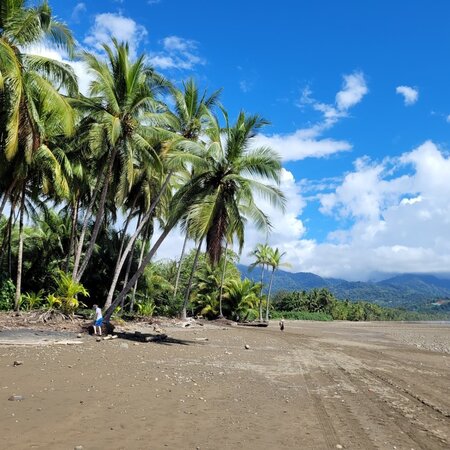
beach in Costa Rica - pure relaxation with our luxury Costa Rica trip


9. Cities and Regions


The largest cities in Costa Rica

City

Inhabitants

San José

339,588

Puerto Limón 64,258 San Francisco 59,484 Alajuela 48,366 Liberia 47,906


Liberia, fifth largest city in Costa Rica


10. Culture, Sights


Volcano Arenal and the town of Fortuna:

The typical village of La Fortuna serves as a starting point to explore the Arenal Volcano and its surroundings. The volcano itself cannot be climbed, as it is one of the most active in Latin America. The unique national park surrounding it offers, in addition to a fascinating diversity of species, waterfalls, rivers, and cloud forests, great viewpoints of the smoking giant. Approaching by boat reveals the breathtaking landscape of the Arenal area right from the start.


Arenal volcano in Costa Rica - a stop on our luxury trip


Monteverde National Park

In the unique cloud forests of Monteverde National Park, Costa Rica reveals itself from a completely different side. Thanks to its altitude, the climate is cooler and more humid, and a special variety of flora and fauna can be admired. For action lovers, this is the right place to try out the famous canopy (ziplines through the treetops) and observe the beauty of Monteverde from above.


Monteverde cloud forest, to be discovered with our luxury Costa Rica trip


Manuel Antonio National Park

On the western Pacific coast lies Manuel Antonio National Park, which is small but stunningly beautiful. Here you’ll find white sandy beaches, palm trees, and crystal blue water. Right next to it is the rainforest with monkeys, iguanas, snakes, and of course a great variety of plants. Unfortunately, this paradise is now very well known and therefore especially crowded on holidays and during the high season.


Manuel Antonio Nationalpark, Costa Rica


Village of Montezuma

The small village of Montezuma, located in northeastern Costa Rica, is no longer just a go-to spot for backpackers and dropouts, but has now become *the* destination for ecotourists, yoga lovers, and artists. If relaxing or enjoying the unique, laid-back atmosphere at the beach or in restaurants isn’t enough, you can also explore waterfalls, endless forests, and diverse animal and plant species.


Montezuma in Costa Rica


Rincón de la Vieja

In this quieter area around the active volcano Rincon de la Vieja, you can explore acid lakes, waterfalls, bubbling mud pools, and geysers along nature trails, always accompanied by a fascinating animal and plant world. The volcano is named after the legend of an old witch who sends her smoke signals from the crater.


Rincon de la Vieja, Costa Rica


Tortuguero National Park

One of the highlights of Costa Rica is surely Tortuguero, deep in the jungle with a unique atmosphere. The village is named after the turtles that can be observed laying eggs and hatching here. There are no cars here; you can only get here by boat through Amazon-like canals. In this natural paradise of Tortuguero, you can discover caimans, monkeys, snakes, sloths, and countless other animals on canoe tours.


Schildkröte am Strand von Tortuguero, Costa Rica


Santa Teresa & Mal Pais

The two villages on the Pacific coast are the ideal destination for surfers. However, this region is also perfect for relaxing, enjoying beaches, or exploring nature reserves.


Puerto Viejo

Puerto Viejo de Talamanca exudes Caribbean flair and is the perfect place for party seekers and beach lovers. During the day, black and white beaches can be reached and enjoyed by foot or rental bike, while at night this otherwise rather sleepy village shows its rhythmic and artistic side.


Cerro Chirripó

From the summit of Costa Rica’s highest mountain, you can see both seas on clear days and enjoy a fascinating view over all of Costa Rica. For sports enthusiasts, this two-day ascent is an absolute must.

back to top of page


11. Holidays


Holiday Date
New Year 1 January
Feast of San José (only in capital) 19 March
Maundy Thursday, Good Friday  Thursday and Friday before Easter
Day of the National Hero Juan Santamaría 11 April
Labour Day 1 May
Corpus Christi  
Peter and Paul 29 June
Annexation of Guanacaste 25 July
Virgin of Los Angeles 2 August
Mother's Day 15 August
Independence Day 15 September
Columbus Day 12 October
Christmas 24/25 December
New Year's Eve 31 December


back to top of page


12. Travel Advice

In general, Costa Rica is the safest country in Central America, but one should be aware that the risk from crime is not comparable to Europe. It is recommended to be especially cautious, especially after dark (after 6pm), and to carry no valuables. Particular caution should be exercised in the capital San José (and the bus stations there).

For further, up-to-date safety advice, always consult the Foreign Office before traveling.


Hummingbird in Costa Rica


back to top of page


13. Foreign Representations

German Embassy in San José

Embajada de la República Federal de Alemania, Apartado 4017-1000, San José, Costa Rica.

Tel: +506 22 90 90 91


back to top of page


14. Sources and Links

www.wikipedia.de


back to top of page


Karte von Costa Rica

×

Send request

Adventure

How did you
hear about us?

Ask a Route Expert

How do you want to travel?