Travel Information Mozambique

Unberührte Strände und vielfältige Kulturen entdecken!

Everything you need to know about Mozambique

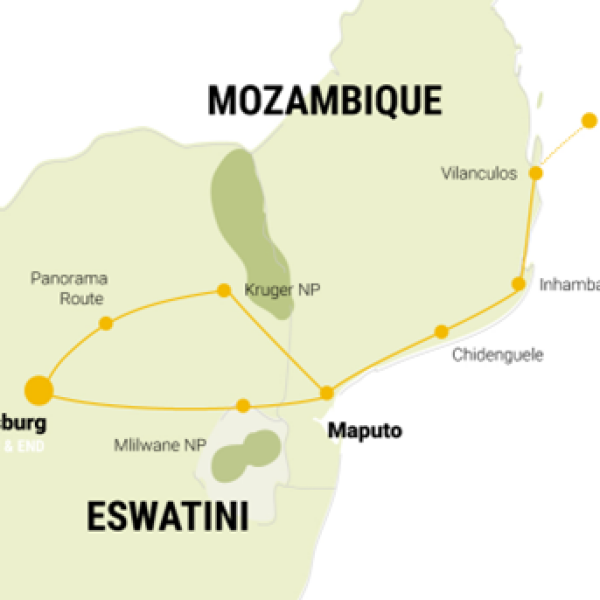
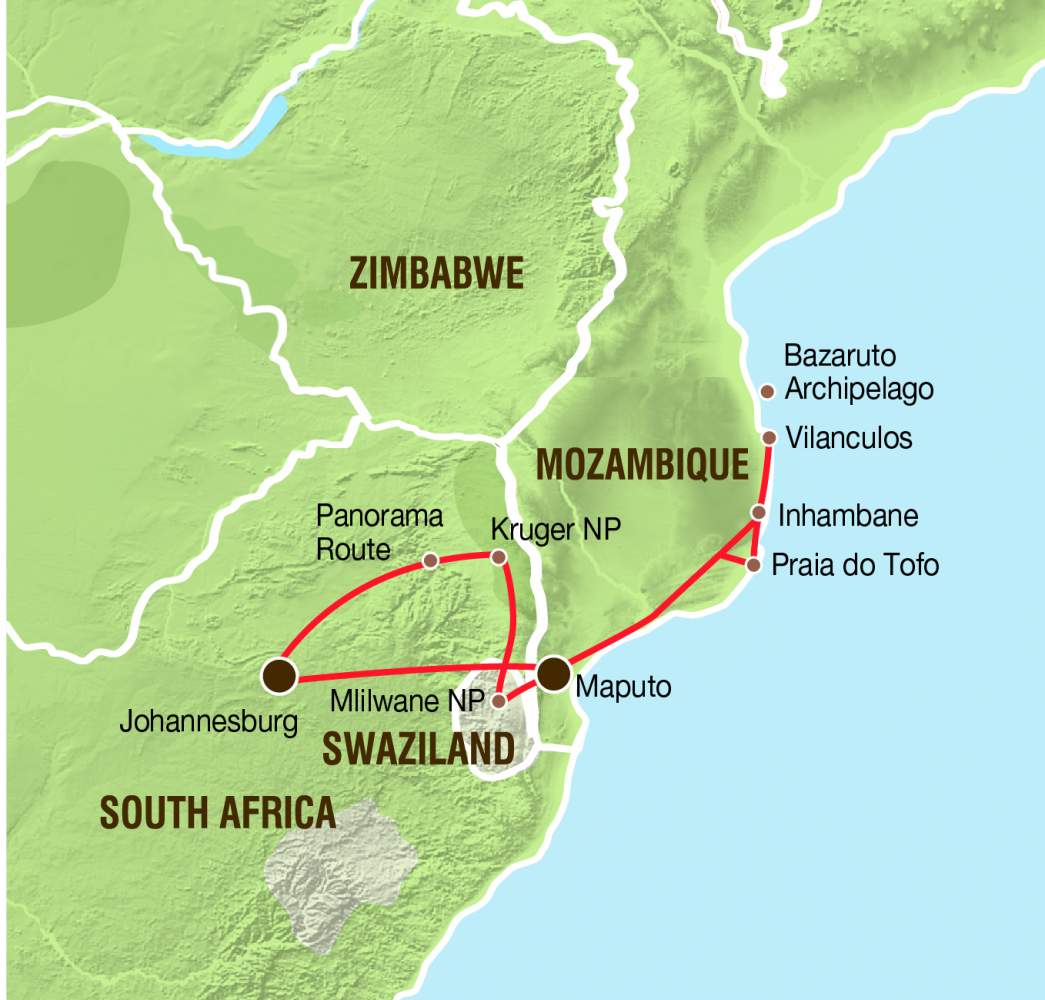
Travel map of Mozambique by tour operator Overcross

Travel map of Mozambique by tour operator OVERCROSS


  1. General information about Mozambique
  2. Travel climate in Mozambique
  3. Geography in Mozambique
  4. Flora and fauna in Mozambique
  5. National parks and nature conservation in Mozambique
  6. Population in Mozambique
  7. Politics and economy in Mozambique
  8. Transport network in Mozambique
  9. Cities and regions in Mozambique
  10. Culture and sights in Mozambique
  11. Public holidays in Mozambique
  12. Medical information for Mozambique
  13. Travel advice for Mozambique
  14. Foreign representation in Mozambique
  15. Information sources for Mozambique


1. General information about Mozambique

Continent: Africa
Geographical location: Southwestern Africa, located in the Southern Hemisphere
Highest elevation: Monte Binga (2436 m. a.s.l.)​
Longest river: Zambezi (2,574 km)
Form of government: Republic​
Government system: Presidential system
Languages: Official language Portuguese, various Bantu languages are also spoken
Neighboring countries: In the south and southwest Swaziland and South Africa, in the west Zimbabwe, in the northwest Zambia and Malawi and in the north Tanzania
Capital: Maputo
Area: Approx. 801,590 km²
Inhabitants: Approx. 32,162,920 people​
Population density: Approx. 40 inhabitants per km²
Religions: Catholic 28.4%, Protestants 12.2%, Muslims 17.9%, others, no religion/not specified 31.5%
Currency: New Metical (MZN); 1 EUR approx. 73 MZN,​​ the current exchange rate can be found at oanda.com
Climate: Savannah climate with humid and dry seasons
Time zone:  UTC + 2
Country code: +258
Country abbreviation: MZ, MOZ​
Electricity: In Mozambique, socket types C, F, and F are used. The mains voltage is 3 x 220V with a 50Hz alternating interval. A travel adapter is an advantage. An overview of sockets and plugs used in our travel countries can be found at wikipedia.de


back to top of page


2. Travel climate in Mozambique

The geographical location of Mozambique in southeastern Africa on the Indian Ocean favors a savanna climate with consistent temperatures between 25 and 30 °C, which can climb up to 35 °C inland and do not drop below 20 °C at night. During the rainy season, from November to April, the main precipitation falls in the humid-hot climate, which can amount to between 700 and 1500 mm per year depending on the region.
During the dry periods, it cools down more at night.
In the past, Mozambique has repeatedly experienced catastrophic weather events, both with extreme drought and torrential rainfall causing widespread flooding in the lowlands of Mozambique.


Travel climate chart for Maputo by tour operator Overcross


Travel climate chart for Pemba by tour operator Overcross


Travel climate chart for Tete by tour operator Overcross


back to top of page


3. Geography of Mozambique

Mozambique is located in the east of the southern African continent on the Indian Ocean and is bordered to the north by Tanzania, to the northwest by Malawi and Zambia, and to the west by Zimbabwe and South Africa. In the far south, in addition to South Africa, the Kingdom of Lesotho borders Mozambique.
The country's area of 801,590 km² is divided into a lowland area along the 2,800 km long coast and a plateau rising in steps up to about 1,000 m towards the west and, from the mouth of the Zambezi, towards the northwest – the high plateau or Chimoio Plateau. The highest elevation is the Monte Binga at 2,436 m above sea level, located on the border with Zimbabwe in Manica Province.
The highlands drain via numerous rivers, some of which have their sources in the western neighboring countries, eastward into the Indian Ocean. The most important river is the Zambezi, which is dammed into one of the world's largest reservoirs by the Cahora Bassa Dam in Tete Province, located in the west between Luangwa and Tete.
Other major rivers include the Limpopo, which flows through the south of the country, the border river Rovuma with Tanzania, as well as the Save and the Lario.

back to top of page


4. Flora and Fauna in Mozambique

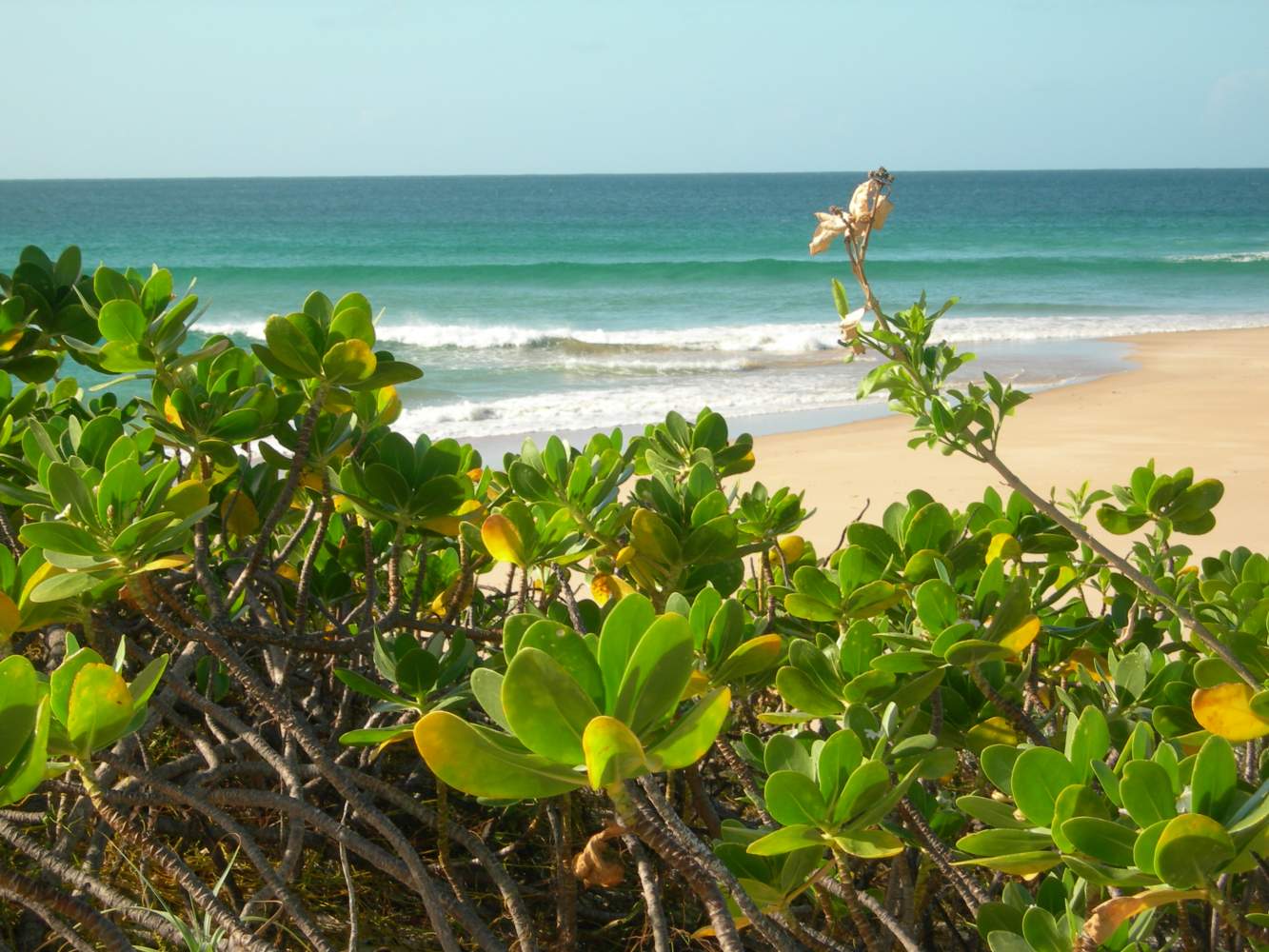
Over half of Mozambique's land area is covered by grasslands and pastures of the dry savannas, whose grasses wither during the dry seasons and can grow into stalks up to 2 meters high during the rainy season. 18% of the country is covered by bush and dry forests, which shed their leaves during the low-precipitation season to regrow during the rainy season. Typical tree species include umbrella acacias and baobabs. The river regions are lined with gallery forests. Mangrove forests are found along the coast.
The central north of the country and the Chimoio Plateau are also covered with denser forests.

Mozambique is home to a broad cross-section of Africa's wildlife. In particular, the palm forests of Gorongosa National Park provide habitat for gazelles, antelopes, lions, warthogs, water buffalo, elephants, baboons, giraffes, and zebras. Other hoofed animals as well as leopards can be found throughout the country. The river regions are home to crocodiles and hippos as well as various species of snakes such as pythons, cobras, and vipers. Large birds such as cranes, storks, pelicans, herons, ibises, flamingos, and vultures are just as much a part of Mozambique's landscape as buzzards and crows.

back to top of page


5. National Parks and Nature Conservation in Mozambique

Gorongosa National Park

The nature park, named after the nearby mountain massif, was established in 1960 over an area of 3,770 km² as Mozambique's first national park by the Portuguese, who were still in power at the time. The park, located mainly in the rift zone of the Great African Rift Valley, in the floodplain of the Rio Púnguè and its tributaries, is characterized by savannas and wetlands from which isolated inselbergs rise. At the center of the national park is Lake Urema, fed by the Rio Urema and other tributaries.
The vegetation is characterized by woodland savannas, which on the dry hillsides and plateaus have typical Miombo character with carob and mopane trees, and in the wetter valleys and marshes are marked by baobabs, sausage trees, elephant trees, and umbrella acacias.
Until the outbreak of civil war in 1976, Gorongosa National Park was considered one of the richest in species in southern Africa. During the war, the park's large mammal population, especially elephants, zebras, wildebeest, buffalo, and lions, was severely decimated by uncontrolled poaching. It was not until 1995 that efforts began to rebuild the park, restore the largely destroyed infrastructure, and reintroduce the original endangered wildlife species. Since 2008, the national park has reopened to tourism.


Limpopo National Park

Together with Kruger National Park in South Africa, Gonarezhou National Park in Zimbabwe, as well as some smaller protected areas, Limpopo National Park was established in 2001 along the river of the same name as part of the transnational Great Limpopo Transfrontier Park in Mozambique.
The appearance of the 10,000 km² national park is shaped by bushland on partly sandy soils, the sandvelds, with a great variety of carob, strychnos, or winged-bean plants. Along the tributaries of the Limpopo there are sometimes extensive mopane and acacia forests. Since parts of the national park are also used as settlement areas, treeless areas used for agriculture are also encountered.
The large wildlife in today's Limpopo National Park area was almost wiped out during both the liberation and subsequent civil war. By relocating the 10 most important animal species from Kruger National Park, a small population of giraffes, elephants, zebras, wildebeest, and warthogs, among others, has been re-established up to now.


Niassa National Reserve

Das Niassa National Reserve umfaßt im Bereich des Grenzflusses zu Tansania, dem Rovuma, eine Fläche von 42.000 km² und ist damit der größte Naturschutzpark Mosambiks. Es ist Teil des 740.000 Quadratkilometer großen Selous-Niassa-Ökosystems und mit dem Selous Game Reserve in Tansania durch einen so genannten „Wildschutzkorridor“ verbunden.
Der Park ist relativ dicht mit Wald bewachsen. Das Reservat beheimatet heute Büffel, Zebras, Kudus, Impalas, Antilopen, Löwen, Leoparden, Afrikanische Wildhunde und Hyänen. In den Gewässern lauern Krokodile auf Beute. Im Niassa National Reservat sind ca. 450 Vogelarten registriert.


Bazaruto National Park

Der 1970 gegründete Bazaruto National Park umfaßt das Ökosystem der ca. 10 km vor der Küste von Beira im Bereich der Save-Mündung im indischen Ozean liegenden Sandinsel Bazaruto. Neben den ausgedehnten Sanddünen sind besonders die Gewässer um den Archipel reich an seltenen Tierarten wie z.B. die vom Aussterben bedrohte Gabelschwanzseekuh oder der weiße chinesische Delfin.

weitere Naturparks sind das in der Nähe der Hauptstadt Maputo gelegenen Machangulo Private Naturreservat und das Maputo-Reservat.


zurück zum Seitenanfang


6. Bevölkerung in Mosambik

In Mosambik ist ein rapide ansteigendes Bevölkerungswachstum auf aktuell 32.162.920 Einwohner festzustellen. Die meisten Einwohner gehören den im südlichen Afrika heimischen Bantuvölkern an, deren Sprachen neben der portugiesischen Amtssprache ebenso etabliert sind. Daneben leben Inder, Pakistani, Chinesen, Europäer (vor allem Portugiesen) und Südafrikaner im Land. Eine nicht unbedeutende Zahl an (Auslands-)Mosambikanern lebt auch im benachbarten Südafrika, in Simbabwe und in Portugal. Die Rückführung von fast 7 Mio Flüchtlingen aus dem Bürgerkrieg in ihre Heimatorte stellt das Land vor große Herausforderungen.
Über 50% der Bevölkerung gehören dem christlichen Glauben an, davon fast 30% der römisch katholischen Kirche. Muslime sind mit ca.18% Bevölkerungsanteil vertreten. Der restliche Bevölkerungsanteil gehört traditionellen oder auch keinen Religionen an bzw. ist deren Zugehörigkeit nicht erfasst.

zurück zum Seitenanfang


7. Politik und Wirtschaft in Mosambik

Die neue Verfassung des Landes nach dem Bürgerkrieg wurde 1990 aufgestellt, nachdem sich im Vorjahr die amtierende Frelimo-Regierung offiziell vom Marxismus distanziert hatte. Sie garantiert freie Wahlen in einem Mehrparteiensystem und freie Marktwirtschaft. Obwohl die immer noch herrschende Frelimo-Partei alle Möglichkeiten zur Einflußnahme nutzt, werden die bisher stattgefundenen Wahlen unter internationaler Beobachtung als fair bezeichnet. Bisher ist es allerdings keiner der untergeordneten Parteien gelungen, auch nur Achtungserfolge bei den Wahlen zu erzielen, so daß das Parlament quasi ausschließlich von Anhängern der regierenden Frelimo- und der Renamo-Partei als einziger Oppositionsgegner besetzt ist.
Die wichtigsten Staatsorgane sind das Parlament (die Versammlung der Republik von Mosambik), der auf fünf Jahre gewählte Präsident und die beiden Räte, der des Staates Mosambik und der für nationale Verteidigung und Sicherheit.

Die Landesverwaltung ist in elf Provinzen aufgeteilt.
Das Rechtssystem basiert auf dem portugiesischen Recht. Die Gerichte in Mosambik sind unterbesetzt und ineffizient, die zum Teil vom Präsidenten ernannten Richter sind unzureichend ausgebildet und stehen in dem Ruf, von der regierenden Partei beeinflusst zu werden. Die Haftbedingungen sind ausgesprochen hart.
2009 wurde noch von schweren Menschenrechtsverletzungen in Mosambik berichtet. Dazu kommen gesellschaftliche Probleme wie häusliche Gewalt, Diskriminierung von Frauen, Missbrauch, Ausbeutung, Zwangsarbeit von Kindern und die Diskriminierung von sexuellen Minderheiten. Die Presse- und Medienfreiheit ist eingeschränkt und wird behindert. Nichtsdestotrotz pflegt Mosambik außenpolitisch gute Beziehungen zu den Staaten der europäischen Union und den Vereinigten Staaten von Amerika.

Anfang der 1990er Jahre zählte Mosambik noch zu den ärmsten Ländern der Welt. Seitdem hat durch das weltweite Interesse an den Bodenschätzen Mosambiks, insbesondere den Rohstoffvorkommen an Steinkohle, Gold, Diamanten, Industriemineralen und Seltenen Erden ein beständiges Wirtschaftswachstum auf bis zu 4% jährlich eingesetzt.
Dennoch basiert Mosambiks Wirtschaft vorwiegend auf der Landwirtschaft und die Mehrheit der Bevölkerung lebt nach wie vor in bescheidenen Verhältnissen.
Aufgrund der Rohstoffvorkommen, seiner verkehrsgünstigen Lage am Indischen Ozean und der wachsenden Wirtschaft wird Mosambik zunehmend das Ziel großer internationaler, vor allem chinesischer und indischer Unternehmen.

zurück zum Seitenanfang


8. Verkehrsnetz in Mosambik

Von dem knapp 31.100 km umfassenden Straßennetz in Mosambik sind lediglich die für den Fernverkehr bedeutsamen Nationalstraßen auf einer Länge von ca. 7.365 km asphaltiert. Die übrigen Pisten sind in schlechtem Zustand und zur Regenzeit mitunter nicht durchgängig passierbar. Die Nationalstraße EN4 nach Südafrika ist vom Grenzbereich nach Maputo mautpflichtig. In Mosambik herrscht Linksverkehr. In Mosambik fahren ausreichend Busse für die Überlandverbindungen. Die Buslinien verkehren allerdings nicht nach festgelegten Fahrplänen, so daß längere Wartezeiten in Kauf genommen werden müssen.

Der Bahnverkehr findet in Mosambik auf mehreren und nicht miteinander verbundenen Schienennetzen mit einer Gesamtlänge von knapp 4.800 km sowohl unter staatlicher als auch privater Kontrolle statt. Die Spurweite ist die im südlichen Afrika übliche Kapspur. Der Schienenverkehr dient überwiegend dem Gütertransport, Personenzüge verkehren nur in größeren Abständen zwischen den wichtigsten Städten und Häfen.

Internationale Flughäfen befinden sich u.a. in Maputo, Beira, Pemba und Nampula.

zurück zum Seitenanfang


9. Städte und Regionen in Mosambik

Die Verwaltung von Mosambik gliedert sich von Norden nach Süden in elf Provinzen, die jeweils in verschiedene Verwaltungsdistrikte unterteilt sind:

Cabo Delgado
In the northernmost province of Mozambique, with the capital Pemba, about 2,688,650 inhabitants live on an area of 82,625 km², which corresponds to a population density of 33 inhabitants per km². The province of Cabo Delgado includes the Quirimbas archipelago in the Indian Ocean off the coast of Mozambique, popular among tourists for its coral reefs. In the capital Pemba, which has around 120,000 inhabitants, there is one of Mozambique's international airports.

Niassa
West of Cabo Delgado, the province of Niassa has 1,965,244 inhabitants on an area of 129,056 km². The provincial capital is Lichinga, located at 1,369 m above sea level, with about 213,360 inhabitants. In the north of Niassa is the Niassa Game Reserve, the largest nature reserve in Mozambique.

Nampula
South of Cabo Delgado and Niassa is the province of Nampula, with an area of 81,606 km² and 6,858,753 inhabitants, and the capital of the same name. The island of Ilha de Moçambique, which belongs to the province, was declared a UNESCO World Heritage Site in 1992 due to the unique coexistence of many different cultures. Unfortunately, the civil war led to extensive movements of refugees among these cultures.

Zambesia
The province of Zambesia, located south of Nampula and east of the Malawi corridor, is named after the river of the same name, which forms the southern border of the 105,008 km² province. About 5,721,563 people live in Zambesia, of which about 350,000 are in the capital Quelimane. The province's coast is characterized by mangrove swamps, the hinterland is relatively forested. The fertile province primarily produces rice, corn, cassava, cashew nuts, sugar cane, coconuts, citrus fruits, cotton, and tea on Mozambique's largest tea plantation, and gemstones are mined in various deposits.

Tete
All the way in the west of Mozambique is the province of Tete, which, with an area of 100,724 km², is one of the largest regions in Mozambique. Of the approximately 3,226,741 inhabitants, 305,722 live in the capital of the same name. Although the province has mineral resources such as nickel, iron, copper, bauxite, coal, and gold, agriculture and especially tobacco farming are the predominant forms of livelihood for the population. The landscape of the province of Tete is marked by mopane woodlands and grasslands.

Sofala
With an area of 68,018 km², the rather small province of Sofala is located in the center of Mozambique on the Indian Ocean. About 2,697,124 people live in Sofala, of which 533,825 live in the provincial capital Beira. A large part of the province lies on the alluvial fan formed by the Zambezi and Pungave rivers in the estuary area, the Sofala Shelf.

Manica
West of Sofala is the province of Manica with 1,911,237 inhabitants on an area of 61,661 km². In the region, characterized by hilly mountain terrain on the border with Zimbabwe, lies the highest peak in Mozambique, Monte Binga, at 2,436 m above sea level. The capital of the province is Chimoio, Mozambique's fifth largest city, with 372,821 inhabitants. The population predominantly subsists on agriculture.

Inhambane
South of Sofala and Manica lies the province of Inhambane with an area of 68,615 km², home to 1,496,824 people. The capital of the same name, located on Inhambane Bay, is, with about 64,000 inhabitants, not the largest city in the province. That is the city of Maxixe, with 108,824 inhabitants, located opposite on Inhambane bay, which is also the economic center of Inhambane. The administrative district of Inhambane also includes the popular seaside resorts Praia do Tofo and Praia da Barra.

Gaza
Westlich und südlich von Inhambane leben 1.446.654 Einwohner in der Provinz Gaza, die vom Flußsystem des Limpopo und seiner Nebenflüsse geprägt ist. Die Landesfläche beträgt 75.709 km², Verwaltungssitz ist die Hauptstadt Xai-Xai mit 116.343 Einwohnern am indischen Ozean. Die Stadt liegt im Mündungsgebiet des Limpopo. Der ca. 10 km südlich gelegene Badestrand Praia do Xai-Xai mit vorgelagertem Korallenriff war vor dem Bürgerkrieg ein beliebtes Touristenziel.

Maputo
Maputo ist die südlichste Provinz Mosambiks an der Grenze zu Südafrika bzw. Swasiland, in der etwa 2,9 Mio Einwohner auf einer Fläche von 26.058 km² leben. Die Hauptstadt der Provinz Maputo ist die Stadt Matula mit ca. 1,6 Mio Einwohnern. Die Hauptstadt Mosambiks, Maputo, ist ein eigenständiger Verwaltungsbezirk innerhalb der gleichlautenden Provinz.


Wichtige Städte in Mosambik sind:

Maputo
Maputo ist mit 1.101.170 Einwohnern die zweitgrößte Stadt Mosambiks und gleichzeitig die Hauptstadt. Sie breitet sich auf einer Fläche von 347 km² im äußersten Süden des Landes an der Westseite der Maputo-Bucht aus. Die Hauptstadt ist ein eigener Verwaltungsbezirk Mosambiks und unabhängig von der umgebenden Provinz Maputo. Gleichzeitig verfügt sie über den wichtigsten Seehafen des Landes mit überregionaler Bedeutung für das südliche Afrika. In Maputo befinden sich ebenfalls die staatliche Universität von Mosambik und die Pädagogische Universität Maputo.

Matola
Matola ist die Hauptstadt der Provinz Maputo und liegt nicht weit von der Landeshauptstadt entfernt am westlichen Ende der Bucht von Maputo. Mit 1.616.267 Einwohnern auf 375 km² Fläche ist sie derzeit die größte Stadt Mosambiks, allerdings sind die Daten zu den Einwohnerzahlen und insbesondere die zugrunde gelegten Flächen in den unterschiedlichen Quellen nicht einheitlich.

Nampula
Das wirtschaftliche Zentrum im Norden von Mosambik wird von der 743.100 zählenden Stadt Nampula gebildet. Die Hauptstadt der gleichnamigen Provinz ist eine Geschäfts-, Banken- und Verwaltungsstadt auf einem Areal von ca. 100 km² und verfügt über eine eigene private Universität der katholischen Kirche. Sehenswert sind zahlreiche Gebäude aus der portugiesischen Kolonialzeit.

Beira
Die in der Mitte des Landes am indischen Ozean und an der Mündung des Rio Pungwe gelegene Stadt Beira hat 533.825 Einwohner und ist Hauptstadt der Provinz Sofala. Das Stadtgebiet umfasst ca. 88 km² Fläche. Während Beira aufgrund der schönen umgebenden Sandstrände früher ein beliebter Badeort für Touristen aus den kolonialen Herrschaftsländern war, hat die Stadt heute und insbesondere der Hafen auch eine wirtschaftliche Bedeutung erlangt. Der internationale Flughafen Beira ist der zweitgrößte Flughafen Mosambiks. Die Stadt ist bemüht, die durch den Bürgerkrieg zerstörten touristischen Attraktionen, insbesondere die hierzu notwendige Infrastruktur und Geschäftsstraßen wiederaufzubauen.

zurück zum Seitenanfang


10. Kultur und Sehenswürdigkeiten in Mosambik

Aufgrund des jahrzehntelangen Bürgerkrieges ist der Tourismus in Mosambik bis heute noch relativ wenig entwickelt. Dies hat ebenfalls Auswirkungen auf die ehemals touristischen Ziele, von denen viele entweder zerstört oder noch nicht wieder aufgebaut worden sind. Obwohl der Tourismus ein wenig entwickeltes Wirtschaftspotential für Mosambik darstellt, drängen auch Jahrzehnte nach den kriegerischen Auseinandersetzungen andere und insbesondere gesellschaftliche und wirtschaftliche Probleme vorrangig auf Lösung.
Anstrengungen werden zur Wiederherstellung und Neuausweisung von unbedingt sehenswerten Natur-Reservaten unternommen. Die vor der Küste von Nampula gelegene Insel Ilha de Moçambique mit der einstigen Hauptstadt von Portugiesisch-Ostafrika hält noch eine sehenswerte Anzahl an Gebäuden im Stil der Kolonialarchitektur bereit und ist aufgrund der kulturellen Vielfältigkeit als Unesco-Weltkulturerbe anerkannt.

Der kulturelle Reichtum Mosambiks entstand aus dem jahrhundertelang währenden Nebeneinander von traditioneller afrikanischer und portugiesisch-europäischer Kultur, der sich nun, Jahre nach dem Bürgerkrieg neu entfaltet. Die Regierung unterstützt diesen Prozess mit der Förderung von regionalen Kulturfestivals. Maputo mit seiner pulsierenden Kulturszene hat sich mittlerweile den Ruf zum kulturellen Geheimtipp "Klein-Havanna" erworben. Das Teatro Avenida ist für seine hervorragenden Aufführungen über die Grenzen Mosambiks hinaus bekannt. Die im Nordwesten von Maputo ansässige Künstlervereinigung Associação Cultural Lhluvuka Arte bietet Künstlern verschiedener Richtungen ein Forum. In Mosambik werden traditionelle Tanz- und Musikstile gepflegt. Über die Landesgrenzen hinaus ist die Timbila-Musik der Chopi aus der Provinz Inhambane und die Marrabenta-Musik aus den Städten bekannt.

zurück zum Seitenanfang


11. Feiertage mit festem Datum in Mosambik

1. Jan Neujahr
3. Feb Tag der mosambikanischen Helden
7. Apr Tag der mosambikanischen Frau
1. Mai Erster Mai
25. Juni Unabhängigkeitstag
7. Sep. Tag des Sieges
25. Sept Tag der Streitkräfte
4. Okt. Tag des Friedens und der Versöhnung
25. Dez Weihnachten


12. Medizinische Hinweise für Mosambik

Die medizinische Versorgung in Mosambik ist mit europäischen Verhältnissen nicht vergleichbar und hinsichtlich der personellen Ausstattung, der Hygienebedingungen und apparativen Ausrüstung vielfach problematisch. Außerhalb Maputos ist englischsprachiges Medizinpersonal kaum anzutreffen. Für dringende medizinische Behandlungen wird die Ausreise nach Südafrika empfohlen. Der Abschluss einer Auslands-Reisekrankenversicherung ist unbedingt zu empfehlen.
Für Mosambik gilt landesweit und ganzjährig ein erhöhtes Malaria-Risiko. Eine entsprechende Beratung mit Prophylaxe durch einen Tropenmediziner wird vor Reiseantritt dringend empfohlen. An der Küste sind Infektionen mit Dengue-Fieber und Chikungunya-Fieber möglich. In Gebieten mit niedrigen Hygienestandards und eingeschränkter Wasserversorgung kommt es zur Regenzeit immer wieder zu Choleraerkrankungen. In allen Süßwassergewässern besteht zudem beim Baden Ansteckungsgefahr durch Bilharziose. Das Baden, Tauchen und jeder andere Wassersport in Seen und Flüssen sollte daher unbedingt vermieden werden.
Das Auswärtige Amt empfiehlt, die Standardimpfungen gemäß aktuellem Impfkalender des Robert-Koch-Institutes für Kinder und Erwachsene anlässlich einer Reise zu überprüfen und zu vervollständigen.

Weitere Informationen: www.auswaertiges-amt.de

zurück zum Seitenanfang


13. Reisehinweise für Mosambik

For entry into Mozambique, a passport valid for at least 6 months and a visa are required. For minors aged 6 and above, it is recommended to carry a child’s passport. When entering from a yellow fever endemic area, proof of yellow fever vaccination is required. For repeated exits and entries, e.g. when visiting cross-border national parks, a multiple-entry visa (visto múltiplo) must be applied for. A re-entry visa is not available at border crossings or in Mozambique. Exceeding the duration of stay specified in the visa can result in heavy fines or, in some cases, even imprisonment.
To drive a motor vehicle, an international driving license in conjunction with the national driving permit is required. The Mozambican police are authorized to carry out identity checks.
Photographing public buildings, uniformed persons, and military or security-relevant facilities is prohibited. Foreign currency may only be imported or exported up to a value of 10,000 US dollars; the import and export of local currency is limited to a maximum amount of 10,000 Meticais (MZN). The import and export of diamonds, weapons, and drugs of all kinds is strictly prohibited. In addition to import and export, possession, consumption, and trade in drugs of all kinds are prohibited and subject to severe penalties. Valuable electronic equipment must be declared upon import. The export of animals and plants protected by the Washington Convention on International Trade in Endangered Species is also prohibited unless exceptionally permitted by presenting the relevant import and export documents, as well as the export of antique coins. Up-to-date customs regulations can be obtained from the Embassy of Mozambique in Germany.

You can obtain the latest security information from the Federal Foreign Office

back to the top of the page


14. Foreign Representation in Mozambique

Embassy of the Federal Republic of Germany in Mozambique
Jurisdiction/
Consular district:
Mozambique
Location: Maputo
Street address: Rua Damião de Góis 506, Maputo
Postal address: Embaixada da República Federal da Alemanha, C.P. 1595, Maputo, Mozambique
Telephone: +258 21 48 27 00, emergency service number for emergencies: +258-82-303 33 00 or: +258-84-303 33 00
Fax: +258 21 49 28 88
E-Mail: [email protected]
Website: https://maputo.diplo.de
Official languages in the host country: Portuguese


Embassy of the Republic of Mozambique in Berlin
Location: Berlin
Street address: Stromstraße 47, 10551 Berlin
Postal address: Stromstraße 47, 10551 Berlin
Telephone: 0 30 398 765 00 1/2
Fax: +49 30 398 765 03
E-Mail: http://www.embassy-of-mozambique.de
Website: http://www.embassy-of-mozambique.de


back to the top of the page


15. Sources of information for Mozambique

Deutscher Wetterdienst
Auswärtiges Amt der Bundesrepublik Deutschland
Wikipedia

zurück zum Seitenanfang

Karte von Mozambique

×

Send request

Adventure

How did you
hear about us?

Ask a Route Expert

How do you want to travel?